
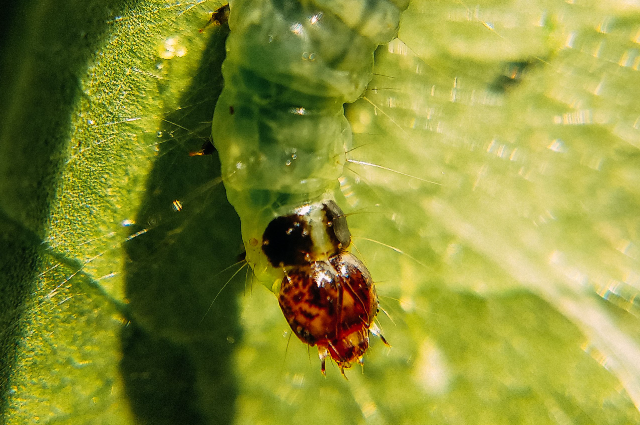
America thought that one of the country’s worst pests had been eradicated for good. Over the course of decades, the United States led an international effort to combat the parasitic infection known as New World screwworm. The pest, a fly that lays its eggs in the living tissue of warm-blooded animals, had been successfully eliminated through a combination of scientific innovation and international cooperation.
Now, after 60 years of peace, the parasite has returned to the United States.
It is currently threatening to make its way across the country and sparking an international response. In June 2026, the United States Department of Agriculture (USDA) reported the first domestic cases of New World screwworm in the continental U.S. since 1966, when the pest was first eradicated from the country. Starting with a single cow in Texas, the infection was found in several other animals in Texas and New Mexico, including a dog.
This development represents more than just a threat to the local livestock industry. It is a reminder that the threat posed by disease never truly disappears for long.
Unlike most species of maggots, the larvae of New World screwworms infect only living animals.
Adult female screwworms are attracted to animals with open wounds or surgical incisions and can also use other types of openings, such as tick bites or brand marks, to enter their host. They then lay hundreds of eggs, which hatch after a few hours. The larvae use mouthparts that have small hooks to infect the healthy tissue of the host, causing an open sore that often becomes infected and can emit an odour that attracts more screwworms to the wound.
Screwworms infest large animals such as cattle and horses. They also affect sheep, goats, pigs, wildlife, pets, and even humans. For decades, up to the twentieth century, screwworms have been one of the most destructive pests affecting the livestock industry. Millions of animals in the Southern United States were infected with the pest annually, leading to the loss of millions of animals and billions of dollars in veterinary fees.
A successful biological pest control program was launched, which entailed releasing billions of sterilised screwworms in the Southern United States. The method used to combat the pests was a great success because it involved the use of sterile insects. Screwworm females only mate once in their lifetime, so when they mate with the released males, they do not lay eggs, leading to a reduction in the screwworm population. The process was repeated until screwworms in the United States and most of Central America were eliminated.
For over half a century, this international effort has kept the United States free from screwworm infections. However, in 2023, veterinary officials in Panama and Costa Rica began to report the emergence of new infections. Cases of the infestation soon cropped up across Central America and Mexico, with reports of livestock, pets, and even humans being infected. By 2026, veterinary officials had treated over one hundred and seventy thousand animals for screwworm infections in Central America alone.
Despite Panama and Mexico’s best efforts to eradicate the pest, cases of New World screwworm continue to appear throughout Central America, with sporadic reports surfacing in Texas. For the most part, the United States remained free of domestic cases, though the USDA continued to monitor the situation near the Mexican border. The situation soon changed in early June 2026, when the USDA announced the discovery of the first domestic animal infected with New World screwworm in Texas since 1966. Since then, several other livestock animals, including cattle and a dog, have been infected with screwworms. After multiple animal quarantine efforts and enhanced fly-trapping operations, USDA researchers have begun a new campaign to release sterile male screwworms to combat the infection and prevent it from spreading throughout the United States.
Although human infections are relatively rare, there is always the possibility that an individual may be infected with screwworm larvae. Myiasis, the medical term for a screwworm infection in humans, occurs when larvae burrow into the victim’s skin. In 2025, health officials in the United States confirmed one travel-related case of myiasis in Maryland after a man returned from a trip to El Salvador. Luckily, the victim recovered shortly after the infection was discovered and treated. Health officials note that the case was not related to a local infestation and that there was no evidence of active local transmission to humans within the United States.
Although New World screwworm infections may sound horrific, the most tangible threat posed by the pest is economic. The cattle industry bears the brunt of the threat; even the tiniest wound can allow screwworm larvae to devastate a herd. Infected livestock animals suffer from weight loss and reduced milk production and can require extensive veterinary care before recovering. Even more worrying is the prospect of an all-consuming infestation; such an outbreak could wreak havoc on both the livestock industry and local veterinary practices by imposing serious restrictions on the transportation of animals and incurring millions of dollars in veterinary costs. Analysts believe that a large-scale infestation would have billions of dollars in economic consequences for the livestock industry.
Researchers are also working to determine why the pest has begun to creep back into the United States and just how much of a threat it poses. There are several suspected causes for the resurgence of New World screwworm, such as increased transportation of livestock and pets across borders and the possibility that the parasite had simply gone unnoticed for a long period of time. Some researchers suggest that the parasite may be expanding its range due to rising global temperatures, but it is unlikely that climate change alone is responsible for the resurgence. The extent to which climate change has contributed to the problem remains unclear, as the connection between rising temperatures and the spread of the screwworm is not fully understood.
It is worth noting that the screwworm infection itself does not pose a threat to the country’s food supply. The parasite is dependent solely on its ability to burrow into the living tissue of its victims, and it does not feed on dead animals. Screwworms are usually found only in animals that are to be slaughtered, and the larvae do not survive the butchering process. As such, USDA researchers consider the food supply to be safe, despite ongoing concerns about the spread of the parasite.
The return of the New World screwworm serves as a reminder that disease is never truly eradicated, only carefully managed and controlled. For 60 years, America has been lulled into a sense of security by the knowledge that New World screwworm infections had been largely eliminated from the United States. Now, the reappearance of the pest has served as a reminder to scientists and government officials that public health is an ongoing responsibility that requires international collaboration and vigilance. The parasite will always seek to take advantage of weaknesses in the system, and nature will always find a way to survive.
References:
- https://www.aphis.usda.gov
- https://www.aphis.usda.gov
- https://www.cdc.gov
- https://www.nature.com
- https://asm.org
- https://www.aphis.usda.gov