
Following the alleged gang rape of a teenager in Aastha Kunj Park, Delhi, the restrictions placed on entering the park raised an old question: whether women's safety comes at the cost of women's freedom.
On 21st September 2026, a 17-year-old girl went to Kalkaji Temple in Delhi with her friend to celebrate her birthday. At night, the two entered Aastha Kunj Park, a park maintained by the Delhi Development Authority (DDA) adjacent to the temple. Police say three men posing as police officers attacked the girl, forcing her away from her companion and gang-raping her. Police arrested the accused, while reports highlighted security lapses at the park, including inadequate lighting and surveillance.
DDA authorities ordered enhanced security measures in all parks, including improved lighting and surveillance, patrolling, and restricted access via selected gates to deter crime. A security audit of all parks in Delhi was also initiated. However, the response to the gang rape incident in Aastha Kunj Park has pitted women's safety against women's freedom.
But women's students at Delhi University (DU) felt that this was not the solution. They argued that parks, roads, and other public places should have adequate lighting, surveillance cameras, and police presence to ensure women can walk safely on roads without being harassed or subjected to sexual violence.
A sunset rule seems to help the safety of the people but leaves another problem, prohibiting women from their freedom rather than trying to solve the first one. As per the reports, in Aastha Kunj Park of Delhi, there were several lapses in security measures like lighting, surveillance, and staff at the park entrance, etc. So, even if the gang rape that allegedly happened there is a horrible incident, the park was not secure for everyone at any given time of the day, as it was a public place. A sunset rule will not solve the problem of surveillance and security, and the already happened rape is proof of that, which allegedly happened there. So, even if the park is closed after sunset, a woman cannot confirm that she will not be sexually assaulted on the roads or other public places.
The fact that the authorities take such an initiative shows that they acknowledge that the problem exists, not in the system that protects women as it should, but in the women themselves. After such an incident, it is completely normal for a woman to be asked if she was wearing short clothes, who she was with, what road she took, and if she was back home before that. But instead of taking care of the women and ensuring that they are safe, the government and executive agencies push them to be safe on their own.
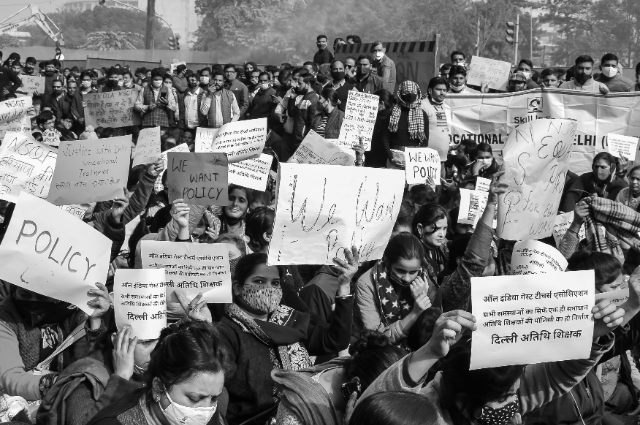
The protests began on September 23rd when students belonging to various colleges, including Lady Shri Ram College for Women (LSR), Miranda House, Gargi College, and Dr B. R. Ambedkar University Delhi convened to demand better safety measures. Students held demonstrations on 23rd and 27th near South Campus, and again on 28th, marching from Miranda House to the Faculty of Arts in North Campus.
The students raised the slogan of Hum Auratein Azaad Hain, and protested against the restrictions placed on accessing public places while demanding surveillance cameras, good lighting, and police presence to guarantee women's safety. The students highlighted how women are constantly subjected to rules about travelling in groups, sharing location details with family and friends, avoiding certain routes and areas, and returning home early every day. The protests also resonated with the nationwide response to the 2012 Delhi gang rape incident, where students and activists questioned why women were still subject to such unacceptable standards when they continued to be denied their right to roam freely in their own city.
While the protests focused on safety and freedom of movement for all women, they also brought to light the numerous restrictions imposed on women students in universities that do not apply to men. Various women's hostels in DU have a strict curfew for women students that does not apply to their male counterparts. Moreover, the rules differ from one college to another.
While some hostels such as Miranda House have a 9 pm curfew, others only impose a 1 am curfew. It is also the case that students must seek permission to return to the hostel if they leave after the curfew time, which again does not apply to men. It is not surprising, therefore, that students at Miranda House have a longstanding campaign to abolish the hostel curfew and have protested repeatedly, highlighting the unequal treatment.
A curfew may seem like an easy solution that enables authorities to enforce a rule that all students must follow. However, it does not make the road to the hostel or the area around it any safer. It makes the students' lives more difficult and imposes stricter rules on women students who are already subject to greater scrutiny.
The question of enforcing a curfew in hostels is entirely different from imposing a sunset rule for visiting parks. It is high time to ask why women have to adjust their lifestyle depending on the rules imposed on them without having any say in this themselves.
The protests against the sunset rule for parks are part of a series of long-standing protests against the numerous restrictions imposed on women in the name of their safety.
In fact, the protests currently taking place in DU in response to the alleged rape in Aastha Kunj Park appear to be linked to the Pinjra Tod protests of 2015. This was a student-led movement that questioned the hostel rules imposing curfews on women students at DU and other colleges. The movement highlighted the double standards applied to women students, who were subjected to strict curfews while male students were free to come and go as they pleased.
The Pinjra Tod protests also questioned the moral policing of women students. They protested against rules requiring women to obtain permission to leave the hostel or stay back after the curfew time and against the harassment and sexual violence they faced.
The protests called for an end to the unequal treatment of men and women students while questioning the imposition of restrictions on women's freedom of movement. The protesters also demanded that women should be provided with opportunities to benefit from the resources of the university without being subjected to rules that in any way fettered their studies and careers.
The authorities of DU have asked all the colleges to make the campuses safe for women by repairing the faulty lights, installing cameras, marking vulnerable spots, increasing the police presence, and pasting emergency contact numbers. Gender sensitisation programs and self-defence workshops have also started. These initiatives will surely help in making the campuses safe, but women mustn't be silenced when they report any incident of harassment and face any kind of punishment or retrenchment.
The installation of CCTV cameras in the parks or roads cannot ensure that women do not face harassment or sexual violence. However, it is justifiable to expect the authorities to take some action to strengthen security rather than confining women to their homes by implementing a sunset rule. Similarly, although a hostel curfew makes women students' lives difficult, it does not enhance their security.
The alleged rape of the teenager in Aastha Kunj Park requires authorities to ensure justice for the victim and take concrete measures to prevent similar incidents. However, the protests question why women have to adjust their lifestyle, including being confined to their hostels or only being allowed to visit public places before sunset, when authorities are unable to ensure their safety.
References:
- https://www.indiatoday.in
- https://www.indiatoday.in
- https://www.ndtv.com
- https://indianexpress.com
- https://www.tribuneindia.com
- https://timesofindia.indiatimes.com
- https://indianexpress.com
- https://en.wikipedia.org/wiki/Pinjra_Tod