
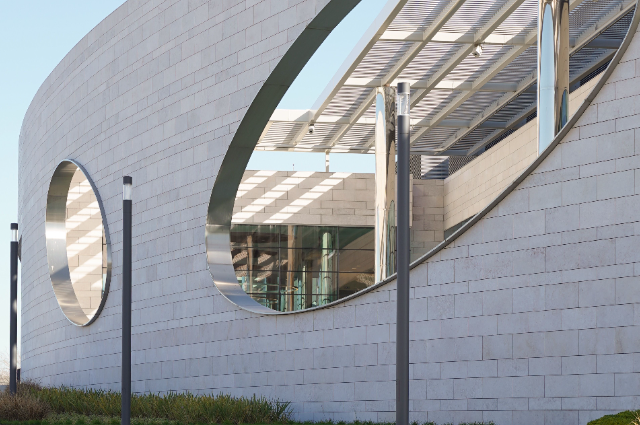
Across the sun-scorched Thar Desert, people turn to air conditioning to escape the summer heat. But this school in the desert outskirts of Jaisalmer has not needed any; the Rajkumari Ratnavati Girls School was built using ancient building tricks to keep cool. The school's design has a cooling effect on the students who attend this school.
The school's design, built by architect Diana Kellogg and the CITTA foundation, allows the interior to remain cool for classes in one of the hottest regions of India.
The Rajkumari Ratnavati Girls School has been built with the intention of providing education for 400 underprivileged females in need in Jaisalmer and the surrounding area. The school was designed to withstand the test of the Thar Desert, as well as to be a great place of education for the girls attending the school.
The school's design was inspired by historical figures and local architecture. The figure after whom the school was named is Rajkumari Ratnavati, a Rajput princess said to have led the charge during an attack on her home kingdom. After defeating the attackers, she was said to have forgiven those responsible (according to local legends). The school wants to inspire its students to act bravely, like the princess who gave her name to the institution.
The school's building is also inspired by history. The building is an ellipse that curves around the landscape. In order to make the building appear less intrusive, it is designed to follow the land rather than take over. The building is made mostly of locally sourced stone. This has provided not only a sturdier material, but a resource found nearby. The Jaisalmer sandstone has been used in many buildings in Rajasthan.
Sandstone walls absorb the heat in the desert at a slow rate because it has a high thermal capacity. The school's buildings, made of this kind of sandstone, can hold the heat for long periods of time. Only at night, when the desert cools down, the sandstone releases some of the stored warmth. This is called the thermal mass effect. This thermal mass keeps the building cooler during the day when students need it most. The use of the local stone not only helps keep the school cool, but it also makes the building harmonise with the local "Golden City", Jaisalmer.
The walls are also finished with a layer of lime plaster, as opposed to cement plaster. This material is used to great effect, as it is used traditionally across the Indian subcontinent. This material allows the building to absorb and release moisture in the air.
Because the Thar Desert has such a dry climate, this property is not used to its maximum potential. Nevertheless, this property allows the building to "breathe", keeping the interior walls damp on hot days and dry on cold days. Lime plaster is also able to reject some of the sun's heat, and is more flexible than regular cement. This flexibility prevents cracks, which would allow unwanted drafts in the buildings.
The most notable design element used in the school's construction is the jali, a sandstone lattice that covers some of the walls of the building. The jali allows the building to stay cool when the desert heat tries to invade.
When the wind blows against the jali, it causes the air to accelerate as a result of it moving through small holes. This is called the Venturi effect. The increased air speed caused by the jali allows for greater ventilation in the buildings without the need for a fan. Ventilation allows for cooler air in the building while pushing out the hot air. The jali also keeps out some of the sunlight. This prevents the rooms in the school from being unnecessarily heated by the sun. The sunlight, however, does make it into the building in interesting patterns. Rather than harsh sunlight streaming into the building, the patterns of the jali soften the light and distribute it across the interior.
The hot air in buildings tends to move upwards. A clever method is used to exploit this characteristic of air. By allowing hot air to exit the building, the cool air can replace the warm air that left. This can be seen in the openings placed at the top of the building. A continuous flow of warm air escapes through the holes, allowing it to be replaced by cool air. The natural convection of the air allows for the building to be constantly supplied with fresh, cool air.
Keeping the classrooms cool is made possible by these methods of cooling. These methods, however, also help to make the school livable during the rest of the year. The techniques used to keep the buildings cool help to keep the indoor temperature 10 degrees Celsius cooler than the exterior, and up to 17 degrees cooler during the hottest summer months in the desert.
The school's impact on the community reaches beyond its architecture.
Many of the labourers who worked on the school campus were fathers of the girls who would attend the school. In building the school, they were able to contribute to the building of an institution that would help educate their children and future generations of young women.
The attention to detail in the school's construction was able to reduce the financial burden on the families as well, as celebrated designer Sabyasachi Mukherjee created uniforms that were made large enough for the girls to grow into. This lessens the need to buy new clothes as the girls get older, limiting the waste of resources from discarded clothing.
The school is only one part of a larger campus that is intended to provide education, empowerment, and job-training for the local community. The creation of this school is an investment in the community. By building not only a school, but a centre for learning, the CITTA foundation hopes to see an increase in the community's overall living standards and involvement.
When it comes to climate change adaptation and mitigation, many people find themselves looking towards new technology to help solve the issue at hand. However, the example set by the Rajkumari Ratnavati Girls School shows people that sometimes using the tried-and-true methods can have better results than investing in new, unproven technology.
For a school in the hot climate of the Thar Desert, this building exemplifies how local materials and techniques can be used to create a comfortable building. This school has been built to last and to provide future students with a great education while minimising the amount of energy needed to keep the building cool. As the world moves towards a hotter future, this school may provide insight for how climate change can be dealt with.
References:
- https://cittaindia.org/the-rajkumari-ratnavati-girls-school/
- https://navbharattimes.indiatimes.com
- https://www.archdaily.com