
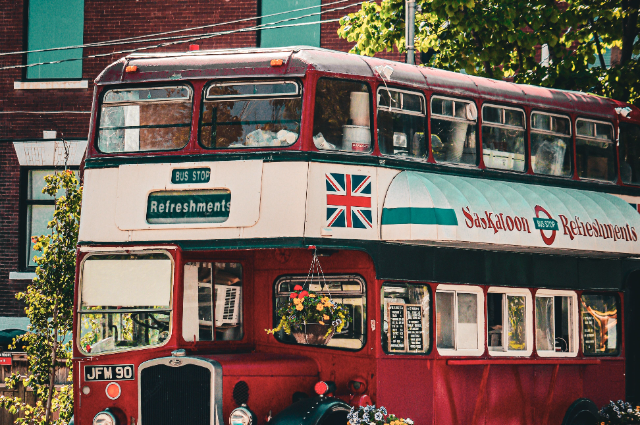
Today, travelling from London to India is routine. A direct flight takes around ten hours. However, there was a time when a bus could take you from London to Calcutta. Between 1957 and 1976, a scheduled bus service linked London with Calcutta (now Kolkata), crossing Europe, the Middle East, and South Asia over nearly 20,000 kilometres.
The bus route from London to Calcutta was one of the longest bus routes in the world. It was popular among backpackers and budget travellers. The route was known as one of the defining routes of the Hippie Trail for hippies to get from Europe to India.
In the 1950s, air travel was expensive, and long bus rides were a great alternative for adventurous students and budget travellers.
The first bus route from London to Calcutta was launched in 1957 by The Indiaman company. Soon, more than thirty bus companies provided various overland journeys. The most popular bus company that organised trips along the route was Albert Travel Company. It became the best-known operator because its double-decker coaches offered a level of comfort that was unusual for such long journeys.
The buses created a sense of community among the travellers. Indeed, the passengers chatted, shared food, and read books from the bus library. Many travellers even became friends on the bus during the long journey. The route covered approximately 20,000 kilometres (12,000 miles) and usually took between 45 and 50 days to complete, depending on road conditions and border crossings.
The bus route began in the capital of the UK, at the Victoria Coach Station. The bus ride through Europe and Asia was an experience. The route could vary depending on the year; however, most of the buses went through Belgium, West Germany, Austria, Yugoslavia, Bulgaria, Turkey, Iran, Afghanistan, Pakistan, and India. Thus, the journey usually took travellers through Istanbul, with its local bazaars, Tehran, the capital of Iran, the mountains of Afghanistan, and several other Asian countries before reaching Calcutta. For many, the journey itself was more important than the destination. Crossing the deserts of Iran and the Hindu Kush Mountains of Afghanistan and observing the cultural differences between the countries were unique experiences that only a bus route could provide.
The ticket usually cost between 85 and 145 pounds. Thus, even though the price for the ticket was considerable, it was still much cheaper than the flight at the time. For many travellers, the fare offered much more than transportation, providing a one-of-a-kind experience of getting from London to Calcutta by bus through Europe and Asia. In addition, most of the bus companies that organised the trips provided additional hotel accommodations on a private basis and helped with further trips. Therefore, the ticket for the historic route could be considered an amazing investment in the memories of the travellers. The expedition was a great opportunity for a young person to experience a “gap year.” The journey through Europe and Asia was much cheaper than the flight from London to Calcutta. It was an amazing opportunity for young people who only had a modest income from their part-time jobs to see the world.
The expedition was one of the most popular ways to get from Europe to India. The route was one of the longest “Hippie Trails”, an overland route that stretched across Europe, the Middle East, and South Asia. Thousands of young travellers made the journey through countries such as Turkey, Iran, Afghanistan, Pakistan, and India in search of adventure, cultural exchange, and spiritual exploration.
The Hippie Trail was the beginning of the modern backpacking culture. The representatives of this subculture shared all the experiences, guides, and stories of their overland journey through Europe and Asia. In fact, the first guidebook, the first issue of the Lonely Planet, was published in 1973 by Maureen and Tony Wheeler, who ttravelled fromEurope to Australia by bus. Thus, the Hippie Trail and the journey from London to Calcutta by bus inspired a new wave of backpackers to explore the world on a budget, long before budget airlines and buses became popular.
The overland bus route from London to Calcutta was closed in 1976 due to political instability in several countries. The route was dangerous, and there were few tourists willing to take such a long and risky journey. Even though the Iranian Revolution and the Soviet invasion of Afghanistan started 3 years after the route was closed, the political situation in these countries had already deteriorated the security situation along the route. Consequently, the service was closed due to the complex geopolitical situation.
The legendary overland service has always fascinated explorers and adventure travellers. As a result, an Indian travel company announced plans to organise a bus service from Delhi to London through 18 countries. This project has gained much attention from the media as it resembles the legendary overland route. The travel time from Delhi to London would last about 70 days through 18 countries. The project has many challenges ahead, including obtaining visas and other logistical issues. For this reason, at the moment, no bus services through Europe and Asia are available in 2026.
The overland service is a great example of the road transportation system of the twentieth century. Today, it is hard to imagine such a long bus journey, but in the mid-twentieth century, the intercontinental bus route was well established. The bus route was closed due to political instability, but today there are plans to reactivate the journey. However, for now, there are still no buses going from London to Calcutta through Europe and Asia. The long bus rides from London to Calcutta were much more than just a way of transportation from point A to point B. The travellers who took the intercontinental route described this experience as life-changing. In fact, the intercontinental bus ride could last almost two months. During this time, the passengers became like a family, shared personal stories, celebrated birthdays, and learned new languages.
References:
- https://en.wikipedia.org
- https://eastindiastory.com/london-to-calcutta-by-bus
- https://www.amusingplanet.com
- https://en.wikipedia.org
- https://edition.cnn.com
- https://www.theguardian.com