
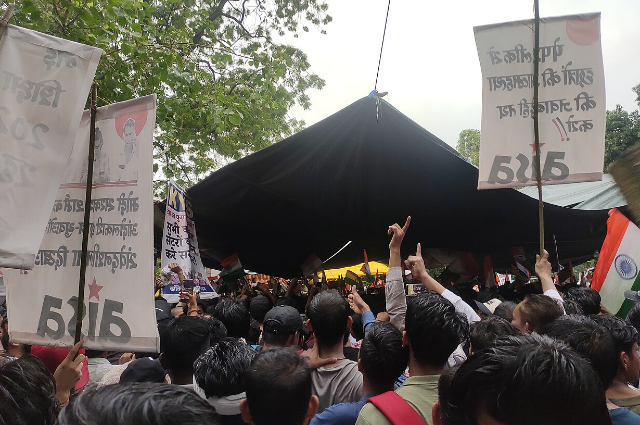
The All India Students’ Association (AISA) is a left-wing student organisation which affiliated itself to the Communist Party of India (Marxist-Leninist) Liberation. Its national president, Neha Bora, became national news in July 2026 after participating in a 23-day-long hunger strike demanding the resignation of the Union Education Minister Dharmendra Pradhan over controversy over examinations.
The All India Students’ Association, or AISA, is a left-wing student organisation which operates primarily on the campus level. Founded in 1990, AISA represents students from across political ideologies but predominantly operates as the student wing of the Communist Party of India (Marxist-Leninist) Liberation, or CPI(ML) Liberation, a political party which emerged from the Indian communist movement.
The organisation campaigns on education and student-related issues as well as on topics which intersect with political accountability, social inequality and the democratic process. AISA falls within a broader tradition of left-wing student politics in India, which encompasses the Students’ Federation of India (SFI) — affiliated to the Communist Party of India (Marxist) — the Akhil Bharatiya Vidyarthi Parishad (ABVP) — associated to the wider Sangh Parivar — and other groups.
The CPI(ML) Liberation is the political organisation behind AISA. Historically, it traces its roots to the radical communist politics which emerged in India during the late 1960s and the Naxalbari uprising of 1967. This affiliation is crucial to understanding AISA, but it does not necessarily imply that every student who participates in its campaigns belongs to the political party or shares its viewpoint. Student organisations can attract people around specific issues even if they have different political motivations. AISA’s supporters see its political orientation as a tool for fighting against inequality and championing public education. AISA’s critics, meanwhile, question its ideological underpinnings and its confrontational street protests.
Neha Bora, the national president of AISA, became an emblematic student protest leader in July 2026. A 29-year-old PhD student in Theatre and Performance Studies at Jawaharlal Nehru University, Bora graduated from Ambedkar University Delhi with her master's degree. Bora became widely known after participating in a 23-day-long hunger strike at Delhi’s Jantar Mantar, which coincided with a similar protest led by climate activist Sonam Wangchuk. The protesters, which included members of AISA, demanded accountability over examination controversies, notably the NEET-UG paper leak, and called for the Union Education Minister Dharmendra Pradhan’s resignation.
The hunger strike was part of a broader campaign which reflected student discontent over unfair examinations, recruitment delays and issues with competitive examinations. Pradhan’s resignation at the end of the month was hailed by Bora and others as a victory for sustained public pressure, although it cannot be attributed to the hunger strike alone. However, the episode did serve to establish Bora as a prominent figure in student politics and increased the profile of AISA as a student organisation.
In October 2026, AISA participated in protests against Chief Election Commissioner Gyanesh Kumar for alleged irregularities in the Special Intensive Revision (SIR) of electoral rolls. The demands around the SIR process remain politically contentious. Protesters have highlighted alleged voter deletions and the transparency of the electoral process, while claims of wrongdoing need to be tempered by documentary or official evidence. Bora was also arrested during protests in Delhi in October. AISA alleged that she had been taken in an unmarked vehicle and was concerned over her whereabouts, until subsequent reporting established that she had been detained. Delhi Police dismissed some of the organisation’s allegations, including those of the seizure of her phone and bag.
For AISA’s supporters, the organisation represents a means for students to demand accountability for rising education costs, call for public education and protest democratic participation on university campuses. Critics view AISA’s close ties to a communist party as indicating that its activism is part of a broader ideological and political project. Some oppose its protest methods as being too confrontational or its politics as anti-national.
The importance of AISA is seen in its ability to take students' issues into a wider political discussion. Though the group is not as widely influential across campuses, the fact that they have had involvement in protests around examination malpractices, education and electoral accountability makes it part of a wider political debate. The fact that AISA is affiliated to CPI(ML) Liberation makes its activism part of a wider left-wing political movement.
The rise of Neha Bora as a key protest leader demonstrates how student activism can take on wider issues of government accountability and democracy. However, the political associations and tactics of AISA continue to be subject to criticism and discussion. Ultimately, the importance of AISA lies in its being both a student organisation and a participant in a wider political movement. There is more to consider than just its ideological identity. To understand the importance of AISA, we must also look at the issues it highlights, the people it mobilises and the evidence behind its accusations.
References: