
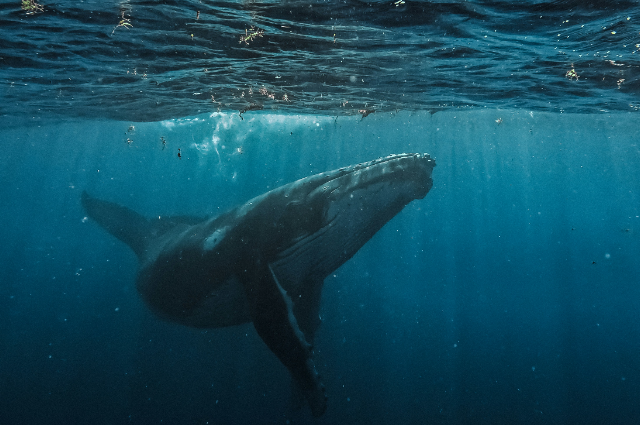
The blue whale is the largest creature to have ever existed on Earth. It can grow to over 30 metres long and weigh more than 100 tonnes. Yet the ecological importance of this great animal is inseparable from life too small to see with the naked eye.
Phytoplankton are microscopic photosynthetic organisms that float in the oceans. They are the foundation of the marine food web and play a huge role in the carbon and oxygen cycles of Earth. The oceans absorb around 31% of human CO2 emissions, and marine phytoplankton contribute to around half of Earth's oxygen production.
Whales are linked to this microscopic world through an often overlooked process: nutrient recycling. Feeding, migration, digestion and, eventually, death all contribute to the transport and redistribution of nutrients in marine ecosystems.
Blue whales are baleen whales, which means that instead of teeth they have plates made of keratin that hang from their upper jaw. These allow them to filter huge volumes of water in their search for small prey, particularly krill.
During peak feeding seasons, single baleen whales can eat several tonnes of krill per day. This means that baleen whales process large quantities of marine biomass and nutrients. A 2025 study published in Communications Earth & Environment examined whale faecal material and found high concentrations of dissolved iron and other trace metals, including forms of iron that can remain dissolved and potentially available to marine organisms. Phytoplankton require nutrients to grow.
While carbon dioxide and sunlight are essential for photosynthesis, phytoplankton also require nutrients such as nitrogen, phosphorus and iron. In some regions, one of these nutrients can become a limiting factor: even when other nutrients are abundant, phytoplankton cannot grow faster if a required nutrient is scarce. Iron is especially important in some of the largest expanses of the Southern Ocean.
Some species spend time diving deeply to feed and then return to the surface to breathe, which can cause nutrients from greater depths to be transported upwards through their urine and faeces. This effect, where deeper waters are brought up to the surface to nourish plankton blooms, is often referred to as the "whale pump." Baleen whales also undertake large-scale annual migrations. They can move vast distances from the nutrient-rich feeding grounds to the lower-nutrient breeding grounds, where many of the nutrients they have accumulated are then expelled back into the ocean through their waste.
Once at the surface, these nutrients can be absorbed by phytoplankton, which use sunlight to photosynthesise.
The process is not as simple as saying that every single whale will lead to the creation of a phytoplankton bloom, since ocean productivity depends on a variety of interrelated factors. However, research is increasingly finding that whales and other marine animals play an important part in nutrient cycling.
The region contains substantial quantities of macronutrients, but iron availability can be a controlling factor for phytoplankton productivity. Researchers have demonstrated that natural iron supplies can stimulate phytoplankton blooms and the amount of carbon that is exported into the deeper waters. A research highlight in Nature Climate Change in 2025 noted that scientists looking at 27 samples of faeces from four species of baleen whales found that, on average, whale faeces contained about ten million times more iron than the Antarctic seawater. The finding suggested that whales could be a significant source of iron for phytoplankton in the Southern Ocean.
A 2025 study discovered that iron in whale faecal material can be associated with organic ligands, which help keep the iron dissolved, potentially available to marine organisms. In the samples studied, the concentrations of dissolved iron varied from thousands to more than one hundred thousand times higher than typical concentrations in open ocean surface waters. The significance is therefore not simply that whale faeces contain iron, but the form that the iron takes is also important.
They take carbon dioxide and turn it into organic matter through photosynthesis. Some of that organic matter becomes food for zooplankton, fish, and larger marine animals and eventually, a fraction of it will sink to the deep ocean, either as the creatures die or are eaten. This process is referred to as the biological carbon pump, and natural iron fertilisation can enhance it in some parts of the Southern Ocean. Research conducted in the Crozet region found that export of carbon into the deep ocean was between two and three times higher in naturally iron fertilised waters compared to nearby high nutrient, low chlorophyll waters.
It would be misleading to say that whales themselves capture the amount of carbon equivalent to several Amazon rainforests. The frequently cited comparison refers to the enormous amount of carbon dioxide captured by global marine phytoplankton, rather than the carbon captured by whale activity alone. NOAA Fisheries describes global marine phytoplankton as capturing an amount of carbon dioxide equivalent to roughly four Amazon rainforests each year. Whales can contribute indirectly by transporting nutrients that stimulate phytoplankton productivity.
Whales also store carbon themselves. The connection between whales and carbon does not end with nutrient recycling. Whales are huge and long-lived creatures, meaning substantial quantities of carbon are stored in their bodies during their lifetimes. NOAA estimates that an individual whale can capture and store an average of around 33 tonnes of carbon dioxide over its lifetime.
A whale's carcass can become an ecosystem itself; various fish, crustaceans, worms, and other organisms can feed on it, and specialised bone-eating worms can colonise the skeleton. At the same time, some of the carbon contained in the whale can remain in the deep ocean rather than returning immediately to the atmosphere.
NOAA notes that carbon associated with whale falls can remain in deep-sea environments for hundreds to thousands of years. Industrial whaling during the twentieth century had an enormous impact on the populations of large whales. A study published in 2025 noted that approximately 1.5 million baleen whales were killed throughout the Southern Hemisphere during the twentieth century, including more than 95% of the largest species such as blue and fin whales. Before industrial whaling, the Southern Ocean contained vastly more large baleen whales. With fewer whales feeding, migrating and releasing nutrient-rich waste, one aspect of nutrient recycling was significantly reduced.
Researchers have therefore proposed that the historical depletion of whales altered the biogeochemical cycles of the Southern Ocean. The ocean is subject to a variety of interacting processes, including winds, currents, sea ice, dust, upwelling, geological sources of iron, and changes in other marine organisms.
Blue whales depend heavily on krill as a source of food. Yet krill are also part of an essential nutrient recycling chain that ultimately supports phytoplankton. Krill consume phytoplankton, and then whales consume huge volumes of krill. When the biomass is digested and the whales expel waste, some of the nutrients that have passed through the food chain can be returned to the water in forms that are potentially available to microorganisms.
That does not mean that whales simply "create" nutrients; they can recycle and redistribute them, which can make them available in locations and chemical forms that may support further biological production. The whale pump is sometimes presented as a simple climate solution: saving whales is a way to increase phytoplankton, which in turn helps remove more carbon dioxide from the atmosphere. Not every nutrient emitted by a whale is going to lead to additional carbon being sequestered. Phytoplankton growth depends on a variety of environmental conditions, and carbon fixed by photosynthesis does not necessarily remain permanently locked away in the deep ocean. Some is rapidly recycled by surface ecosystems, eventually returning to the atmosphere.
Scientists are continuing to investigate exactly how much additional long-term carbon storage can be attributed to whale activity. Yet this uncertainty does not detract from the broader ecological significance whales hold. They shape food webs, redistribute nutrients, store biomass, support deep-sea communities and link distant marine ecosystems through their migrations. Their importance goes far beyond their potential contribution to climate regulation.
Blue whales are currently classified as endangered, though some populations have recovered since the cessation of large-scale commercial whaling. Modern-day threats to blue whales are diverse, including entanglement in fishing gear, ship collisions, underwater noise, habitat modification and changes in prey availability. When a recovering whale population is re-established, it restores animals that have spent millions of years participating in marine ecosystems: their feeding, redistributing biomass, their migrations transporting nutrients, their waste fertilising surface waters, their bodies storing carbon and supporting deep-sea communities after death.
The blue whale may be the largest creature to have existed on Earth, but its ecological significance begins with incredibly small things, microscopic organisms, molecules of iron, and tiny particles of carbon. Perhaps that is the most interesting lesson about the whale pump: the health of the largest animal in the ocean is inextricably linked to the health of some of its smallest inhabitants, and the better scientists come to understand that connection, the more they can realise the importance of conserving whales to prevent the loss of this intricate biological process.
References
- https://www.fisheries.noaa.gov
- https://www.nature.com
- https://www.nature.com
- https://www.nature.com
- https://www.nature.com