
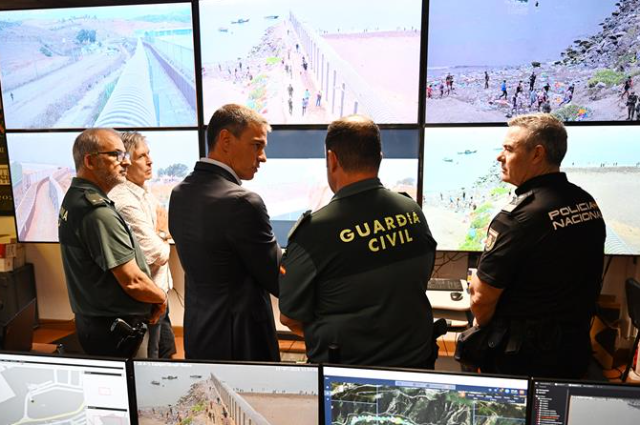
A recent migration activity has been identified with almost 50,000 migrants commuting across the border from Morocco, especially the Tarajal Border fence, into the Spanish enclave of Ceuta, Ceut, since 28th July. Among them, 57 people have been reported as dead. Many have returned to Morocco as they failed to take refuge.
Ceuta’s streets became overly crowded with the sudden influx of migrants, which disrupted the city’s normal functioning and social services.
Where is Ceuta and why is it the central point of conflict?
Ceuta is a Spanish enclave located on the northern part of Africa, ca which shares its border with Morocco. It’s also connected to the mainland of Spain via the coast of Gibraltar.
This city has long been a point of political conflict between the two nations, Spain and Morocco. The fundamental conflict is related to the fact that to which state does Ceuta belon.
On one hand, Spain claims it to be historically an integral part of itself since 1580. It has remained isolated from the mainland only due to geographical factors. Ceuta is also very important for the Spanish because it has served as its military base for years. On the other hand, Morocco claims that Ceuta is their territory based on the ancient Islamic conquest of the 8th century.
Because of the above reasons, Ceuta often comes up as a central point of conflict between the two sovereign states. Apart from this, it has also served as a pathway for migrants from Morocco who enter the mainland of Spain via this route.
Waves of earlier illegal migration into Ceuta
A huge number of labourers from other African countries settle down in Morocco for better work opportunities. These migrants often have the desire to step into EU territory in countries like Spain, France, Belgium, etc fora better standard of living and work opportunities.
Such migration has happened before, in 2022, when the Moroccan Government relaxed its border restrictions and almost 8000 people moved into Ceuta within two days. However, many people later returned to Morocco.
How does Ceuta facilitate the migrants?
Stepping into Ceuta is much easier because it is a passport-free zone. This dates back to an EU/Schengen agreement signed in 1985 by its member states, which allows people from the EU nations to move across countries without needing any visa.
Once the migrants from Morocco enter Ceuta, they are formally a part of the Schengen Agreement,t and hence they can enter the other EU countries like Spain, France, Belgium, um etc. That’s why this migrant row is not just restricted to Spain but forms a larger problem for the rest of the European countries as well.
Possible Reasons behind this sudden influx of migrants
Several speculations have been going on surrounding this sudden surge of young people aged 16 and17, which indicates that this flow might be instigated by human trafficking rackets or smuggling networks.
Moreover, Spain is economically rising, and these young people might have shifted in hopes of employment opportunities,s which is otherwise a huge concern in Morocco, as their unemployment rate has dropped from 37% to 13% since 2025.
Another reason which could be a possibility for this sudden flow of people is that Pedro Sanchez had formerly declared to offer legal status to as many as 5 lakh unregistered migrants living in Spain under his regularisation program.
Morocco’s Response
Karima Benyaich, the Ambassador of Morocco in Spain serving since 2018, stated that Morocco was unaware of any such illegal emigration activity. She further added that the country stands in favour of a safe and legal process of migration.
Italy imposes stricter regulations.
Giorgia Meloni, Italy’s Prime Minister, er has reacted strongly to this voluntary migration and has asserted that strict border controls would be imposed that would prevent the migrants from entering Italy. If the migrants enter their territory, it would be a cause of concern for summer tourism in Italy.
Spain, however, requested Italy to withdraw their border restrictions, which Rome refused,d as it anticipates another large-scale migration of people in Ceuta.
Measures taken by the Spanish Government
Juan Jesus Vivas, the President of Ceuta, ta has termed this exodus a social emergency. Spanish PM Pedro Sanchez, stated that the government has sent its military to Ceuta to restore order. To restrict such movements, Sanchez has authorised the creation of floating barriers on the sea around Ceuta.
The June 29 Spanish Court ruling passed a judgement that migrants arriving on Spanish territory by sea would be forced to be expelled from the country if they refused to follow the due process of law and border checking as mentioned in the Spanish Law.
This is also based on an international bilateral agreement between Spain and Morocco, where Morocco is bound to accept those migrants who illegally enter Spain after Spain has declared them to return to their original African land.
This judgement was passed to prevent the migrants from shuttling without undergoing any governmental verification.
In addition to Italy’s tighter border enforcement, Madrid has imposed a month-long program in which travellers have to meet strict regulations to enter the land. This move has been taken by the Spanish Government to de-escalate tensions between the regions around Ceuta and the African and European country.
World Leader’s Statements
Trump has called this unusual movement of people an “invasion” into the sovereign territory of Spain. French Minister of the Interior in the second government, Laurent Nunez, also suggested enforcing tight regulations at the Spanish border to manage illegal migration.
EU President Ursula von der Leyen condemned such illegal movement and has asked to immediately curb such dangerous and unlawful activity.
References: