
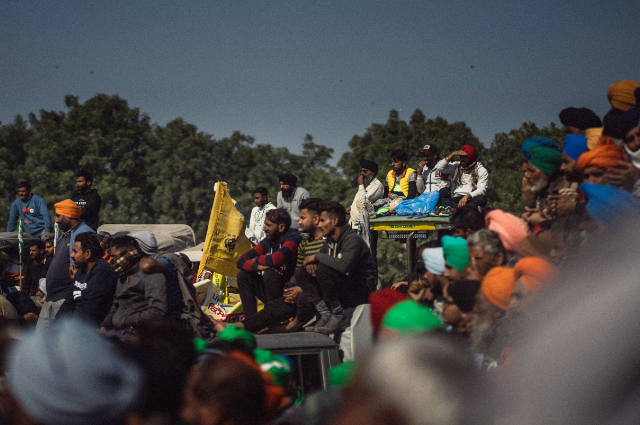
Source: Rupinder Singh on Unsplash.com
After days of continuous protests by the students in Delhi’s Jantar Mantar, followed by several mass rallies and dissent movements across the country regarding alleged paper leaks and corruption has culminated in the resignation of Union Minister Dharmendra Pradhan.
But as soon as one issue is dealt with, another issue crops up, with farmers protesting in Delhi over the proposed trade deal with the US in February 2026. Although the deal has not yet been finalised and is still in the negotiation phase, it has raised serious concerns about the livelihood and survival of India’s farmers.
The India-US Free Trade Agreement
The India-US Free Trade Agreement (FTA) essentially deals with the reduction in tariffs between the two countries and greater access to each other’s markets with the aim of expanding bilateral trade. It aims to allow the US to gain more access to India’s huge market, especially the agricultural sector and at the same time makes it beneficial for India to gain greater access to the US market.
This trade deal does come with huge advantages in terms of reducing tariffs and boosting trade, yet at the same time sparks major concerns for the domestic market that might suffer due to global competition, potentially affecting the economic stability of Indian farmers.
What instigated the Outbreak of the farmers’ protest?
These apprehensions might have caused greater uncertainty and unease among the farmers. Moreover, the youth-led demonstration against corruption in education might have encouraged and instigated the farmers to come out on the streets in large numbers in order to voice their grievances.
Farmers from various organisations such as Kisan Mazdoor Sangharsh Committee (KMSC) along with leader Sarwan Singh Pandher, Kisan Mazdoor Morcha, Azaad Kisan Morcha and BKU Ekta Sangharsh of Punjab and Haryana mobilised in large numbers under the banner of Desh Bachao Morcha across Delhi on July 21 against the probable India-US Trade Deal, stating that this deal could pose a significant threat to farmers, agricultural industry and MSMEs. The rally was organised at Kisan Ghat in Delhi and demanded the cancellation of this deal.
Attempts to Halt the Protests
The authorities tried to block these demonstrations, and many farmers were held back at major border points, especially in the Punjab-Haryana Border. However, they weren’t successful in their attempts, as the majority of the protesters from Ambala, Kurukshetra and neighbouring districts managed to reach the rally point. Tajveer Singh, a spokesperson of the Bharatiya Kisan Union, revealed that the Haryana Police held up barricades outside their jurisdiction in Punjab. Many farmers were also halted at the Sambhu border, the entry point to Haryana.
The road to the capital was sealed with multi-layered barricades and iron spikes to prevent the protesters from entering the city. The farmers strongly condemned the government for encroaching upon their fundamental right to assemble. The conflict further escalated when several union farm leaders were arrested.
After much chaos, the farmers finally withdrew when the Haryana Government assured them of releasing the detained leaders. The Government also agreed to set up a meeting with the Union Agriculture Minister, Shivraj Singh Chouhan.
Demands of Samyukta Kisan Morcha (SKM)
United Farmers Front or Samyukta Kisan Morcha (SKM), a union consisting of over 400 farmers, appealed to President Draupadi Murmu, proposing to cancel all the free trade agreements signed with other countries like the US, the European Union, the UK, and New Zealand.
The union body put forward its demands to present all proposed documents before the public and to conduct a thorough discussion of the clauses in Parliament. The letter sent to the President claimed that negotiations were largely shaped by corporate pressure and with the objective of advancing capitalistic interests rather than addressing broader public concerns.
The concerns raised in the letter centred around a significant increase in the import of heavily subsidised agricultural and processed food products in the Indian Market. Such imports would be competition for the domestic market, as consumers would likely choose the cheaper imported products, including dairy products and processed foods.
Moreover, India was forced to cut down on import duties on products such as Olive Oil, vegetable oils, lamb, beer, wine and margarine, which would make these products more accessible to consumers. As a result, domestic producers would also have to lower their prices to remain competitive. This would pose significant economic challenges for the small- and medium-scale farmers of India.
Moreover, SKM highlighted the vast structural difference between Indian and US agriculture. US has more agricultural land holdings compared to India, enabling large-scale production at lower production costs.
These protests are an epitome of farmers’ mobilisation against the potential impact of international trade on India’s agricultural scenario, as the dissenters march towards a more meaningful dialogue that ensures a fair and suitable alternative for all.
REFERENCES: