
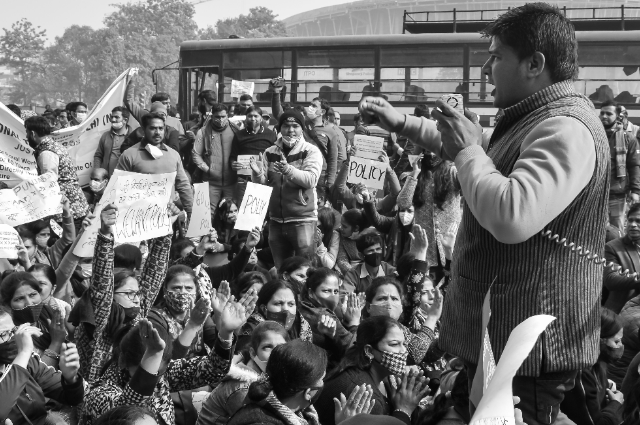
As soon as the Jantar Mantar protest over the NEET paper leaks settled down, a fresh wave of agitation sparked among the youth once again, this time in the eastern part of India, i.e. in Jharkhand.
Students took to the streets right after the Jharkhand Government issued notices on the cancellation of the major recruitment exams, particularly the Jharkhand Public Service Commission (JPSC) and the Jharkhand Staff Selection Commission (JSSC). Mass demonstrations crowded the streets of Jharkhand when the Government declared that 22 job recruitment exams were annulled and 23 others are awaiting investigations.
What instigated the protest?
The main reasons behind the mass uprising, as stated by the protesters, were that many of the question papers were leaked, and allegations were made that the results were not fair.
Many of the protesters who sat for the recruitment exams claimed that the marks were tampered with and manipulated and that many who actually cleared the exams were falsely shown that they failed to pass the test. This raised questions about the transparency of the marking system and the education department of the country.
The agitators urged for re-examination of those recruitment exams so that honest evaluation is re-examination is meted out to the honest candidates.
These above-mentioned discrepancies related to recruitment exams angered the students who have been preparing for months to sit for these exams.
Protest turned into a statewide outrage.
These internal issues soon escalated when the dissenters marched towards Jharkhand Vidhan Sabha, demanding fair and transparent examinations. The Jharkhand protest movement soon turned into a mass outrage very similar to the protest over the NEET paper leak. Several people organised a sit-in rally to voice their grievances and disappointment, which was instigated by the sudden cancellation of exams. Just like the Jantar Mantar Protest, several students were arrested in the Jharkhand protest as well, without any reason.
The protesters conducted a 26-day strike after which they called for a peremptory demand to the State Government to look into the matter and take immediate action. Several students and aspirants assembled at Jaipal Singh Munda Stadium in Ranchi.
The police blockaded roads and tried to stop the protesters. They also used tear gas and water cannons, and many of the people were arbitrarily arrested.
JPSC and JSSC Manch jointly led the protest march with Rupesh Kumar Pal, Savita Kumari, Rahul Kranti, and some of the members from the group who fasted for 15 days. Piyush Kumarand Singh, one of the members from the reform Manch, appealed to the Chief Minister of Jharkhand, Hemant Soren, to actively take up and resolve the issues so that the exams can be conducted in due time and intervals. Piyush Kumar Singh also demanded the removal of the FIRs issued against such persons.
Devendra Nathato, one of the prime leaders of the protests, went on a 16-day hunger strike in protest against the malpractices involved in the job recruitment examinations. He ended his fast following the State Government’s declaration of scrapping the Jharkhand Staff Selection Commission-Combined Graduate Level (JSSC-CGL) examination.
The Government scrapped the recruitment exams, which date back to 2014, due to which new levels of anxiety have been sparked among current government employees, who are in fear of losing their jobs.
Following such mass mobilisation, the Central Government assigned the Criminal Investigation Department (CID) to investigate the matter. After a probe conducted by the CID, it was found that the Chief of the Jharkhand Public Service Commission was involved, and subsequently he was arrested.
Chief Minister Hemant Soren further cancelled the exams held by TSR Data Processing Private Limited (TDPL).
Moreover, the Supreme Court has given the verdict of appointing the CBI to conduct a thorough investigation into the JPSC Civil Services Preliminary Examination 2025.
For such tough examinations, a paper leak or an irregularity in the evaluation process of the examination can seriously harm the confidence of the candidate who has put years into preparing oneself to clear these exams. The outrage did not just erupt out of a single paper leak or mis-evaluation of this year’s JPSC, but the inherent and long-term ongoing issues attached to the proper conduct of the exams, the delays in procedures and examinations; all of this together culminated in the mass demonstration.
These recurrent protests related to various factors across the country signal the inherent corruption of our government system, which is largely impacting the youth, their education, their employment and their careers overall. These protests are a means of demanding the two most important things needed for a government to function: transparency and accountability.
Thus, these demonstrations are a wake-up call for the government to not compromise on the future of the country’s youth and to ensure a fair and accessible education system for all.
References: