
Rajkumari Ratnavati Girls School in Rajasthan has earned widespread recognition as a symbol of holistic and sustainable development. With generous support from various organisations and philanthropists, it has grown into a very impactful institution.
Before diving into the ideation of this school, let me first enlighten you about one of the school uniform's fascinating features.
The Uniform That Tells a Story
All of us are familiar with the typical school uniforms, a combination of white shirts and blue skirts largely derived from the Western style of clothing. But a very unique and different approach to the style of school uniforms has been introduced in Rajkumari Ratnavati Girls School, which focuses more on India’s style of clothing. The school uniform is designed in Ajrakh print, indigenous to Rajasthan and the uniforms are created by one of the top designers of the country- Sabyasachi Mukherjee.
Sabyasachi Mukherjee, the renowned Indian fashion designer, is the main creative mind behind the design of this school uniform. Known for his strong association with traditional Indian textiles, he has incorporated the Ajrakh pattern, an indigenous textile tradition having its origins in Rajasthan.
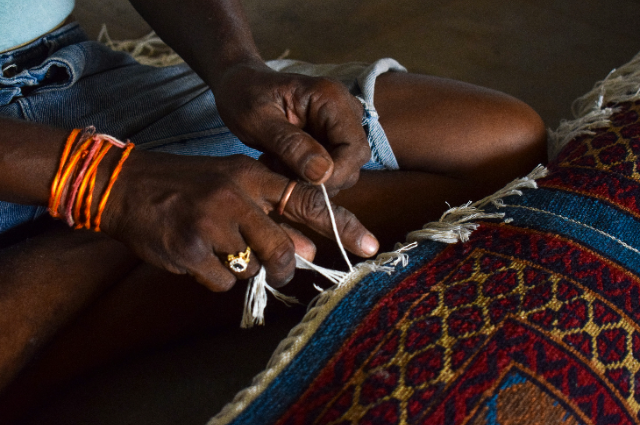
Ajrakh, known for its unique geometric designs with its staple colours of crimson and indigo, undergoes 21 stages of dyeing and printing before the final work is revealed. Ajrakh printing dates back to the Harappan civilisation, and one of the most remarkable features about it is that both Hindu and Muslims craftsmen belonging to the Khatri community jointly contribute to creating this design.
This initiative not only gives the students a unique visual identity but also highlights the importance of preserving India’s traditional textile heritage.
The Brainchild Behind the Vision
A very unique approach to empowerment has been jointly undertaken by CITTA and Sabyasachi Mukherjee. It’s truly remarkable to see how one single initiative can address so many important causes-empowering education, supporting artisans and promoting environmental protection, all at the same time.
This innovation has been spearheaded by Michael A. Daube, the founder of the non-profit organisation CITTA based in Jaisalmer, Rajasthan. This organisation focuses on the upliftment of the marginalised strata in society, with a focus on imparting education to the girl child and empowering the women's community of India. CITTA functions on the HEED Model- Health, Education and Economic Development.
Michael A. Daube is a New Y designer and artist, known for his many philanthropic works. He has established a hospital in Nepal along with a women’s centre which is devoted to making knitwear and crochet using cashmere and wool.
The idea behind creating this initiative first appeared in Daube’s mind while he was visiting Jaisalmer. It was then that Daube witnessed the extraordinary talent of the local craftsmen and their unrecognised labour.
His initiative took shape when Daube got an offer from Donna Karan and Christina Ong to produce yoga bags. Donna Karan and Christina Ong were both interested in starting a business with the underprivileged women of Bali’s Como Shambala.
Following this, Michael Daube approached Sabyasachi and asked him to collaborate in his new venture. Sabyasachi responded enthusiastically to this opportunity, which fostered a meaningful connection between the two. Both shared a common goal focused on empowerment, and this project aimed to bring together education and local craftsmanship under one roof.
This initiative was introduced with the vision to stabilise India’s craftsmen community and give them a stable livelihood, thus fostering a thriving economy for all. It has also been done to preserve our heritage, especially the dying handicraft tradition of Rajasthan, prevalent in the Thar and Sindh regions.
A School Designed for the Desert
Rajkumari Ratnavati Girls School provides education to all most 400 girls. This school was built with financial support from Harmeet Bajaj, a consultant in fashion and lifestyle marketing who belongs to one of the royal families in Rajasthan. It comprises a training centre for the women, most of whom are the mothers of these children, to continue their handicraft business.
Rajasthan, the state with the lowest literacy in India, requires special assistance for its development and growth. In a place like Jaisalmer, where the day temperatures reach soaring heights, building an educational institution seemed impossible.
The beauty of Jaisalmer captured the heart of Diana Kellogg, a New York-based architect who firmly expressed that she would like to build an educational institute for the destitute. She believed that education is a must for all and that it changes the way one perceives the world. Under this project, a school, a handicraft cooperative, and an exhibition hall have been built by Diana Kellogg.
Diana worked closely with the architects to build an institution that could withstand the extreme temperatures. The building is designed in such a way that it does not require air conditioning. The building is made up of sandstone that keeps the interiors cool, preventing the penetration of heat. The inner walls are coated with lime plaster to minimise humidity. A grid-like wall is built to allow fresh air to permeate within. All this reduces the indoor temperature by 20 to 30 degrees. The school has also been designed in a sustainable manner by using solar and wind power and effectively practices water harvesting.
This school is an example of how a single vision can transform the lives of millions of people. We need more such initiatives, and only then can we move towards a better India.
REFERENCES: