
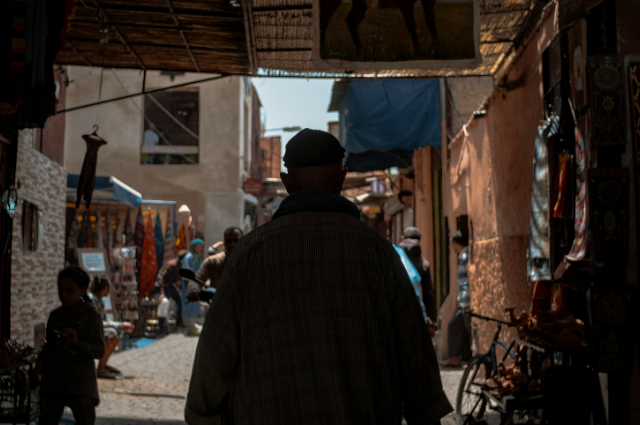
Have you wondered what being a spy looks like? The chic black suits, leather, or spandex jumpsuits that make you look cool. The gadgets that work effortlessly and are minimal so you can carry them around in disguise.
Movies and films have portrayed the cool side of being a spy, but the reality is far from it.
Back in 1973, during a theatre performance in Delhi, Ravindra Kaushik was recruited by the Research and Analysis Wing (R&AW) of India for his captivating performance in linguistic command, psychological presence and his ability to improvise. His talent in assimilating and grasping a strong command over languages was what caught the attention of the RAW, and when they recruited him, he was just 23 years old.
At that age, certain people are still in the formative ages of their lives, but Ravindra was ready to serve his nation, and this earned him the title ‘Black Tiger’ from the then Prime Minister, Indira Gandhi herself (The Economic Times n.d.).
But being a spy isn't just about the cool lifestyle or gadgets you get to use. It's self-deprivation of the things you used to know and stepping into a new life, in a new territory that could determine your life or death.
Ravindra’s story is one that shows not only the realities of being an undercover agent, but also the harsh realities that have now become a wake-up call for every person looking to defend their nation. would your nation fight for you?
ORIGIN
Ravindra was born on the 23rd of June, 1958, to J.M. and Amladevi Kaushik (Aich, 2025). His father was an Indian Air Force Officer while his mother was a homemaker. At an early age, Ravindra was invested in theatre, public speaking and elocution.
He hails from Sri Ganganagar, Rajasthan and was partly raised in Kolkata’s Bagbazar neighbourhood in India. He was already accustomed to the cross-border sensitivity happening in the country, and because of its proximity to Pakistan, Ravindra was able to assimilate and transition into the Pakistani lifestyle more quickly.
His training went on for two years, which included mastery in Urdu (Pakistani dialects), study of Islam including the Qur'an verses and rituals, Pakistani lifestyle and mannerisms, combat training, and so much more. He was to take on a new identity as ‘Nabi Ahmed Shakir’, which required him to completely detach from his biological origin in India as Ravindra Kaushik.
Which 23-year-old would do that in this time and age, especially when they find out that all their efforts were going to go down the drain when they were caught?
Ravindra assumed the above identity and played his part well. The training had him learning and rehearsing false memories, creating life stories from thin air, which would soon be the anchor for his new life in Pakistan.
He went on to cross the border and began living in Lahore, where he enrolled in a law program and slowly fit into Pakistan's lifestyle. He married a local, Amanat and became a father. His social charisma earned him a place in the country, and he soon reached the rank of Captain after joining the Pakistan Army as a clerk.
The office provided him access to military accounts, units, postings of key officials and train movements of materials (The Print, 2023). Ravindra sent back information by recording all he found in invisible ink and mailing his notes to addresses in Kuwait or Dubai.
Rising to the rank of Captain in another man's land is no small feat. Ravindra had to have been on guard about his movements and discreet with whomever he shared information with. The average spy displaced by the Western media, tells us this much.
How then did he get caught?
As recorded in the International Journal of Creative Research Thoughts, The Indian Express (2013, as cited in Aich, 2025) explains it as a systemic lapse that cost India its most valuable operative. His operation was flawless, but the hindrance to the plan and his downfall were caused by another agent, Inayat Masih.
In September 1983, Inayat was captured as soon as he entered Pakistan due to the priority of his mission. After a series of interrogations and torture, he confessed his mission and released the cat out of the bag on Ravindra, who was then arrested and tortured for two years at an interrogation centre in Sialkot and then
jailed in Mianwali for 16 years, where he was moved between prisons that were in solitary confinement, tortured, and he was left to die (The Economic Times n.d.).
Ravindra died in November 2001 from pulmonary tuberculosis and heart disease in the New Central Multan Jail.
His Impact on India and India’s response to him.
From 1979 to 1983, Ravindra shared Pakistan’s intelligence with India, and he has been known to be the greatest spy India has ever produced. This earned him his Black Tiger title that has also gone on to impact and act as an inspiration to the nation.
One example of this is shown in the entertainment industry, in the film Dhurandhar. The movie has been compared to Ravindra’s life as a spy and has received its share of criticism and responses to how spies have been treated.
The Indian government, as well as the RAW, did not make any public release regarding Ravindra’s case in Pakistan. It was as though he never existed as a citizen and all his work was nullified. This was true, given the erasure of his existence in the Indian records, but it is also heartbreaking to see a man who was once glorified in his field of work now reduced to nothing.
According to Maloy Krishna Dhar’s Open Secrets: India’s intelligence unveiled (Manas Publications, 2005, as cited in Aich 2025), releasing public statements was nearly impossible given the nature of Ravindra's work. It would mean that the government admits to certain intricacies that could jeopardise the organisation’s plans.
Ravindra's family has since been left in distress as his late parents sent back-and-forth letters to the government and RAW organisation, pleading for help to bring back their son. This was to no effect.
India failed one of its own, and for more than twenty-five years, his story still lives on. A man gave up his identity for a nation, to fight for it, but the nation couldn't fight back.
His story is one that has revealed the harsh realities of ethical, moral and political sacrifices that all end up in vain. But Ravindra, even in pain and torment, said this
in one of his letters to his family, ‘Had I not been born an Indian, I would not have suffered like this. But if I were to be born again, I would still serve my nation’.
References:
- Aich, S. (2025). Ravindra Kaushik (Black Tiger): A research study on his role in the history of RAW and the tragedy of his final years. International Journal of Creative Research Thoughts, 13(12). https://www.ijcrt.org
- The Economic Times. (n.d.). Story of RAW agent, Ravinder Kaushik, who worked as a Pakistan Army Major – Forgotten hero. https://economictimes.indiatimes.com
- ThePrint. (2023, April 22). The cost of being an Indian spy: What happened to Ravindra Kaushik, RAW's Black Tiger. https://theprint.in