
In many societies today, leadership has always been patriarchal, for certain reasons such as logical thinking, good business ventures, and masculinity. In other words, a man in power assures that everything is under control. He is assertive, strong, vigilant, and great at doubling income.
What if the roles get reversed and those who have been tagged breadwinners in other societies challenge the natural order of the world and stick to wearing veils?
Tuareg are a nomadic group of people from the Central Sahara who practise Islam and belong to the Berber ethnic group that speaks Tamasheq. Their ancestral home was once in the Sahara and edges of the Sahel, but now spreads across Mali, Niger, Algeria, and Libya. A majority of the population can now be found across Mali and Niger (Terres Touraeg).
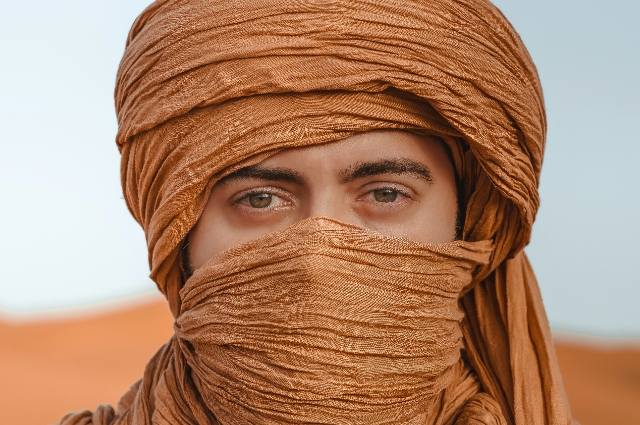
These people go by many aliases: ‘free people’ and ‘blue men’, and they earned this title from their independent lifestyle, as well as the indigo veil-turban called the Tagelmust or Litham worn by the tribe, but most especially the men.
You have probably wondered why Muslim women have to cover their faces, and men don’t, and your pondering led you to believe it is within their religious conduct. That is not the case for the Tuareg. The Tagelmust or Litham is a piece of clothing that ties them to their masculinity and identity.
The Litham is a long piece of cloth, roughly 10 metres, which is dyed in Indigofera Tinctoria plant extract. Its process is the very reason for the nickname, ‘Blue men’, because the indigo colour stains the wearer’s skin permanently. The Litham serves various purposes, but most importantly, it is a rite of passage. An introduction of a young boy into society as a man.
A boy of about 20 years of age passes through what is called ‘anagad’, as described by Kohl (as cited in GhanaWeb, 2024). It is a veil-giving ceremony where the boy’s father or maternal uncle presents the Litham to the child, who is expected to wear it for a straight week, morning and night. Women are also given the Tagelmust to wear, but, by contrast, they receive theirs on their wedding day.
The Tagelmust or Litham is an important piece of clothing to the free people as it symbolises various things, spiritually and physically. Its length protects the wearer from extreme heat temperatures in the Sahara from head to toe; the indigo dye used on the clothing also serves as protection against harsh UV rays, which could cause hyperpigmentation when in contact with the skin. Spiritually, the Tuareg people believe that if a man unveils himself, he has given room for a ‘bad eye’ upon his life. The Litham protects him against unsuspecting evil.
The social use of this clothing is quite interesting; the man must always wear his veil as a sign of respect to whomever he is speaking to, covering his nose downwards. Especially towards his wife’s family. It can only be taken off when he is around his immediate family.
That is something you’d hear a woman say, not a man.
The society of these people is unique, from their cultural background to the matrilineal society. Tobi Efunowo, in his article about The Free People in Unruly, wrote about the founding figure, Queen Tin Hinan, who led her people into Algeria in the 4th-5th century. The men have always respected the women, as they are seen as leaders who have held their ground and led them through trials unfailingly.
Freedom is relative to people, and for the Tuareg women, freedom is to choose what to do, when they want to do it, without having anyone decide against their will. Their free will allows them to acquire property, take as many partners as they deem fit before and even after marriage, provided boundaries are respected. Say, a lover, for instance, has to leave the woman before dawn and must not be seen by her husband. They are free to initiate divorce, and not entitled to wear the veil at all times.
It all sounds too good to be true, but it is. Family lineage has been traced from the maternal line, and women are traditionally the ones entrusted with literacy in the Tifinagh script. They're the primary poets, musicians, and custodians of Tuareg oral history and language (First People, "The Tuareg Exception").
The people are devout Muslims, and as far as Islam and tradition go, they are deeply rooted in their Berber heritage and keep up with their religious activities, fasting, praying, and observing the core tenets of Islam,
The men might be veiled for life after puberty, but it does not limit their roles in society or emancipate them. They wear it like it is their birthright, and have caught the eye of the modern world, which in turn has influenced the tribe, exposing the world to its beautiful and rich cultural background. Tourism, for instance, has grown increasingly; camel transport, which has been the oldest form of transportation, has now been replaced with quad bikes and pick-up trucks. The Tagelmust has also been modernised, as the younger generation now opts for more colourful versions, adapted to the modern T-shirt and trousers. (World Cultural Threads).
Music, on the other hand, has given a new meaning to this veil for these men. Tinariwen, founded by a young man, Ibrahim Ag Alhabib, who built his first guitar out of a tin can, stick, and bicycle brake wire after seeing one in a film, carries Tuareg’s poetry and solidarity in regions where there was no official media.
Tamasheq language media. The sound, ‘Desert blues’, became a source of expression along the themes of longing, faith, displacement and grief.
This veil did not mask away their masculinity; rather, it separated them from the world’s definition of who men should be. These men might be veiled for eternity, but their strength and unity are what keep the tribe alive, reverencing the heroes past and honouring their legacy.
References:
- Efunnowo, T. (2026, April 18). The free people: Inside the ancient culture of the Tuareg. Unruly.
https://getunruly.com - GhanaWeb. (2024, January 27). Interesting insights on why the Tuareg of North Africa wear the face veil. https://www.ghanaweb.com
- Terres Touareg. (n.d.-a). The Tuareg people: Territory and tribes. Retrieved July 12, 2026.
https://www.terres-touareg.com - Terres Touareg. (n.d.-b). History and origins of the Touareg people. Retrieved July 12, 2026.
https://www.terres-touareg.com - World Cultural Threads. (2025, November 23). Tagelmust Berber: The 10-meter turban that represents the Sahara Desert.
https://worldculturalthreads.com. . .