
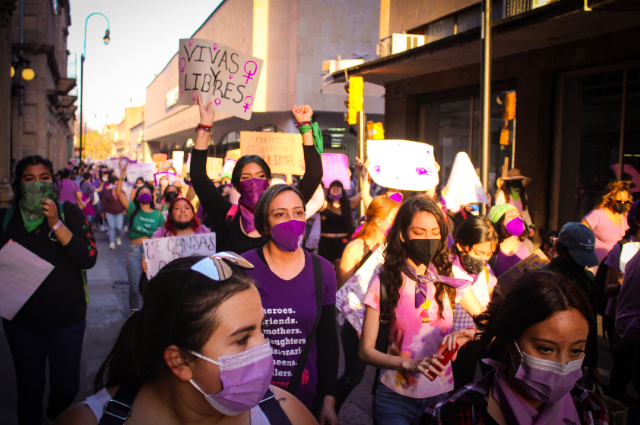
As long as there is injustice in the world, there will be people who will stand up against it. Where good lives, evil tries to prevail and vice versa. In the case of the 4B movement, it's women who are taking a stance to stop the misogynistic thinking in the world they find themselves in.
Taking it back to when the 4B movement was first announced in 2015 by a community called the Megalia, during a period of intense gender tensions in South Korea. The 4B movement means four nos to four Korean words: bihon (no marriage), bichulsan (no childbirth), biyonae (no dating) and bisekseu ( no sex(with men)).
These four words were coined in online spaces to counter the misogyny in Korean society. The hashtag #IAmAFeminist circulated on Twitter, and it provoked a conversation surrounding feminist issues.
In August of 2015, two Korean men used the MERS gallery of the DC Inside website to spread false rumours about two Korean women infected with Middle East Respiratory Syndrome who chose not to quarantine but rather continued shopping in Hong Kong. The news circulated and sparked hatred towards Korean women.
Megalia, a website that used to function as a response and mirror to what the Korean women were facing in their society, had users who would mirror and reciprocate the same misogynistic behaviour that other website users, such as the DC Inside users, did. They targeted words and language directed at Korean women and threw back similarly towards the men.
It was shut down in 2017 due to the public backlash, and a similar, yet radical website, WOMAD, was created in 2016. The website was created explicitly for women only, excluding gay men, transgender-identified men and others who were not explicitly women.
The Movement gained more momentum in 2016, after a Gangnam station femicide, which occurred when a man killed a woman in the public restroom after he claimed she had always ignored him. The Internet was triggered by this, and it led to a public sticky note memorial campaign and the outrage of feminists. It was also intensified when a series of digital sex crimes was revealed. It led to the exposure of certain tech companies and websites that support the distribution of illegally obtained images and videos of women through hidden cameras in public bathroom stalls and transportation.
This has been a case that the government has been so flexible with, taking its time to investigate and respond to these crimes.
The Movement has not been accepted wholly as a transformational movement for women by society. The values it is against are core to building the world, and some communities are against it. Churches and groups in the Christian community have campaigned against abortion and promoted marriage and childbearing policies.
This movement has been affiliated with the low birthrate in Korean society, and it is seen as the primary cause of misandry, disrupting anti-family values and gender conflicts.
The 4B movement expanded to 6B4T, including other critical issues beyond the female gender. It includes 6Bs, including two new ones: Bisobi (no consumption) against companies that sell misogynistic products or engage in sexist marketing; Bidopbi (unmarried women help other unmarried women, also meaning no help no). 4Ts, tal-corset (escape corset), tal-jonggyo (escape religion), tal-otaku (escape otaku culture), tal-idol (escape idols; fandom culture). This new movement has not gotten the widespread fame of the 4B, but it has since been adopted in the media by women, influencing a feminist discourse in China.
It gained an uproar internationally during the 2024 reelection of President Donald Trump. Women in the country felt constrained by the ideas and narratives of Trump's rhetorical statements like ‘Your body, my choice’. It became a trend among Gen Z American men, and this influenced their votes.
American women adopted the 4B movement as it was already a confirmed movement, encouraging every woman to adopt its values. This movement was not largely accepted by the queer community because they saw that the 4B movement leaned only on the biological term of who a woman is and did not include spaces for them. In South Korea, this has shown up in different ways, like sex verification before entering women-only areas, and a separation during protests. A trans woman noted on the subject that most Korean women in the Movement are not transphobic. The concerns are targeted at what the movement excludes.
Before 4B took its stance in society, political lesbianism had been. It was a political act of resistance against male-dominated power, and researchers studying the 4B have found the same logic in it. Some participants have openly wondered if stepping away from men should go further than abstention, into intentionally choosing women instead. Gender studies scholar Ju Hui Judy Han put it plainly, ‘We call it 4B now, but structurally, it's political lesbianism. And it's exactly here, at the point where "woman-only" becomes a boundary someone has to police, that the TERF concern sharpens. Han herself has said she'd hate to watch a full-blown trans-exclusionary movement take root in Korea through this door.
Not everyone supports the values of the 4B movement; it has stood as a solidarity community for women in South Korea (and spreading across the world) to express themselves and stand up against the misogynistic order in the world.
References:
- FeministWiki. (2025). 4 B movement. https://feministwiki.org
- Fabello, M. A. (2025, March 31). I'm interested in the 4B movement. But wait—is it TERF-y? https://www.melissafabello.com
- Human Rights Watch. (2020, March 27). South Korea online sexual abuse case illustrates gaps in government response. https://www.hrw.org
- Human Rights Watch. (2021, June 16). "My life is not your porn": Digital sex crimes in South Korea. https://www.hrw.org
- Lee, Y-I. (2026). 4B movement. Encyclopedia Britannica. https://www.britannica.com
- Sandspur, The. (2024, December 9). Op-ed: The rise of the 4B movement. https://www.thesandspur.org
- Time. (2026, March 10). The problem with adopting the 4B movement in the U.S. https://time.com
- University of Illinois Daily Illini. (2025, February 3). From country to country: 4B movement reshapes today's feminism. https://dailyillini.com