
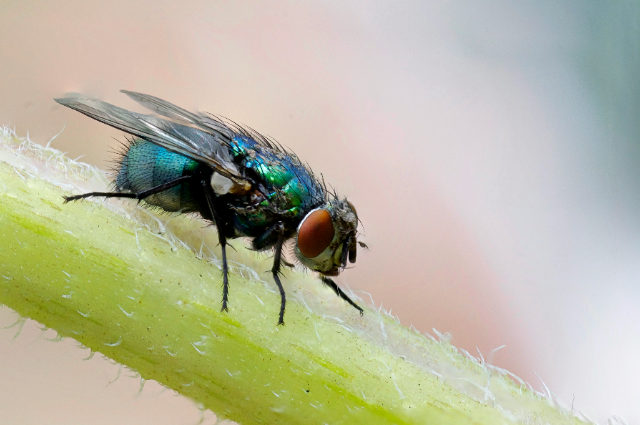
There's a creature, slowly making its way into society.
It targets body openings- the nose, ears, eyes, mouth, and any open wound on a living thing, using them as a nursery to lay its eggs and complete the second half of its lifecycle. It feeds on live tissue, not dead flesh, which is what makes it different from every other maggot.
It grabs onto its chosen opening with sharp mouth hooks, burrowing into the top layer of skin and down into the flesh, leaving behind a painful, throbbing, foul-smelling wound. It makes life unbearable for whatever it's feeding on. This is exactly why, right now, cattle ranchers are out at dawn, checking every inch of their herd because of one insect.
The New World Screwworm Fly (Cochliomyia hominivorax).
You probably thought that was made up. This is no work of fiction; NWS is real, and it's spreading fast across Central America and Mexico.
The First Eradication
The New World screwworm was first eradicated in the 1950s; USDA entomologists Edward Knipling and Raymond Bushland developed the Sterile Insect Technique (SIT). It is essentially a form of reproductive birth control imposed on the fly population (Klassen, 2004).
Male flies were mass-reared, sterilised with radiation, and released into the wild to mate with females who, crucially, only mate once in their lifetime.
The first concept came in 1954, on the Dutch island of Curaçao, off the coast of Venezuela. In just seven weeks, the fly was completely wiped out, saving the island's goat herds, which are a critical source of meat and milk for its people (Ag Journal, n.d.).
The New screwworm was completely eradicated of the New screwworm in 1966 to the early 2000s, spanning the affected areas: Central America and Mexico (Wikipedia contributors, 2026).
This was until 2016, when an outbreak in the Florida Keys killed 135 endangered Key deer before it was declared neutralised in 2017 (American Society for Microbiology, 2025). A key reminder that to eradicate doesn’t mean total elimination.
Present-day Cases
In 2023, Panama and Costa Rica confirmed NWS was spreading again (Centres for Disease Control and Prevention, 2026). It seemed contained, but by 2025, a person returning to the US after travel to El Salvador became the first human case confirmed on American soil in decades. And on June 3, 2026, it was confirmed in an animal, a Texas calf, and since then, more than 30 animal cases have been confirmed across Texas and New Mexico.
The regional numbers are over the top, with over 185,000 animal cases and 2,263 human cases recorded across Central America and Mexico (Centres for Disease Control and Prevention, 2026).
The USDA has since built out an entire awareness platform (screwworm.gov) to keep both ranchers and the general public informed (U.S. Department of Agriculture, Animal and Plant Health Inspection Service, n.d.).
The platform stated the symptoms to watch for, which include larvae moving in a wound, a foul-smelling odour, and bleeding from open wound sores.
Part of what makes NWS so hard to stay ahead of is how efficiently it reproduces. A single female can lay 200 to 300 eggs at a time, and up to 3,000 over her 30-day lifespan. Those eggs hatch into larvae that burrow into the skin and feed for about seven days before dropping into the soil to complete their transformation into adult flies (Wikipedia contributors, 2026), and then the cycle starts again.
To be clear: the USDA has assured the public that this isn't a food safety issue. Food products such as meat, fruits, and vegetables aren't at risk (U.S. Department of Agriculture, Animal and Plant Health Inspection Service, n.d.). But the insect still depends entirely on livestock to complete its lifecycle, which is exactly why it's a problem worth watching closely.
But at what cost?
Why are Cattle Farmers Watching Out for This Insect?
NWS is dangerous to livestock, cattle, and sheep especially, and its broad host range makes it a genuine public health and food security concern, given the extreme suffering and often death it causes in the animals it infects.
The economic ripple effects are already visible. Cattle imports now require screening to confirm herds are screwworm-free, both before and after they cross borders. Locals feel it too, since beef prices shift with every added layer of testing and treatment. According to Al Jazeera, Mexican cattle are typically fed and fattened on US farms for five to six months before slaughter, so any reduction in that process, caused by screening or quarantine, pushes beef prices higher across the board (Al Jazeera, 2026).
Livestock isn't the only target, either. Humans who contract NWS have had to endure antibiotic treatment to clear the infestation, and in more severe cases, surgery is required to remove embedded larvae (The Hill, 2026). That's why farmers and the veterinarians who work alongside them have to watch their own bodies as closely as they watch their herds, keeping wounds covered while they inspect livestock for any sign of infestation (American Veterinary Medical Association, 2017).
All of this is costing farmers their livelihoods, which is exactly why full eradication, and not containment, has to be the goal. Earlier this year, the USDA launched the New World Screwworm (NWS) Grand Challenge, a fund of roughly $100 million aimed at combating NWS and stopping its spread (U.S. Department of Agriculture, 2026).
It's framed as an investment in farmers and ranchers as much as it is an investment in food and supply security.
What can You Do?
This fight doesn't belong only to the USDA, the WHO, or the scientists and doctors developing new treatments. There's a part for the rest of us to play too.
The most recent human case in the US, after decades, was contracted mid-travel. To help and keep people and animals safe, the CDC has advised those living in affected areas to keep wounds clean and covered at all times, wear loose-fitting clothing, long sleeves, trousers, hats, and socks to limit exposed skin, and use insect repellent both on the body and around the home or farm.
Travellers and pet owners should also make sure animals are inspected and treated before and after crossing borders, particularly if they're coming from or going to affected regions.
NWS can be beaten back again. It's been done before, but it will stay gone if we all do our part in keeping it that way.
References:
- Al Jazeera. (2026, June 4). First US screwworm case in 60 years: Should America be worried?
https://www.aljazeera.com - American Society for Microbiology. (2025, September 5). New World screwworm: Rise, fall and resurgence. ASM.org. https://asm.org
- American Veterinary Medical Association. (2017, January 15). Screwworm infestation kills endangered deer. https://www.avma.org
- Centres for Disease Control and Prevention. (2026). About New World screwworm.
https://www.cdc.gov - Klassen, W. (2004). Sterile insect technique. In Encyclopedia of entomology. Springer.
https://doi.org - The Hill. (2026). Flesh-eating New World screwworm can infect humans and pets. Here are the symptoms to look for.
https://thehill.com - U.S. Department of Agriculture. (2026, January 21). USDA announces New World Screwworm Grand Challenge [Press release].
https://www.usda.gov - U.S. Department of Agriculture, Animal and Plant Health Inspection Service. (n.d.). Screwworm.gov: Unified government response to protect the United States.
https://www.aphis.usda.gov - Wikipedia contributors. (2026). Cochliomyia hominivorax. In Wikipedia.
https://en.wikipedia.org. . .