
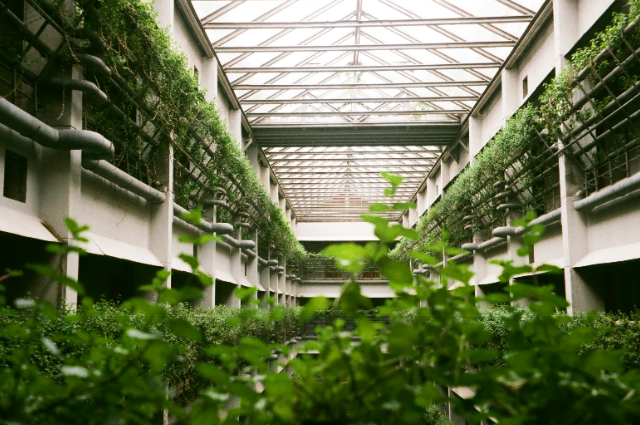
On a typical workday in Harare, Zimbabwe. Two buildings stand opposite one another as the hot afternoon air sweeps in. To the left, the office attendants immediately turn up the air conditioning. The hot air is enough to steam some bean cakes for a party of ten.
One staff member taps another, and they both look out the window, which faces the other building. No one’s unfazed, and work is going on. The windows are opened ajar, and the same hot air sweeps in, but they look refreshed.
How?
The science of Biomimicry in The Eastgate Centre.
Biomimicry, as the name implies, is an innovative design approach that seeks to solve human challenges by emulating nature’s time-tested patterns and strategies. In plain terms, humans look to natural means to solve certain struggles. (Pablo Luna Studio)
In the case of The Eastgate Centre, it looked to the termites and watched how they harnessed wind power. By replicating this in the building, the Centre utilises a passive cooling system to reduce the reliance on air conditioning, hence supporting sustainability. (Rethinking the Future, 2024)
The building is a shopping and office complex whose architectural style incorporates modern tools and Zimbabwean aesthetics to meet local climate and community needs. It supports the SDGs 7, 9 and 11, which are: affordable and clean energy, industry, innovation and infrastructure, and sustainable cities and communities.
The Way of The Termites
In learning the way of the termites, a 2015 research study was conducted by Harvard researchers, who found that the natural rise and fall of temperature during the day helps drive the airflow, which pushes carbon dioxide out of termite nests and, in turn, ventilates the mounds (Johnson, 2024). This explains how the mounds work: by breathing on their own, moving air in and out, but not in the way people seemed to think. The initial thought process of the human mind was that the mound allows hot air to rise, which then
escapes at the top and pulls in fresh air at the bottom. That is the basic principle of convection, but not in the case of the termite mound.
Follow-up research by Dr Rupert Soar and Biologist J. Scott Turner proved the theory wrong (Johnson, 2021). The small surface tunnels of the mounds, where worker termites move around, block strong gusts of wind from getting in. The air moves gently into the deep of the mound, where air is exchanged like gas, as seen in the mechanism of the lungs.
The lungs, which carry a similar gas exchange process, ventilate the human body by means of a bulk exchange. Take the following scenario: a window is opened and immediately, a gush of air sweeps through the room; or the AC, when turned on, swaps the air already inside the room with another wave of air, in response, losing the moisture and heat in the air. The lung doesn’t swap air immediately with the next available air; rather, it mixes in gas in small amounts as we breathe in and out. This is similar to the termite mound. (Johnson, 2021)
Renowned Architect Mick Pearce emulated this theory in the building by stacking 48 bricks and concrete blocks like a chimney to trap heat during the day, as Zimbabwe is known for its warm days. And letting the hot air escape slowly out of the building, hence replicating the mound.
When heat is trapped by these materials infused into the block, as well as by the people and machinery used in the building, the gentle escaping of air mixing through the walls of the chimney-like stack and fans in the building keeps the inside cool. That’s the principle of the termite mound.
The iconic structure that is the Eastgate Centre is an environmentally sustainable construction focusing on blending functionality with ecological responsibility. By harnessing a cooling system from natural means, it has minimised energy consumption by 35% when compared to six Harare buildings, saving 10% in construction costs. (Johnson, 2021)
The building depicts Pearce’s idea of weaving ducts and channels directly into the building’s structure. While it is not the true replica of the termite’s mound as stated by Soar in his research, it is an embodiment of sustainable architecture.
References:
- Johnson, J. (2021). Feature: Nature's engineers inspire sustainable building designs. Institution of Mechanical Engineers.
https://www.imeche.org - Pablo Luna Studio. (n.d.). What is biomimicry architecture?
https://pablolunastudio.com - Rethinking The Future. (2024). Eastgate Centre, Zimbabwe: A marvel of sustainable architecture.
https://www.re-thinkingthefuture.com. . .