
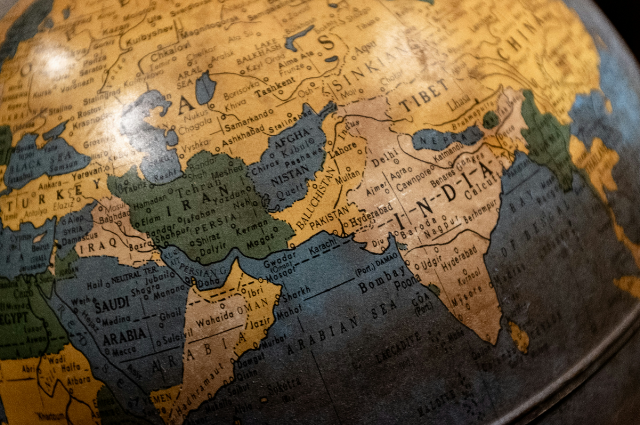
In the Indian National Anthem, Rajasthan, Kashmir, and the Northeast are missing from the list of provinces mentioned, and Dravida is used to categorise four distinct languages in the South. The answer lies in when the anthem was written and, probably, why.
Since 1911, Punjab, Sindh, Gujarat, Maratha, Dravida, Utkala, and Banga made up the provinces under British rule. But Rajasthan, as stated earlier, was not yet a unified political entity but a collection of states called Rajputana, which was unified after independence in 1948-1949 and completed on March 30th 1949 (Rajasthan High Court, n.d.).
Dravida, on the other hand, was already a standard term used by linguists to group the South, and it is still used today (New Ulster Biography. (n.d.). Now, that might not exactly be fair, as Tagore was just using what had already been in existence.
If a province wasn't included in the anthem because it hadn't been unified yet, then why is one which no longer exists still there?
The Indian national anthem, Jana Gana Mana, was composed by Rabindranath Tagore and sung on 27th December 1911 at a convention of the Indian National Congress in Calcutta (Indian Embassy Zagreb, n.d.)
The complete poem is of five stanzas, and only the first stanza was adopted as the anthem on January 24th 1950. The song’s lines read, in English
Thou art the ruler of the minds of all people,
dispenser of India’s destiny.
Thy name rouses the hearts of Punjab, Sind,
Gujarat and Maratha,
Of the Dravida and Orissa and Bengal;
It echoes in the hills of the Vindhyas and Himalayas,
mingles in the music of Jamuna and Ganges and is
chanted by the waves of the Indian Sea.
They pray for thy blessings and sing thy praise.
The saving of all people waits in thy hand,
thou dispenser of India’s destiny.
Victory, victory, victory to thee.
This poem practically praises India, but there's quite a problem that has been pointed out. The inclusion of Sindh.
In 2018, Congress MP Ripun Bora moved a private resolution in the Rajya Sabha, seeking an amendment to the National Anthem and replacing the word ‘Sindh’ with the ‘Northeast’ region.
He explained that Sindh represented the province, which was no longer a part of India and is now in Pakistan's territory. It was to be removed from the anthem and replaced with something that was a part of the country (Sanskriti Magazine, 2018).
The reason Bora suggested this amendment, as described in Sanskriti, was that the Northeast had become an important part of India but it wasn't added to the anthem, whereas Sindh, which is no longer a part of the country, is still listed. “On the other hand, Sindh is mentioned, which is no longer a part of India but of Pakistan, which is a hostile country,” Bora told ANI (Sanskriti Magazine, 2018).
Bora wasn't the only one who thought the inclusion of Sindh sounded wrong. The case of Sanjeev Bhatnagar versus Union of India (2005) shows that a Public Interest Litigation (PIL) was filed under Article 32 of the Constitution asking the Supreme Court to order deletion of the word “Sindh” from the National Anthem because it was no longer a part of India (Supreme Court of India, 2005).
That is a valid reason: to eliminate something that used to be there but hasn't been for so many years now. It should be that simple. Yet, it's quite difficult.
Justice R.C. Lahoti dismissed the petition because the National Anthem was sung to express national sentiment and was not a document that defined the national geography. The word Sindh did not refer to a location, but rather to a people who have now been spread across India, and the petition was not in the public interest, so it failed the threshold test.
In an essay by Sajan Venniyoor, he argues that Tagore was a poet, and while the word 'Sindh' might refer to a location, he did not see it as a geographer. He also points out how difficult it is, historically, to alter the lines of a poem once it has been adopted and set to use by a nation (Venniyoor, n.d.).
Why has the government still held on to the Anthem as it is?
Since 2005, all petitions, resolutions, or challenges made have not succeeded in changing any word in the anthem. The government’s response, whether in court or parliament, has been to leave the original 1911 text as it is.
References:
- Indian Embassy Zagreb. (n.d.). National anthem.
https://www.indianembassyzagreb.gov.in - New Ulster Biography. (n.d.). Robert Caldwell.
https://www.newulsterbiography.co.uk - Rajasthan High Court. (n.d.). History of the Rajasthan High Court.
https://hcraj.nic.in - Sanskriti Magazine. (2018). Congress MP Ripun Bora demands 'Sindh' be replaced with 'Northeast' in national anthem.
https://www.sanskritimagazine.com - Supreme Court of India. (2005). Sanjeev Bhatnagar v. Union of India & Ors.
https://www.ndl.gov.in - Venniyoor, S. (n.d.). On not having Sindh: Reflections on an irredentist anthem. Kafila.
https://kafila.online. . .