
When you walk into a building, ceilings high, windows taller than the trees in the environment, and then a blast of wind causes goosebumps on your skin. The shrill that runs down your spine causes you to notice your surroundings clearly.
There are no air-conditioning units, no industrial fans blasting at full force. How does a building in the desert keep classrooms cool? You study the surroundings, and when you look up, you notice a large oval courtyard; from below, you can feel its warmth, and above, it is shaped like a tight hug.
In a CNN Style edition, this building was named ‘2020 Building of the Year’ in Architectural Digest, India (CNN, 2023). The Rajkumari Ratnavati Girls’ School: built for women's empowerment and gender parity for women, designed by women.
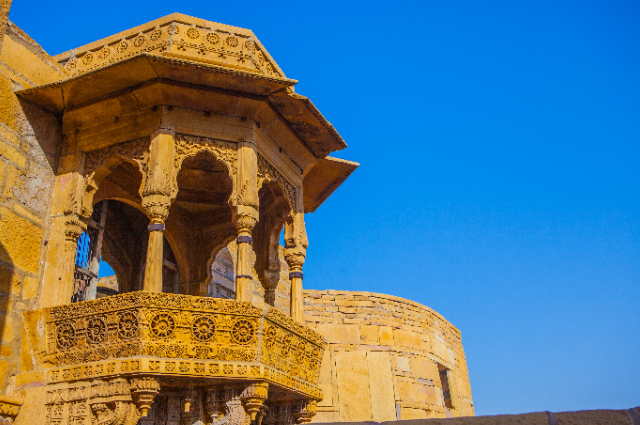
The school is located in the Jaisalmer Thar Desert, also known as the ‘Golden Fort’ for its golden sandstone, which originated in the 12th century and has since been used in building, giving it a golden colour when the sun hits its walls (GoJaisalmer, n.d.)
The Thar Desert, located in western Rajasthan, is about 45km from Jaisalmer. Its temperature is mostly high and dry from April to September, but the cool daytime till sunset from October to March makes it the best place for a Camel Safari (GoJaisalmer, n.d.) It also offers the perfect location to build a school, far away from the community, and sitting in the desert like a monument, erected to pass across a message: women deserve education.
The CITTA, founded by Michael Daube, is a non-profit organisation that supports development in some of the most economically challenged, geographically remote, or marginalised communities in the world (Archello n.d.). The non-profit collaborated with Diana Kellogg of Diana Kellogg Architects and built the first complex of three buildings, which is known as the GYAAN Centre. (Designboom 2021).
It will also consist of The Medha, a performance and art exhibition space with a library and museum, and The Women’s Cooperative, where local artisans will teach mothers and other women weaving and embroidery techniques from the region. (Divisare: The GYAAN Centre n.d.)
The building was named after Rajkumari Ratnavati, a Jaisalmer princess and daughter of Maharawal Ratan Singh, a historical figure tied to Jaisalmer’s royal Bhati dynasty who is remembered for valour and mercy during a historic siege. The 400-capacity building provides the region’s poorest families and ties them to Jaisalmer’s own royal, feminine legacy, turning the building into a continuation of that name rather than a tribute. (Architectural Record, 2021)
The mysterious air conditioning that cools the classroom is a wonder. In an article by Archello, Diana states that “Since the building was built for a non-profit to support girls’ education, every effort was made toward economic design. We needed to incorporate authentic cultural elements, so the Centre was a true representation of the region and its members.
The materials include: sandstone thermal mass for slow heat penetration, lime plaster interiors for cooling, jali lattice walls, the venturi effect where wind speeds up through small gaps, and high ceilings and windows, which provide a stack effect to allow hot air to escape upwards.
In the Style Edition (CNN, 2023), Diana explains the importance of these materials: “There are methods to cool spaces that have been used for centuries. What I did is I put them together in a combination that worked,”. The classrooms were built using the Local sandstone; it is hand-cut by the artisans from the surrounding regions. The sandstone is used for decorative purposes, but it also absorbs the desert heat during the day and takes hours for the heat to travel through it into the classrooms. Before heat would get to a classroom, the sun’s already set.
The sandstone doesn’t work alone in trapping heat; inside the walls is a coat of limestone plaster. It is an ancient material that acts as a cooling system. Since Lime is porous, it will hold onto tiny amounts of moisture, releasing it gradually to pull heat out of the air as it evaporates. It is a similar technique to the skin, except this is a wall.
The Jali are lattice-cut sandstones used to wrap the walls of the building. It has a perforated grid pattern which allows wind to speed up as it passes through it. This is possible with the Venturi effect; a process where air gets forced through small gaps, then picks up speed, turning a light breeze into an industrial air conditioning unit. (Architectural Record, 2021).
The building's oval-shaped structure provides openings which are positioned to let air flow through and cool the interior (Arquitectura Viva, 2023). Its high ceilings and windows provide room for hot air, which rises naturally, to escape. The phenomenon is simple: hot air goes out through the top, while cool air is pulled in from below.
All these materials in the walls work together to provide the building with a cooling system made from stone, plaster, wind, and physics. All with no electricity involved. Solar panels were later added, alongside older vernacular water-harvesting techniques.
While physics and nature might have made up the cooling system of the school, it was the fathers who built it by hand.
For a school designed by women for women, the fathers of the girls attending the school built it from the ground up. It marked their support for the change Michael and Diana were bringing to their part of the country. The uniforms were designed by Sabayasachi Mukherjee to be oversized and last for years. (AIA, 2023)
What's important to note is the building's approach to sustainability. The GYAAN Centre is a three-part centre to blend in architecture, sustainability, and girls' empowerment for generations to come.
A Metalocus article stated that it will equip young women with the tools to further their education and independence, as well as raise awareness surrounding issues Indian women have been facing. Divisare noted that local artisans would work with mothers and other women in the region at The Women’s Cooperative to enhance gender parity in the region.
The School program includes a computer centre and a large terrace. This is a big win for women in the region, and in the CNN Style edition (CNN, 2023), Diana said so herself: “The change in the girls has gone from being quite shy to being these bright lights, devouring whatever kind of information you put in front of them”
This School’s Walls are far from behind; the natural elements working together to provide an environment fit for teaching and learning show the region's expertise and emphasis on how ancient techniques have, from time past, been effective for generations.
References:
- Archello. (n.d.). The Rajkumari Ratnavati Girls' School | Diana Kellogg Architects.
https://archello.com - Architectural Record. (2021, April 30). Diana Kellogg designs Rajkumari Ratnavati Girls School in India. https://www.architecturalrecord.com
- Arquitectura Viva. (2023, December 26). Rajkumari Ratnavati Girls' School, Jaisalmer (India) - Diana Kellogg Architects.
https://arquitecturaviva.com - American Institute of Architects. (2023). AIA award winner: The Rajkumari Ratnavati Girls' School.
https://www.aia.org - CNN. (2023, February 5). Lee, C., How this school in the Indian desert stays cool even in extreme heat.
https://www.cnn.com - Designboom. (2021, April 26). Diana Kellogg completes the Rajkumari Ratnavati Girls' School in rural India.
https://www.designboom.com - Divisare. (n.d.). The GYAAN Centre - Rajkumari Ratnavati Girls School.
https://divisare.com - GoJaisalmer. (n.d.). Jaisalmer: Desert safari & camping in Thar Desert, Rajasthan, India.
https://www.gojaisalmer.com - Metalocus. (n.d.). An oasis of freedom. Rajkumari Ratnavati Girl's School by Diana Kellogg Architects.
https://www.metalocus.es. . .