
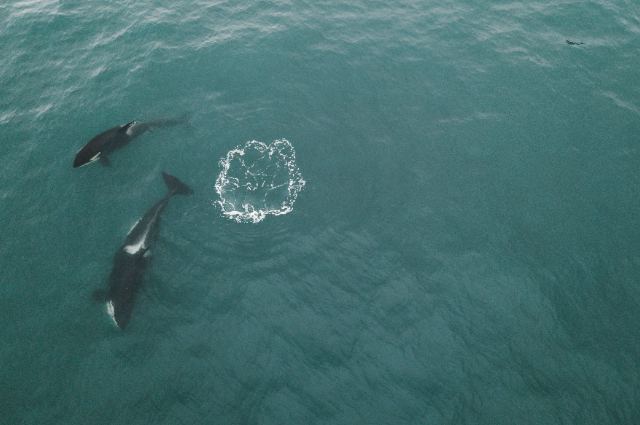
The blue whale is the largest animal to have ever lived on our planet, and it is hard to fathom its sheer size without using comparisons. A large blue whale can reach a length of around 110 feet and weigh up to 330,000 pounds, according to the National Oceanic and Atmospheric Administration (NOAA) Fisheries. In other words, it can be as long as a basketball court and weigh around 150 metric tonnes. However, an animal of this size has a surprisingly small diet, mainly consisting of tiny, shrimp-like creatures called krill.
The blue whale belongs to the baleen whale family, meaning that, unlike toothed whales, it does not use teeth to catch and chew large prey. Instead, it has hundreds of baleen plates hanging from its upper jaw, which allow it to filter water and capture krill. When it encounters a dense swarm of these crustaceans, the whale opens its enormous mouth and takes in a large amount of water and krill. It then pushes the water back out while keeping the krill inside. A blue whale can eat several tonnes of krill in a day during feeding periods; NOAA estimates that some may consume up to six tons per day.
This feeding method helps explain a common misconception about blue whale biology. Blue whales do not feed directly on microscopic phytoplankton, which are single-celled photosynthetic organisms that act as primary producers in many marine ecosystems. Instead, phytoplankton form the basis of the food supply for many sea animals, including krill. It takes a food chain to get from sunlight to the blue whale’s diet.
Phytoplankton also play an important role in producing oxygen on our planet. They generate a large share of the oxygen produced through photosynthesis, and NOAA estimates that about half of Earth’s oxygen production comes from the ocean. However, this does not mean blue whales are responsible for producing half of Earth’s oxygen. The connection is indirect: energy moves from sunlight to phytoplankton, then to krill and, eventually, to the blue whale.
Another part of the blue whale’s food chain is what happens after it feeds. Marine biologists have studied how marine mammals move nutrients through the ocean. In 2010, a study published in the scientific journal PLOS ONE described this process as the “whale pump.” Marine mammals can feed in deep or nutrient-rich waters and then return to the surface to breathe and release waste. This waste can carry nutrients into sunlit waters, where they may support microscopic organisms. The Gulf of Maine study estimated that marine mammals could recycle around 23,000 metric tonnes of nitrogen into the sunlit waters each year—more than the amount carried into the local ecosystem by rivers.
Iron also plays an important role in the food web. It is needed by phytoplankton, but in some parts of the ocean it is scarce enough to limit growth. The Southern Ocean, for instance, is known for its low iron availability, and adding iron to certain waters has been found to increase phytoplankton productivity. In a 2010 study of baleen whale faeces published in Marine Ecology Progress Series, researchers reported iron concentrations roughly ten million times higher than those in the surrounding Antarctic seawater. This refers to the concentration of iron in the faeces, not a ten-million-fold increase in phytoplankton. The finding suggests that whale waste can be a source of a nutrient that is scarce in parts of the Southern Ocean.
The connection between whales and ocean productivity is worth considering, but it should not be used to present whale conservation as a complete solution to climate change. Whales store carbon in their bodies, and when a whale dies and sinks into the deep ocean, some of that carbon can remain away from the atmosphere for a long time. Their movements and waste can also influence nutrient cycling and phytoplankton growth. However, scientists are still studying how large the overall long-term climate effect is. It is more accurate to describe blue whales as an important part of the wider marine ecosystem than as a solution to climate change on their own.
The blue whale’s history also shows how human activity has affected marine life. It has been estimated that around 1.3 million blue, fin and humpback whales were killed in the Antarctic during the twentieth century. Blue whales became especially vulnerable when industrial ships and modern harpoon guns made large-scale hunting possible. The International Whaling Commission, an intergovernmental organisation established to conserve whale populations, has protected blue whales from commercial hunting since 1966. Today, the IWC estimates that Antarctic blue whale numbers remain far below their pre-whaling levels.
The Antarctic population has been studied extensively, providing more information about blue whale numbers over time. The IWC estimates that there may have been between 168,000 and 276,000 Antarctic blue whales before industrial whaling. Its 2024 estimate puts the population at around 4,000, although there is considerable uncertainty around that figure. The population has increased since commercial whaling ended, but it remains far below its estimated historical level. Blue whales also face modern threats, including ship strikes and entanglement in fishing gear. Changes in krill availability may affect the food supply on which these whales depend.
The blue whale’s sheer size is undoubtedly part of what fascinates us about it. However, it sits near the top of a food chain that begins with much smaller organisms, which are often overlooked despite their importance to marine ecosystems. Because blue whales feed on krill, their survival is closely linked to the conditions that affect these tiny shrimp-like creatures. Whale waste can also return nutrients to the water, supporting organisms lower down the food chain. In this way, the life of one of the largest animals on Earth is connected to the smallest parts of the marine ecosystem.
References:
- NOAA Fisheries — Blue Whale
- NOAA Ocean Service — How Much Oxygen Comes From the Ocean?
- PLOS ONE — The Whale Pump
- Marine Ecology Progress Series — Iron in baleen whale faeces
- International Whaling Commission — Antarctic Blue Whale Research
- International Whaling Commission — Blue Whale