
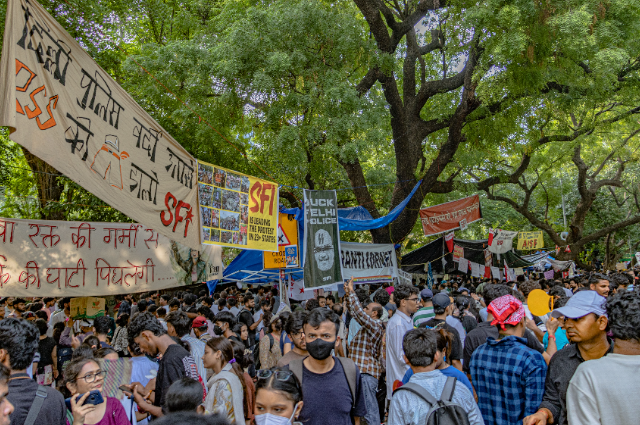
Neha Bora participated in a 23-day hunger strike with other student activists at the Jantar Mantar in Delhi, protesting the NEET-UG leak. Meanwhile, Ladakhi activist Sonam Wangchuk protested at the main stage for the Cockroach Janta Party (CJP) protest, standing just a few metres away.
Bora, a 29-year-old national president for the All-India Students’ Association (AISA), a Left student group associated with the Communist Party of India (Marxist-Leninist) Liberation, went on a hunger strike when she found out Wangchuk was participating in the CJP protest. She explained in an interview with The Indian Express, “We decided to go on a hunger strike to demand resignation of Union Education Minister Dharmendra Pradhan.”
Hunger strike:
The hunger strike was a protest for the leak of papers in the NEET-UG 2026 exams, causing issues with competitive exams across the country. Two other protestors were admitted to hospital, but by July 20, three people had gone on a 23-day hunger strike, including Bora. They were persuaded to stop by opposition MPs and civil society leaders.
Bora explained that Wangchuk inspired her. During the protest, she explained in an interview with The Indian Express that she admired how Wangchuk, an older activist, managed to withstand the heat and humidity. However, there was a distinct difference in the protests between Wangchuk and Bora, as Wangchuk was on the main stage for the CJP and Bora, along with her AISA members, went on a hunger strike.
Dharmendra Pradhan resigned on July 25 after months of public outrage about the NEET controversy and constant protests from the CJP and other student groups. However, it is an oversimplification to say that it was due to one individual, organisation or even just the hunger strike. The hunger strike was just one part of a much larger movement.
Background as Student Activist:
Bora was brought up in Khatima, Uttarakhand, with an army background. She moved to Delhi to continue her education. She studied sociology at Hindu College, University of Delhi, before going on to postgraduate studies at Dr B. R. Ambedkar University Delhi. She is currently a Doctoral Scholar at Jawaharlal Nehru University School of Arts and Aesthetics, and her specialism is theatre and performance studies.
Bora’s passion for theatre led her to get involved with politics. In an interview with The Indian Express, she explained that she was introduced to a political theatre group when a senior at Delhi University recommended it. She became involved with Sangwari, a street theatre group. By performing plays on social issues, she became involved with activism. She became involved with the protests about the Citizenship (Amendment) Act in 2019.
This means that she has become well-known for her speaking, street protesting and organising. AISA organise campaigns about issues affecting students. Her issues have started to gain more recognition as they have become part of the national conversation around the reliability of entrance and recruitment exams.
Police accountability:
Since the July protest, Bora has raised issues about police accountability. On August 1, she explained to PTI that AISA are asking for the resignation of Union Home Minister Amit Shah and removal of Delhi Police Commissioner Anurag Kumar due to police actions on July 20. This is a political stance rather than conclusions made from an independent investigation.
She became involved with student protests in Jharkhand due to alleged malpractice in recruitment exams from the Jharkhand Public Service Commission and Jharkhand Staff Selection Commission. On August 7, an ink protest disrupted a protest towards the state Assembly in Ranchi. News reports mentioned that a man was arrested for allegedly splashing ink on her.
Arrest:
Bora became a prominent figure in protests calling for the resignation of Chief Election Commissioner Gyanesh Kumar due to alleged malpractice in the Special Intensive Revision of electoral rolls. Protests happened in Delhi and Mumbai with AISA and other student and civil society groups.
On October 4, Bora was arrested whilst demonstrating in central Delhi. She was released, but AISA claimed that she was arrested in a private or unauthorised vehicle and was not handed back her phone or bag. However, Delhi Police denied she was in a private vehicle. ThePrint mentioned that a senior police official confirmed she was in a government vehicle and taken to Narela.
A week later, her name became well-known due to a mix-up. On October 11, police at RK Ashram arrested a woman they believed to be Bora. However, the real Bora was not present and was arrested later on, close to Vijay Chowk, whilst walking around with the protestors in Connaught Place. This mix-up became known as the two Nehas incident. It shows how quickly videos and updates on social media can go viral.
Student Leader:
Whilst Bora has gained support, she may have also received some criticism. Some may not agree with her political views as AISA is a left-wing group. Others may not like the aggressive language used during the protests. Words like anti-national should not be repeated as facts without clear sources and evidence.
Although Bora shone a light on herself due to the hunger strike with Wangchuk, she has had a long journey to get to where she is. She has studied at university, got into theatre and become a student activist. Being on a hunger strike with an older activist over a shared cause made her stand out. However, she has also become involved with other protests, showing that her concerns are wider than just one exam issue.
Overall, will the demands for reliable exams, transparency in recruitment, police accountability and meaningful protest rights for students lead to any lasting changes in institutions? Bora’s story is continuing, and the significance of her actions will depend on what happens after the protests.
References:
- The Indian Express, interview with AISA president Neha on the 23-day hunger strike (27 July 2026) https://indianexpress.com
- Reuters, background on the CJP protests and Dharmendra Pradhan’s resignation (22 July 2026) https://www.reuters.com
- The Indian Express, Dharmendra Pradhan’s resignation amid student protests (25 July 2026) https://indianexpress.com
- Hindustan Times/PTI, Bora’s comments on paper leaks and Jharkhand protests (11 August 2026) https://www.hindustantimes.com
- The Indian Express, alleged ink attack during Jharkhand jobs protest (7 August 2026) https://indianexpress.com
- The Deccan Chronicle/PTI, AISA’s demands for Amit Shah and Delhi Police Commissioner accountability (1 August 2026) https://www.deccanchronicle.com
- ThePrint, detention and conflicting accounts about vehicle and belongings (4 October 2026) https://theprint.in
- The Indian Express, mistaken-identity episode involving Bora’s lookalike (11 October 2026) https://indianexpress.com
- The Times of India, profile of Bora’s education and theatre background (13 October 2026) https://timesofindia.indiatimes.com