
The 4B movement is a Korean feminist movement built around four forms of refusal: no marriage, no childbirth, no dating and no sexual relationships with men. The four terms are bihon, meaning not marrying; bichulsan, meaning not giving birth; biyeonae, meaning not dating; and bisekseu, meaning not having sex. Although the movement is often presented internationally as a decision by women to avoid relationships with men, its origins are connected to much wider debates in South Korea about gender inequality, marriage, motherhood, work, violence and the expectations placed on women. For some participants, these choices are decisions about how they want to live. For others, they represent a form of protest against structures that they believe place unequal responsibilities on women.
The movement developed within South Korea's changing feminist environment during the 2010s. Online feminist communities became important spaces for young women to discuss issues that were difficult to address through traditional organisations. The 4B movement became more visible alongside feminist campaigns, including the Escape the Corset movement, which challenged conventional beauty standards. Academic research published in the Journal of Gender Studies describes 4B as emerging among Korean feminists as a response to expectations surrounding marriage, reproduction and heterosexual relationships. Researchers Jieun Lee and Euisol Jeong describe it as both a criticism of South Korea's pronatalist policies and a way for women to imagine futures that did not depend on marriage or motherhood.
The four principles are closely connected. They do not all mean the same thing for every person who identifies with the movement. Someone following 4B may reject marriage because of concerns about domestic responsibilities, while another person may focus more on avoiding pregnancy or heterosexual relationships. The movement is therefore better understood as a collection of practices and ideas rather than a formal organisation with membership cards, a central leadership, or one agreed programme. A 2021 Korean academic study similarly describes 4B as a movement that spread among women in their twenties and thirties and connected the four refusals with a rejection of expectations about women's roles.
One important reason 4B developed in South Korea is the country's gender and family environment. South Korea has experienced low fertility for years while marriage and childbirth have traditionally been closely connected. Government policy has often focused on encouraging people to have children. Some feminist activists have argued that such policies do not sufficiently address the conditions that make marriage and parenthood difficult for many women. These conditions include the distribution of domestic work, career interruptions associated with motherhood, and wider concerns about gender inequality. Academic research on 4B describes the movement as a response to what participants saw as pressure to follow a predetermined life path of education, employment, marriage and motherhood.
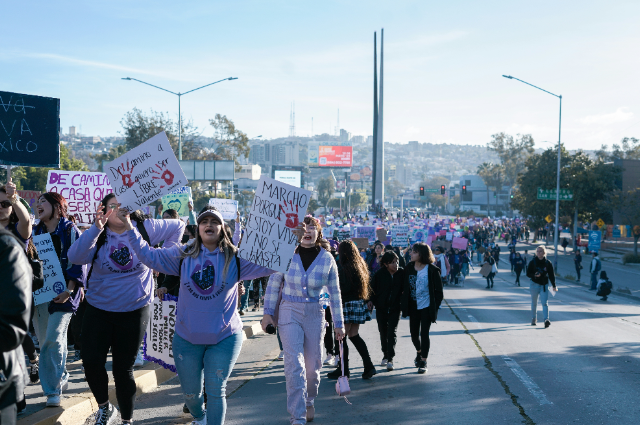
The issue of violence has also been important in the Korean feminist movement. The 2016 murder of a woman near Gangnam Station became a major moment in South Korean feminist activism after the perpetrator reportedly said he had targeted her because women had ignored him. The incident triggered public discussions about violence against women. In the years feminist activists also organised against hidden-camera crimes and other forms of digital sexual exploitation. According to research published in 2026, more than 300,000 women participated in a series of anti-spycam protests in 2018. These campaigns created an environment in which personal decisions about relationships could also be discussed as responses to concerns about women's safety and treatment.
Digital technology has played a role in the movement's development. Unlike political movements that depended heavily on formal organisations, 4B-related discussions have often taken place through online communities and social media. This made it easier for women to exchange experiences, discuss relationships, and question expectations without necessarily joining a formal feminist organisation. Research on Korean 4B describes platforms such as X, Instagram and YouTube as spaces for creating a shared identity and spreading feminist ideas. The internet also made it possible for people outside South Korea to encounter the movement and interpret it through their social and political circumstances.
This international spread became particularly noticeable in the United States after the 2024 election. Social-media discussions about adopting practices received increased attention after Donald Trump's victory, with videos and posts encouraging women to reconsider marriage, dating and relationships with men circulating on platforms such as TikTok. However, the American version of the conversation should not be treated as identical to the South Korean movement. The social conditions that produced 4B in South Korea are different from those in the United States. Researchers have therefore described the spread as a process of adaptation in which people take an idea developed in one country and give it new meanings in another.
This distinction is important because some online discussions presented the popularity of 4B as though large numbers of women had suddenly joined an organised movement. There is less evidence for that interpretation than there is for increased online visibility. Social-media posts can spread rapidly without showing how many people change their behaviour. A viral hashtag or video can therefore demonstrate interest without proving the size of an organised movement. This is one reason researchers studying the 4B phenomenon distinguish between digital visibility and actual participation.
Another complicated issue concerns the movement's relationship with transgender people. Some strands of radical feminism have developed strongly sex-based ideas about who should be included in women's movements. Academic research published in 2026 examines the growth of trans exclusionary feminist ideas in South Korea and notes connections between some online feminist communities and campaigns concerning transgender women. However, this does not mean that every person who supports 4B holds trans-exclusionary views. Research on the movement also warns against treating the people associated with 4B as a single group. The relationship between 4B and trans-exclusionary feminism is therefore an area of debate rather than a simple description that applies equally to every participant.
There is also a question about whether 4B should be understood primarily as activism or as personal lifestyle choice. Supporters can view refusing marriage, dating, sex or childbirth as a way of withdrawing participation from systems they consider unequal. From this perspective, private decisions can have meaning when many people make similar choices. Academic research has described this as a form of refusal, where women challenge expectations by choosing not to follow a socially prescribed path.
Critics, however, question whether individual withdrawal can produce change. Choosing not to marry or have children may allow an individual to control her life, but it does not automatically change workplace discrimination, domestic labour arrangements, violence against women or government policy. This creates the debate surrounding 4B. Is refusing participation itself a meaningful form of protest, or does lasting social change require participation in institutions and collective political action? There is no answer accepted by everyone involved, and the movement continues to be interpreted differently by researchers, activists and commentators.
South Korea's continuing gender and demographic challenges make the debate especially relevant. The country has one of the world's lowest fertility rates, while young people face high housing costs, demanding work environments and changing attitudes toward marriage. Women are also increasingly questioning whether traditional family arrangements provide opportunities for both partners. In this context, 4B can be seen not as a feminist movement but also as part of a much larger debate about what adulthood, relationships and family life should look like in modern South Korea.
The international attention surrounding 4B has therefore brought both its ideas and its limitations into the spotlight. Its four principles are easy to understand, which helps explain why the concept can spread quickly in the media. The movement's original meaning is tied to specific Korean social conditions, including gender inequality, reproductive expectations, digital sexual violence and debates about marriage. Applying the framework to another country can produce very different meanings.
Ultimately, the 4B movement sits between choice and collective protest. A woman choosing not to marry, date, or have sex. Having children can make that decision for deeply personal reasons, while the same choice can also be understood as part of a wider social movement when it is connected to shared criticism of gender expectations. The movement's growing international visibility has raised these questions widely discussed, but it has also created debates about representation, inclusion and whether online visibility translates into real-world social change. Then, being simply a trend on social media, 4B is best understood as part of a continuing debate about women's autonomy, relationships, family expectations and the changing meaning of feminism, in the digital age.
References:
- Lee, Jieun & Jeong, Euisol. “The 4B Movement: Envisioning a Feminist Future With/In a Non-Reproductive Future in Korea.” Journal of Gender Studies, 2021. University of Yonsei/research record
- Han, Woori. “The Rise of Trans-Exclusionary Feminism in South Korea: Popular Feminism and the Mediation of Women's Bodies.” Feminist Media Studies, 2026. Taylor & Francis research article
- Kim, Jinsook. “The Return of Global Sisterhood? The Transnational Journey of the 4B Movement on TikTok.” Flow Journal, 2025. Flow Journal article
- “Feminist Refusal: 4B and the Rejection of Scripted Womanhood in South Korea.” Plurality, University of Edinburgh, 2026. University of Edinburgh — Plurality
- Singh Gujjar, Ankita. “When Women Withdraw: The Global Politics of Refusal — Feminist Resistance, Digital Diffusion, and the Transnational Life of 4B.” Yale Journal of International Affairs, 2025. Yale Journal of International Affairs