
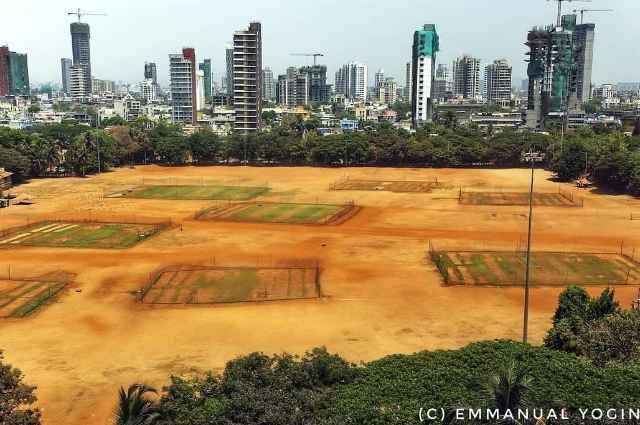
On October 2, Gandhi Jayanti, in Shivaji Park, Mumbai, a protest began, which was meant as a challenge to the Election Commission and later drew the authority of the police. Cockroach Janta Party (CJP) founder Abhijeet Dipke called a Jail Bharo' protest demanding chief election commissioner Gyanesh Kumar's resignation and a stay of the Special Intensive Revision (SIR) of electoral rolls, which the party claimed could result in eligible voters being excluded. The Election Commission has denied any claims that the SIR is being used to manipulate rolls.
They held the demonstration regardless of the Mumbai Police's denial of permission. Beforehand, the police had cited a 2013 Bombay High Court order which barred the use of Shivaji Park for anything other than sporting activity, a lack of civic permission to use the ground and the noise, traffic and proximity to hospitals as reasons for the denial. The organisers challenged the denial and argued their case as a non-violent assertion of the right to protest, and it was this clash between the state's authority to regulate and protect that set the scene for October 2.
On October 3, police registered a First Information Report (FIR) following a complaint from Shivaji Park resident and advocate Siddhi Deolekar. Following media reports, the case names Dipke and CJP leaders Ashutosh Ranka, Saurav Das and Ratna Singh. It charges that the organisers went ahead despite a denial of permission and with a large turnout in a residential area. A complaint is not a conviction; the truth of the allegations needs to be established through a police investigation.
Besides, the police registered a case involving the organisers and between 400 and 500 unnamed people, according to reports quoting an officer. The FIR refers to allegations of unlawful assembly, disobedience of a lawful order and obstruction of traffic, along with the Maharashtra Police Act. As of the initial reports on October 3, police said no one had been arrested and that further investigation was ongoing. An FIR provides the basis for investigating allegations; it does not establish guilt.
The size and tone of the protest made it more than a typical political rally. Photos and stories tell of young protesters displaying witty placards, memes and film references along with messages supporting voting rights and the Election Commission. Actor Naseeruddin Shah and musician Vishal Dadlani were among the celebrities reported as attendees; actor Shabana Azmi was also in attendance. The presence of familiar faces added to the profile of a protest which, beyond the party's supporters, had few obvious champions. At the same time, a celebrity turnout or a large crowd cannot resolve the issues at the heart of this dispute.
In the wake of the protest, Dipke expressed his gratitude to the Mumbai Police for their conduct on the day and criticised the Delhi Police's conduct of separate demonstrations in the capital. He highlighted the contrast which the organisers themselves drew between the two
cities. In Delhi, Congress, Aam Aadmi Party, left groups and student and civil society organisations had gathered at Jantar Mantar on the SIR. Rahul Gandhi extended his support to youth-led protests. The events in Mumbai and Delhi were part of the same story in different cities.
A rival group, Gen Next Mumbai, also turned up on the occasion. This was a sign that the SIR was a matter of public concern in more ways than one. To some, the protests represented a legitimate expression of demands for transparency; to others, the very idea of repeated large gatherings represented an unacceptable disturbance in residential areas. To put it another way, Shivaji Park is a public space but a park which is part of a residential area, and disruption to traffic and access to hospitals are matters which affect anyone who lives or works in the vicinity.
This, perhaps, is the significance of Deolekar's complaint. A resident's objection to a protest is not necessarily an argument against the protest's objectives. Equally, the organisers' assertion of a constitutional right to protest does not automatically override considerations of convenience and safety. What matters are the facts: what permissions were needed, what orders applied, whether there was a breach of those orders, what disruption was caused and whether the police dealt with the situation appropriately. The facts will emerge through investigation; they should not be inferred from assumptions about the intentions of either side.
The larger issue continues to be the Special Intensive Revision of electoral rolls. The Election Commission claims that revisions are needed to ensure the rolls are accurate, whilst the opposition parties and activists allege that eligible voters will be excluded. These are serious charges which require answers, whether in the form of assurances that no eligible voter will be excluded or detailed explanations of how the Commission intends to deal with complaints of errors on the rolls.
The protest in Mumbai provided an outlet for such concerns, and the complaint against the organisers raises a separate but related issue: what constitutes acceptable conduct in making such a protest. That investigation should proceed on its own merits, without preconceptions about either side's case. Only then will the public be in a position to judge the protest on its own merits.
The events of October 2 left two matters in the public eye. One is the question of the integrity of India's voter rolls and the confidence which citizens have in the Election Commission to safeguard that integrity. The second is the responsibility which political parties have when they decide to stage a protest in a residential area. A functioning democracy requires open debate and the ability of all sides to make their cases, and to hold each other to account if and when they fail that responsibility. What happens next will be for the police, the named organisers and, eventually, the public to decide.
References:
- Mid-day, “CJP protest in Mumbai: FIR against Abhijeet Dipke, 400-500 unidentified protesters” (4 October 2026) https://www.mid-day.com
- The Times of India, “CJP’s Mumbai protest: FIR against party supporters for unlawful assembly, traffic disruption” (3 October 2026) https://timesofindia.indiatimes.com
- The Indian Express, “Police deny CJP permission to protest at Shivaji Park on Oct 2” (28 September 2026) https://indianexpress.com
- Reuters, “Hundreds from India’s Gen Z-led ‘cockroach’ party protest, seek election chief’s resignation” (2 October 2026) https://www.reuters.com
- The Tribune / PTI, “CJP protest at Shivaji Park: FIR registered against organisers, 400-500 unidentified persons” (3 October 2026) https://www.tribuneindia.com