
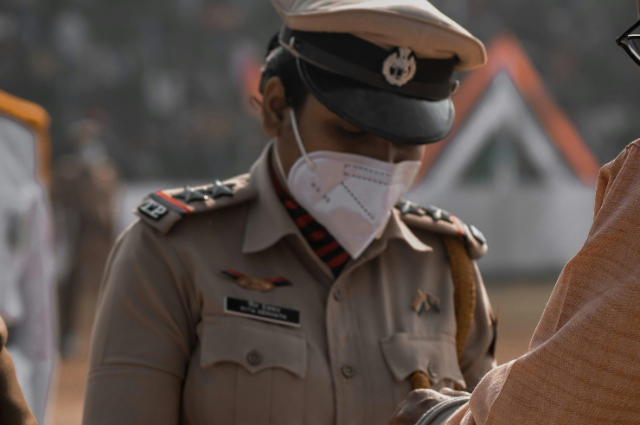
D. Roopa Moudgil is from the 2000-batch Indian Police Service and belongs to the Karnataka cadre. She is known for her high-profile assignments, controversial cases and frequent transfers that have often come together during her career. She gained widespread attention after raising allegations about special treatment given to jailed AIADMK leader V. K. Sasikala in Bengaluru in 2017. Years later, she was the subject of public attention again during her dispute with IAS officer Rohini Sindhuri. Another controversy came up in March 2025, after her transfer from the Internal Security Division to the post of Managing Director of the Karnataka Silk Marketing Board Limited. The latest transfer brought renewed attention to an unusual career marked by repeated changes in posting.
Roopa cleared the UPSC Civil Services Examination in 2000 with an All-India Rank of 43. While that rank could have allowed her to pursue the Indian Administrative Service, she opted for the IPS because she was interested in policing. Her interest in the uniform had developed during her years in the National Cadet Corps, and she has also spoken about being inspired by Kiran Bedi, India's first woman IPS officer. Her background was not limited to academics. She trained in Bharatanatyam and Hindustani classical music and later became one of the better-known women officers in the Karnataka police. The Indian Express has described her as Karnataka's first woman IPS officer, while other reports more specifically describe her as the first woman Kannadiga IPS officer to serve in the Karnataka cadre.
One of the earliest incidents that drew her attention came in 2007, when she served in Madhya Pradesh. She arrested then-Chief Minister Uma Bharti for an old rioting case, after a court order. The incident was one of the frequently cited episodes of her early career, because it involved action against a sitting chief minister. Later, during her time as Deputy Commissioner of Police in Bengaluru's City Armed Reserve, she acted against the unauthorised deployment of police personnel and vehicles for politicians and VIPs. In an account she later gave publicly, Roopa said she identified 82 politicians who had 216 gunmen beyond their authorised entitlement and began withdrawing the excess personnel.
Roopa also became the first woman police officer to head the cybercrime division in Karnataka, according to multiple profiles of her career. Her work in cybercrime, economic offences and other specialised assignments helped establish her as an officer who had served in areas outside conventional law-and-order policing. She received the President's Police Medal for Meritorious Service in 2016, an award that has also been highlighted in profiles of her career.
The episode that changed her public profile came in 2017. In June that year, Roopa became the Deputy Inspector General of Prisons in Karnataka. Within weeks, she submitted a report of irregularities at Bengaluru's Parappana Agrahara Central Prison and alleged that Sasikala, who was serving a sentence there, had received preferential treatment. Roopa's report also alleged that around ₹2 crore had been paid to prison officials for providing special facilities. These were allegations contained in her report, rather than findings that should automatically be treated as proven facts. The government ordered an inquiry into the matter, and Roopa was transferred from the prisons department to the Traffic and Road Safety post.
The timing of that transfer became an important part of the public discussion around Roopa's career. She had joined the prisons post only shortly before the controversy and was moved out after submitting the report. Some later profiles described her tenure as only around 17 working days. The more consistently documented point is that her stint was very short and that she was moved out shortly after making the allegations. The government cited that the transfers of Roopa and another senior prison official were related to maintaining the integrity of the inquiry into the allegations.
Frequent transfers subsequently became a recurring feature of discussions about Roopa. Reports have variously described her as having been transferred more than 40 times during more than two decades of service. Roopa herself acknowledged in a 2019 interview that she had been transferred over 40 times, while explaining that transfers were a part of government service and that she generally chose to work wherever she was posted. Importantly, not every transfer can automatically be attributed to a disciplinary action or disagreement with the government; some were ordinary administrative changes, promotions or new assignments.
Another major controversy came up in February 2023, when Roopa and IAS officer Rohini Sindhuri became involved in a highly publicised dispute. The two officers exchanged allegations, with Roopa making several claims about Sindhuri's conduct and Sindhuri rejecting them. The controversy also involved photographs and communications dating back to 2021 and 2022, which is why some accounts connect the dispute to those earlier years. However, the major public confrontation took place in 2023, not 2021. The Karnataka government eventually transferred both officers from their respective posts, without immediately giving them new postings.
The dispute did not end with the transfers. Legal proceedings followed, including a defamation-related case between the two officers. In 2023, the Karnataka High Court dealt with proceedings involving Roopa and Sindhuri, and the matter continued through the courts. In 2026, the Supreme Court allowed Roopa access to certain call-detail records in connection with the continuing legal dispute. This later development shows that the 2023 confrontation was not a short-lived administrative disagreement but evolved into a longer legal battle.
The controversy that led to Roopa's latest major transfer started in 2025. While she served as Inspector General of Police in the Internal Security Division, she became the subject of a complaint from DIG Vartika Katiyar, a 2010-batch IPS officer. Katiyar alleged that two junior police personnel had entered her office during her absence and planted confidential documents there, at Roopa's direction. The complaint was submitted to Karnataka's Chief Secretary in February 2025. These claims were allegations made by Katiyar and disputed by Roopa. Roopa described the allegations as false and baseless and argued that, as a senior officer, she already had official access to files and therefore had no reason to secretly plant them in another officer's office.
The government subsequently transferred both officers. On March 5, 2025, Roopa was transferred from the Internal Security Division and appointed Managing Director of the Karnataka Silk Marketing Board Limited in Bengaluru. The government order stated that the post was equivalent in status and responsibilities to the relevant Inspector General-level cadre post. Katiyar was also transferred to another assignment. Therefore, the Silk Board posting was not itself a finding that Roopa had committed the conduct alleged in the complaint, but it was an administrative transfer that followed the dispute and complaints between the officers.
The Silk Board role also gave Roopa a very different administrative environment from the police and internal-security assignments that had defined much of her career. After taking charge, she publicly described the silk sector as involving farmers, cocoon markets, reelers and weavers, and spoke about the organised and computerised nature of Karnataka's silk cocoon marketing system. Her appointment was therefore another shift in responsibilities rather than an end to her government career.
Roopa Moudgil's career is difficult to summarise in a single description. Her supporters often refer to episodes such as the action against unauthorised security personnel and her 2017 prison report as examples of an officer willing to raise difficult issues. At the same time, her career has also included disputes with other officials, investigations and allegations against her that she has denied. The available record therefore contains both documented administrative actions and contested claims, and separation of the two is important when examining her career.
Her move to the Karnataka Silk Marketing Board after the 2025 complaint is the latest chapter of that pattern of changing assignments. Whether viewed through the lens of policing, administration or the debate over frequent transfers of senior civil servants, Roopa's career illustrates how a government officer can move through very different responsibilities over the course of two decades. The controversies surrounding her are part of that story, but so are the official positions she has held, the awards she has received and the administrative work she has undertaken after each new posting.
References:
- The Indian Express — Profile of D. Roopa and her early career
- The Indian Express — D. Roopa's account of women in policing and her UPSC background
- India Today — 2017 transfer after the Sasikala prison allegations
- The Indian Express — 2017 transfer and inquiry into prison allegations
- The News Minute — 2025 complaint by Vartika Katiyar
- NDTV — Roopa's 2025 transfer to Karnataka Silk Marketing Board
- The Indian Express — 2023 Roopa–Rohini Sindhuri dispute and transfers
- Hindustan Times — 2026 Supreme Court development in the Roopa–Sindhuri legal dispute