
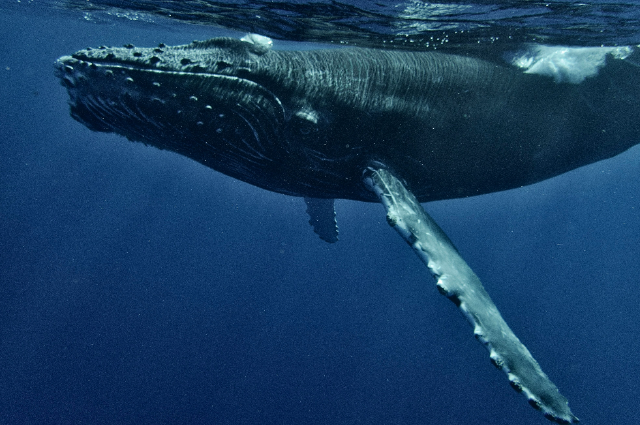
A Giant That Still Amazes Me
I’ve always found the blue whale hard to wrap my head around. It is the largest animal that has ever lived on Earth — bigger than any dinosaur we’ve found so far. An adult can reach nearly 100 feet in length and weigh as much as 200 tons. Its heart is roughly the size of a small car, and the main blood vessel leaving that heart is wide enough that a person could crawl through it. When I first read those numbers, I kept checking them because they sounded too extreme to be real. Yet they are measured and documented. These animals still swim in our oceans today, even if their numbers are a fraction of what they once were.
What I find even more striking is that the real power of the ocean for the climate and for the air we breathe does not come from these giants. It comes from something far smaller. Phytoplankton — microscopic, plant-like organisms that drift near the surface — produce an estimated 50 to 80 per cent of the oxygen in Earth’s atmosphere. That is more than all the forests on land combined. They also pull vast amounts of carbon dioxide out of the air. The blue whale and these tiny organisms are linked in a way that researchers call the whale pump, and that link is what makes the story interesting to me.
How the Whale Pump Works
Blue whales and other large whales feed deep in the water column, often on dense swarms of krill. Then they return to the surface to breathe. While they are at the surface, they release waste that is unusually rich in nutrients, especially iron. In many open-ocean regions, iron is scarce and limits how much phytoplankton can grow. Whale feces can contain iron at concentrations up to 10 million times higher than the surrounding seawater. That concentrated fertiliser lands exactly where the phytoplankton live — in the sunlit upper layer of the ocean.
The result is a boost in phytoplankton growth. More phytoplankton means more photosynthesis, more oxygen released into the water and atmosphere, and more carbon dioxide taken up from the air. Some of that carbon eventually sinks toward the deep ocean when the plankton die or are eaten, and their remains fall. Scientists have described this as a natural fertilisation system. Whales are not just living in the ocean; they are helping keep parts of it more productive than they would otherwise be.
I think this is one of those quiet ecological processes that is easy to overlook. We tend to notice the big, visible animals. We pay less attention to the microscopic ones that actually do the heavy lifting for oxygen and carbon. The whale pump connects the two.
What Whaling Did to the System
Commercial whaling in the nineteenth and twentieth centuries reduced most great whale populations to a small fraction of their historical size. Blue whales were hit especially hard. Because the whale pump depends on the number of whales moving nutrients to the surface, that decline meant the fertilisation system now runs at a much lower capacity.
Researchers have tried to estimate what that loss means for carbon. Some studies and assessments have linked the combined effects of whale populations — through both the pump and the carbon stored in their own bodies and in sinking carcasses — to amounts of carbon capture that can be compared to the scale of major forests. One often-cited framing is that the role of phytoplankton, which whales help support, is equivalent in carbon terms to several Amazon rainforests. Exact numbers vary by study, but the direction of the finding is consistent: more whales tend to mean more support for the processes that remove carbon from the atmosphere and produce oxygen.
I do not want to overstate the case. Restoring whale populations will not single-handedly solve climate change. The amounts involved are meaningful at the scale of certain ocean regions, but they are still small compared with total global emissions. Still, the point is that whale conservation is not only about protecting a charismatic species. It is also about restoring a natural process that helps the ocean do part of its climate and oxygen work.
Why This Matters Beyond the Numbers
When I put all of this together, what stands out is the contrast in scale. The blue whale is the biggest animal we know. Its heart is the size of a car. Yet the real leverage for the atmosphere comes from organisms you need a microscope to see. The whales help those organisms by moving nutrients to the right place at the right time. That is a form of climate service that evolved long before humans started worrying about carbon dioxide.
Conservation efforts that protect and rebuild whale populations therefore carry a double benefit. They give a chance of recovery to animals that were driven nearly to extinction. They also strengthen a natural fertilisation pathway that supports phytoplankton, oxygen production, and carbon uptake. This is one of the quieter ways to support the climate system. It does not require new technology. It requires letting the animals that already perform the service return toward their former numbers.
Of course, whales face other pressures today — ship strikes, entanglement in fishing gear, noise, and the effects of a changing ocean. Protecting them is not simple. But the science around the whale pump gives an additional reason to treat that protection as more than a single-species issue.
My Own Takeaway
I started with the size of the blue whale because that is what first grabs attention. The heart the size of a car, the length of a basketball court, the weight of dozens of elephants — those facts stick in the mind. But the deeper story is the connection between that giant and the microscopic phytoplankton that produce most of the oxygen we breathe. The whale pump is the link. Whales dive, feed, surface, and fertilise. Phytoplankton bloom more strongly where the nutrients arrive. Carbon is taken up. Oxygen is released. The system works better when there are more whales.
Commercial whaling broke much of that system. Recovery is still incomplete. If we succeed in bringing whale numbers back up, we will not only be saving a remarkable animal. We will also be restoring a natural process that quietly supports the air we breathe and the climate we depend on. That is why, for me, the blue whale is more than the biggest animal in the ocean. It is one of the quiet partners in keeping the planet’s living systems running.
References:
- Britannica. “Blue whale.” Encyclopædia Britannica.
- World Wildlife Fund. “What makes whales fin-tastic nature champions.” WWF stories on whales, phytoplankton, and the whale pump.
- Roman, J., et al. “The Whale Pump: Marine Mammals Enhance Primary Productivity in a Coastal Basin.” PLOS ONE, 2010.
- National Ocean Service / NOAA. Estimates of oxygen production by oceanic plankton.
- University of Washington News. “Whale poop contains iron that may have helped fertilise past oceans,” February 2025.
- International Labour Organisation / related assessments. Frameworks valuing carbon sequestration linked to cetaceans and phytoplankton.
- IFAW. “How whale poop and phytoplankton fight climate change.”