
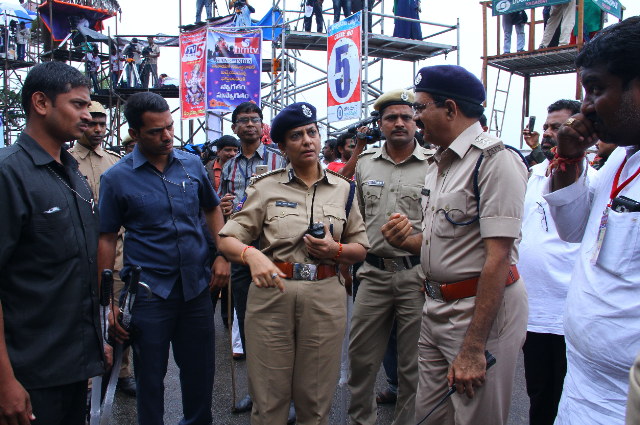
A Career Measured in Postings, Not Just Achievements
I think the first thing that grabs anyone reading about D. Roopa Moudgil’s career is the transfer count. Over roughly two decades in the Indian Police Service, she’s been moved more than 40 times — a number that, once you sit with it, works out to more than two transfers a year, every year, for twenty years straight. For most officers, even a handful of unexplained transfers would raise eyebrows. For Roopa, it’s become almost a defining feature of her biography, mentioned in nearly every profile written about her.
She’s a 2000-batch IPS officer of the Karnataka cadre, and she holds a distinction that matters beyond just her own career: she was Karnataka’s first woman IPS officer, and the first Kannadiga woman to get her home cadre. She scored All India Rank 43 in her UPSC exam, a result strong enough to have taken her into the more prestigious IAS track if she’d wanted it. She didn’t. She chose the IPS instead, something she traces to her NCC days and an early fascination with Kiran Bedi, India’s first woman IPS officer, whose example she says shaped her decision long before she sat the exam.
The Case That Made Her a Household Name
If there’s one episode that defines Roopa’s public reputation more than any other, it’s what happened in 2017. She was serving as Deputy Inspector General of Prisons at the time, and within weeks of taking the post, she submitted a report to her superior alleging that V.K. Sasikala — the jailed aide of the late Tamil Nadu Chief Minister J. Jayalalithaa, serving time in a disproportionate assets case — was receiving extraordinary VIP treatment inside Bengaluru’s Parappana Agrahara Central Prison.
The details she laid out were striking. According to her report, Sasikala had access to five separate cells for her own private use, plus an entire 150-foot corridor sealed off as her personal space, heavily barricaded on both sides. She had a private room set aside to meet visitors that, unlike the jail’s official visitors’ room, wasn’t covered by CCTV. Roopa also alleged that officials, including the prison’s Director General, had accepted roughly ₹2 crore in bribes in exchange for arranging these privileges.
What happened next is the part of the story I find genuinely revealing about how the system tends to respond to this kind of whistleblowing. Rather than being commended, Roopa was transferred out of the post within days — by some accounts, after barely 17 working days in the role. A one-person inquiry panel appointed by the government later confirmed her findings were accurate. She’d been proven right. It didn’t change the outcome. She’d already been moved on to a new posting in Traffic and Road Safety, before the investigation had even concluded.
A Résumé Full of Confrontations With Power
The Sasikala case wasn’t an isolated act of courage — it fits a much longer pattern in her career. In 2007, as part of an all-woman police team, she led the arrest of Uma Bharti, then a senior BJP leader who had ignored several court-ordered summons connected to the 1994 Hubballi Idgah Maidan communal clashes. Arresting a prominent politician of that stature isn’t a small thing for a young officer to take on, and it put her on the national radar early in her career.
Later, while serving as Deputy Commissioner of Police for the Bengaluru Armed Reserve, she moved to withdraw 216 unauthorised gunmen that had been allotted, without proper sanction, to 82 different politicians — along with several unauthorised vehicles being used for VIP convoys. In 2013, she became the first woman officer in India to head a Cyber Crime police division, adding yet another “first” to a résumé that was already unusually long for someone still relatively early in her service.
The Controversies That Complicate the Picture
None of this makes her a spotless figure, and I don’t think it’s fair to tell her story as pure heroism without the messier parts too. In 2021, she became embroiled in a very public, very ugly feud with IAS officer Rohini Sindhuri. Roopa accused Sindhuri of sending inappropriate photos to several bureaucrats and levelled a string of corruption allegations against her; Sindhuri responded by publicly implying Roopa had mental health issues. It got personal, it got messy, and it ended with the Karnataka government transferring both women without new postings — along with Roopa’s own husband, IAS officer Munish Moudgil, caught up as apparent collateral damage in the fallout.
More recently, in early 2025, a junior officer named Vartika Katiyar filed a formal complaint accusing Roopa of orchestrating the “planting” of files inside Katiyar’s office using two subordinate officers acting on her instructions. The government transferred both women shortly after the complaint became public — Roopa landing at the Karnataka Silk Marketing Board as Managing Director, a post formally equivalent in rank to an Inspector General of Police, but a long way from the front-line prison and security postings that defined the more dramatic chapters of her career.
Why She’s Still There
What I find most interesting about Roopa’s story isn’t any single incident — it’s that she’s never left. In a 2018 TEDx talk, she said something that’s stuck with critics and admirers alike: that Indian bureaucracy is chained up by two phobias, the fear of transfers and the fear of politicians, and that the day officers manage to shed both, the country will have the best bureaucracy in the world. She’s made her own answer to that fairly clear through two decades of action rather than words — choosing, transfer after transfer, to stay inside the system she keeps exposing, rather than walk away from it.
Whether you read that as stubbornness, genuine conviction, or simply a career that’s become impossible to untangle from the controversies that built it, the fact remains: more than 40 transfers in, D. Roopa Moudgil is still a serving IPS officer. That alone says something about both her and the system she’s spent twenty years pushing against.
References:
- The Weekend Leader. “Story of supercop Roopa Moudgil, IPS officer of Karnataka cadre.”
- The Print. “D Roopa, President Medal awardee IPS officer who has been transferred over 40 times in 20 yrs.”
- Governance Now. “Meet the whistle-blower cop of Karnataka,” August 31, 2017.
- Swarajya. “Uncivil Catfight In Karnataka: IPS Roopa Moudgil, IAS Rohini Sindhuri Transferred Without New Postings,” February 21, 2023.
- The Quint. “Karnataka Officers’ Epic Spat: Who Are IPS Officer Roopa Moudgil & IAS Officer Rohini Sindhuri?”
- Deccan Herald. “Karnataka IPS row: Roopa Moudgil is now Silk Marketing Board Ltd MD,” March 5, 2025.
- Deccan Herald. “IPS officer Vartika Katiyar transferred day after complaining against boss D Roopa,” March 3, 2025.
- India.com. “Who is IPS Roopa Moudgil? Got transferred 40 times in 20 years, arrested former CM, cracked UPSC exam with AIR 43.”
- Dr Kamini Rao. “Beauty with Brains - D. Roopa Moudgil.”