
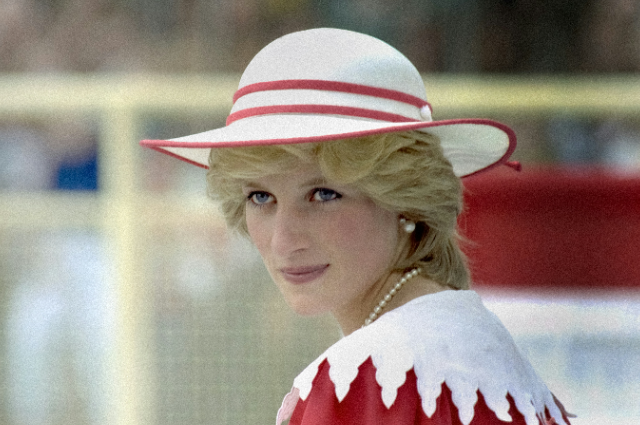
I keep coming back to one photograph from February 1992. A woman in a cream Catherine Walker dress sits on a school stage in Hyderabad. On her lap is a small girl in traditional Lambadi costume, face painted, bare feet dangling. The woman’s hand rests lightly on the child’s back. That woman is Princess Diana. The girl is Avanti Reddy, then four years old. What happened between them that afternoon still sits with me more than three decades later.
A School Visit That Was Never Meant to Be the Story
Diana and Prince Charles were in the middle of a formal royal tour of India. Most of the coverage focused on the big moments—the Taj Mahal, official receptions, the carefully staged public appearances. On 14 February 1992, they stopped at Lalapet Government High School in Hyderabad. Local organisers had arranged a short cultural performance. Among the children who danced that day was Avanti, the youngest in the group. Her mother, Japamala Rani, a dance teacher, had helped choreograph the Lambadi number.
After the dance finished, Avanti sat down on the floor with the others. Diana noticed her. She walked over, lifted the child, carried her back onto the stage and settled her on her knee. She asked the girl’s name, which school she attended, and which class. Avanti later recalled that she had a cold. Diana wiped her nose with her own handkerchief. Then, as the visit wound down, Diana said something Avanti has never forgotten: “I don’t have a daughter, so today you are my daughter.” She also told the child she did not want to leave her.
That is the core of the story. It is not complicated. It is not a claim of secret parentage or a hidden royal scandal. It is a brief, unscripted moment of tenderness between a famous woman who loved children and a small girl who happened to be in front of her. Diana herself framed it that way—temporary, affectionate, human.
Letters, a Photograph, and a Missed Reunion
The connection did not end when the royal motorcade left the school grounds. Diana and Avanti’s family exchanged letters for a time. The princess sent a signed photograph of the two of them together. Avanti, now in her late thirties and working as a dance and primary-school teacher, still keeps that framed picture. She has spoken about showing the letter around when she was younger, proud of the link.
In 1997 Avanti travelled to Europe with her dance group. Plans were made for a second meeting with Diana in Britain. Those plans never materialised. Diana died in Paris a few days before the reunion could take place. Avanti was ten years old. She remembers watching coverage of the funeral from Belgium, where the troupe was performing. The scale of Diana’s public life only became clear to her later—her work with AIDS patients, her campaign against landmines, her quiet visits to hospitals and children’s homes.
What stays with me is how ordinary the lasting bond actually is. No grand gestures. Just letters, a signed photo, and a memory of being held and spoken to with unusual kindness. Avanti has described Diana as “a very motherly figure.” That phrase, simple as it is, captures the whole encounter better than any royal headline.
A Separate Thread: Distant Indian Ancestry
There is another story that sometimes gets tangled up with this one, and it is worth keeping separate. In 2013, the genetics firm BritainsDNA published research showing that Princess Diana carried a rare mitochondrial DNA marker of Indian origin. The lineage traced back to Eliza Kewark, a woman born around 1790 in western India, who worked as a housekeeper for a Scottish merchant of the East India Company in Surat. Kewark’s daughter Katherine began the unbroken maternal line that eventually reached Frances Shand Kydd and then Diana. Because mitochondrial DNA passes from mother to child, both Prince William and Prince Harry inherited the same marker.
The amount of South Asian ancestry is small—estimated at roughly 0.3 to 0.8 per cent in living matrilineal cousins who were tested—but the genetic signature is clear. The haplogroup, R30b, is rare even in India. Scientists described the evidence as strong. William will one day become the first British monarch with documented Indian ancestry on that maternal line.
This DNA finding has nothing to do with Avanti Reddy. One is a genetic fact about a distant ancestor born more than two centuries ago. The other is a personal memory of a few minutes in a Hyderabad schoolyard in 1992. Mixing the two only confuses both stories. Diana’s brief, warm interaction with a four-year-old dancer stands on its own.
Why the Moment Still Matters
Royal tours are designed to project distance and ceremony. Diana repeatedly stepped outside that script. She sat on hospital beds, held the hands of people others avoided, and, on that February afternoon, treated a schoolgirl as if the cameras were not there. The handkerchief, the questions about school and class, the casual claim of temporary daughterhood—these were small acts, but they were consistent with the person many people felt they recognised.
Avanti has grown up into a teacher who still dances. She has spoken of the encounter without exaggeration. She does not claim any lasting special status beyond the memory and the signed photograph. That restraint makes the story stronger. It remains what it always was: a brief crossing of two lives, one globally famous, one local, joined by a few minutes of uncomplicated human contact.
When people retell the episode, they sometimes stretch it into something larger than it was. The truth is quieter and, I think, better. A princess who did not have a daughter of her own told a child, for one afternoon, that she could fill that place. The child kept the photograph. The letters eventually stopped. Life continued. Thirty-four years later, the image of the two of them still circulates because it shows something rare in public life—an uncalculated moment of care.
I do not need the story to be more dramatic than that. The fact that it happened at all, in the middle of an official tour, and that both sides remembered it with warmth, is enough.
References:
- Daily Mail. “Meet the Indian girl, 28, who Diana called ‘my daughter’,” August 14, 2017.
- Hello Magazine. “Avanti Reddy is all grown up and remembering her special day as Princess Diana’s ‘daughter’ in India,” August 17, 2017.
- Times of India. “Who is Avanti, the Indian girl whom Princess Diana called ‘my daughter’,” January 7, 2026.
- BritainsDNA / University of Edinburgh. Research on Princess Diana’s matrilineal Indian ancestry via Eliza Kewark, June 2013.
- CNN. “DNA tests reveal Prince William’s Indian ancestry,” June 14, 2013.
- Washington Post. “DNA tests estimate that Prince William is 0.3 to 0.8 per cent Indian,” June 14, 2013.
- Getty Images. Archive photographs of Diana’s visit to Lalapet High School, Hyderabad, 14 February 1992.
- The Daily Star. “The Indian girl who Diana called ‘my daughter’,” August 17, 2017 (updated).