
A Well That Wouldn’t Sit Still
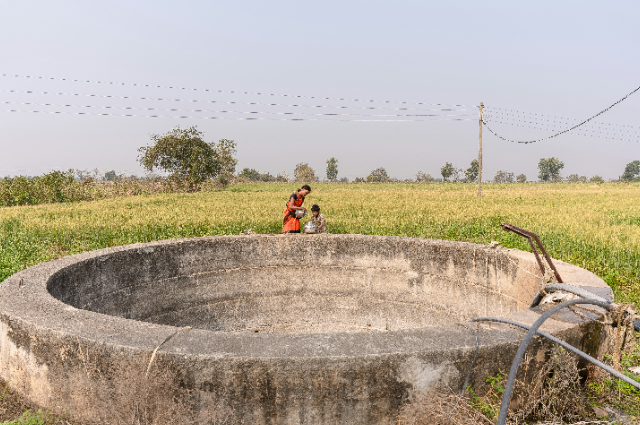
On the morning of 2 August, farmer Pranjivanbhai Sadariya arrived at his field in Virparda village, in Gujarat’s Morbi district, and found water spilling over the edge of his well. That alone might not have drawn much attention. What has, in the weeks since, is what happened next: the water inside the 18-foot-deep well hasn’t stopped moving. It continues to ripple and surge in continuous, wave-like patterns, occasionally intense enough to spill over the rim, despite there being no visible cause, no ongoing rainfall at the moment of filming, and no one disturbing the surface.
What has made the phenomenon even harder to explain away as a simple fluke is its isolation. According to residents in the area, wells located just metres away from Sadariya’s have remained completely calm throughout the same period. Whatever is causing the water to move, it appears confined to this one well alone — a detail that has done more than anything else to fuel speculation about what’s actually happening beneath the surface.
From a Farmer’s Field to a Roadside Attraction
The well itself is a recent addition to the property, built only around three months before the movement began. Once video of the oscillating water began circulating on social media in early August, it spread quickly, drawing large crowds from surrounding villages and even prompting motorists travelling along the nearby highway to stop and take a look. Visitors have described the sight as genuinely striking: water swaying rhythmically from one side of the well to the other, with no external force to explain it.
The virality brought with it the usual flood of online speculation. Some commenters suggested the well might be haunted, a theory that gained enough traction to become a recurring joke across the videos’ comment sections. Others floated the idea of undetected earthquake activity. A more grounded theory circulating locally pointed to Morbi’s proximity to the coast — the district sits roughly 35 kilometres from the sea — with some residents suggesting the well might somehow be tapping into a hidden underground channel connected to Arabian Sea tides, a folk explanation that, however unlikely scientifically, speaks to how genuinely strange the sight has appeared to people watching it in person.
Ruling Out the Earthquake Theory
Given how quickly speculation escalated, local authorities moved fairly fast to investigate. District officials confirmed there had been no seismic activity in the area and no fault lines running near the well capable of producing this kind of sustained water movement, ruling out the earthquake theory that had been one of the more persistent explanations online.
With seismic activity off the table, attention turned to the district’s geology team, which visited the site directly. District Collector Swapnil Khare confirmed that geologists had examined the well and offered a preliminary explanation: the water’s movement is most likely caused by trapped air beneath the surface, which shifts and escapes in a way that disturbs the water above it and produces the visible ripples.
The Science Behind the “Well Seiche”
District Geologist J.S. Vadher offered a more specific technical explanation for what’s being observed, attributing the phenomenon to something known as a “well seiche.” In simple terms, a seiche is an oscillation that occurs when water in an enclosed or semi-enclosed body — a lake, a harbour, or, in this case, a narrow well — is disturbed and begins swinging back and forth in a standing wave pattern, similar to water sloshing in a bathtub after being nudged.
According to Vadher’s assessment, this year’s unusually heavy monsoon rainfall has driven rapid recharging of the local groundwater table. As that water moves through underground rock layers, it can force trapped air or gas out of pore spaces within the rock under pressure, and that escaping air disturbs the water column above it, generating the kind of turbulence now visible at the surface. It’s a natural, if uncommon, hydrogeological process — one that would help explain both the wave-like motion and, potentially, why it’s confined to this specific well: differences in the surrounding rock structure or in how recently the well was dug could plausibly leave one well more prone to trapped-air release than its neighbours just metres away.
Not everyone following the story online has found that explanation fully convincing. Some commenters pushed back on the idea that trapped air alone could generate ripples as forceful and sustained as the ones seen in the videos, arguing there had to be some additional factor at play. One social media user speculated that a nearby drainage pipeline connected to the recharge well might be feeding extra water and air into the system in a way that intensified the effect — a plausible enough alternative that officials have not entirely ruled out as they continue investigating.
Officials Call In Reinforcements
Recognising both the scientific interest and the potential for the situation to be misunderstood or exaggerated further, Gujarat authorities have escalated their response. The state government has been formally notified, and a specialised team from Gandhinagar, along with researchers from the Gujarat Groundwater Research Institute, has been asked to travel to Virparda to conduct a more detailed study and submit a formal report on the well’s behaviour.
In the meantime, the site itself has effectively become a minor local attraction, with officials taking steps to manage the crowds it continues to draw. The area around the well has been barricaded to keep visitors at a safe distance, and authorities have publicly urged the public not to spread unverified rumours or supernatural explanations while the investigation is still ongoing.
A Mystery With a Likely Mundane Ending
For now, the well in Virparda remains a genuine object of fascination — equal parts viral curiosity, minor tourist draw, and small-scale scientific puzzle. The most likely explanation, based on what district geologists have said so far, involves nothing more exotic than heavy monsoon rain, rising groundwater, and trapped air working its way out of saturated rock — a natural process with an unusually dramatic visual result. Whether the forthcoming report from Gandhinagar confirms that explanation in full, or turns up something more specific about why this particular well has been affected while its neighbours sit still, is likely to become clearer once the state’s groundwater researchers complete their assessment.
References:
- Free Press Journal. “Gujarat’s Oscillating Mystery Well In Morbi Leaves Internet Scratching Heads; Viral Videos Have Netizens Saying ‘It’s Haunted’,” August 7, 2026.
- WION. “VIDEO: Mysterious well in Gujarat’s Morbi found generating waves, ripples - Here’s what geologists suggest,” August 7, 2026.
- Curly Tales. “Gujarat Has A Haunted Well? Viral Video Of Mysteriously Shaking Well Sparks More Questions Than Answers,” August 7, 2026.
- The Daily Jagran. “Gujarat: Mysterious Waves In THIS Village Well Leave Locals Stunned; Here’s What Experts Reveal,” August 7, 2026.