
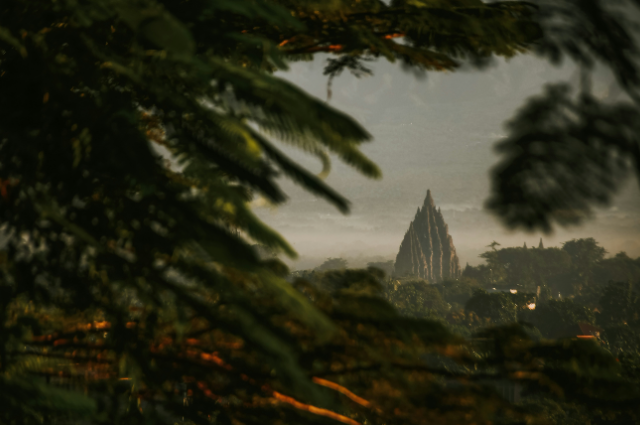
A Hindu Monument in the World’s Largest Muslim Nation
Indonesia is home to over 270 million Muslims, making it the world’s largest Muslim-majority nation by population. Yet a few hundred kilometres northeast of Yogyakarta, rising 47 meters above the Javanese plain, stands one of Southeast Asia’s most magnificent Hindu temple complexes, untouched by conversion or demolition for over a thousand years. Prambanan, also known as Loro Jonggrang, has survived sultans, earthquakes, volcanic eruptions, and centuries of religious transformation to remain a living monument to a civilisation that predates Islam in the region by hundreds of years. In July 2026, India’s Prime Minister Narendra Modi visited Indonesia to jointly inaugurate a conservation project with President Prabowo Subianto that puts this monument at the centre of contemporary diplomacy, a relationship built not on trade agreements or military alliances, but on something older and stranger: shared history carved in stone.
Built During Java’s Hindu Kingdom
The Lara Jonggrang was said to have been built by Dhaksa, a king of Mendang-Mataram (Hindu-Mataram) in the early 10th century, to worship the Hindu god Shiva. It is the largest Shiva temple in Indonesia. But the complex is older than Prambanan itself. Rakai Pikatan oversaw the construction and design of the main temple complex, while other structures were built soon thereafter by later kings, including Rakai Kayuwangi (r. 850-898 CE), Balitung (r. 899-911 CE), Daksa (r. 910-919 CE), and Tulodong (r. 919-924 CE). The temple’s construction was deliberate political theatre. Rakai Pikatan and his successors belonged to the Hindu Sanjaya dynasty, which was the rival of the Buddhist Sailendra dynasty for power in the “Medang” or Mataram kingdom in central Java. It is worth noting that the Sailendra dynasty oversaw the construction of the Buddhist temple of Borobudur. As Borobudur is located only 19 km (12 miles) from Prambanan, some scholars interpret Prambanan’s genesis as a direct artistic, political, and religious response to that of Borobudur.
Prambanan Temple Compounds is a 9th-century Hindu temple compound in the Special Region of Yogyakarta, in southern Java, Indonesia, dedicated to the Trimūrti, the expression of God as the Creator (Brahma), the Preserver (Vishnu) and the Destroyer (Shiva). The temple compound, a UNESCO World Heritage Site, is the largest Hindu temple site in Indonesia and the second-largest in Southeast Asia after Angkor Wat. It is characterised by its tall and pointed architecture, typical of Hindu architecture, and by the towering 47-metre-high (154 ft) central building inside a large complex of individual temples. Prambanan temple compounds originally consisted of 240 temple structures, which represented the grandeur of Hindu civilisation in Java.
The reliefs carved into these stones tell an entire epic. The Hindu temples are decorated with reliefs illustrating the Indonesian version of the Ramayana epic, which are masterpieces of stone carvings. For centuries, Prambanan was not a museum piece; it was a living centre of worship, where the Sanjaya kings and their successors made offerings, performed rituals, and asserted their spiritual authority over Java.
The Abandonment and the Legend
Then, within a hundred years of its completion, something changed. Despite its grandeur and rich exterior ornamentation, the Javanese abandoned Prambanan within 100 years of its completion around c. 950 CE. Although the ravages of time and natural disasters took their toll on Prambanan, the Javanese never forgot the ruins, and Prambanan continued to play a part in Javanese folklore. The reasons remain unclear; some historians point to the shift of power eastward toward the coast, others to religious transformation as Islam began arriving in Java from Arab merchants and Sufi missionaries starting around the 13th century. What is clear is that Prambanan was not destroyed. It was simply left behind, its purpose fading as the kingdoms that built it disappeared.
But abandonment created something unexpected: legend. Centuries later, inhabitants near the temple compounds were no longer Hindu or Buddhist followers. They did not know the history behind the piles of rocks near their village. Hence, a folktale emerged, a story about fallen kingdoms, a prince with supernatural power, and a cursed princess. This story became a famous legend of Roro Jonggrang. In the legend of Roro Jonggrang, Bandung Bondowoso cursed Roro Jonggrang to become the statue in the 1000th temple, presumably the statue of Durga in the north chamber of the Shiva temple in Candi Prambanan. The legend transformed Prambanan from a forgotten ruin into a sacred narrative for the Javanese people, even as the region’s dominant religion changed.
Rediscovery and Restoration
It took centuries for the stones to regain attention. Research and the restoration of Prambanan began in earnest in the early 20th century CE, and the temple complex was declared a UNESCO World Heritage Site in 1991 CE. The work was slow and painstaking, interrupted by war, disaster, and the simple reality that restoration of a monument this vast requires resources and expertise that Indonesia, as a developing nation, had to balance against countless other needs. Since the 1960s, it has been performed every full moon night in the Prambanan temple. Since then, Prambanan has become one of the major archaeological and cultural tourism attractions in Indonesia. Since the reconstruction of the main temples in the 1990s, Prambanan has been reclaimed as an important religious centre for Hindu rituals and ceremonies in Java.
The Pluralist Philosophy Behind Preservation
What allowed Prambanan to survive at all in a Muslim-majority Indonesia is rooted in the nation’s founding philosophy. Indonesia’s constitution, adopted at independence in 1945, enshrines Pancasila, a set of five founding principles that, crucially, does not privilege Islam over other faiths. Prime Minister Narendra Modi’s visit to the Prambanan Mandir complex in Yogyakarta with Indonesian President Prabowo Subianto marked the revival of a civilisational partnership that stretches back nearly two millennia through maritime trade, religion, architecture, literature and cultural exchange. Indonesia’s leaders have consistently treated Hindu and Buddhist temples as part of national heritage, not as relics of a false religion to be erased. This is unusual globally and represents a deliberate political choice.
Modi’s Visit and Contemporary Diplomacy
When Modi arrived in July 2026, Prime Minister Narendra Modi and Indonesian President Prabowo Subianto on Wednesday (July 8, 2026) jointly unveiled the India-supported conservation and restoration project at the UNESCO World Heritage-listed Prambanan Temple complex in Yogyakarta. The two leaders jointly inaugurated the Prambanan Temple Restoration Project, under which India’s Archaeological Survey of India (ASI) will assist Indonesia in conserving one of the world’s greatest Hindu Mandir complexes.
This was not ceremonial tourism. India’s involvement reflects a deliberate strategy called “Act East,” under which India partners with Southeast Asian and South Asian nations to preserve shared heritage sites. Since 2014, the Modi government has backed the conservation of several significant heritage sites across Asia. India helped restore the UNESCO-listed My Son Sanctuary in Vietnam, a major Shaivite temple complex and the spiritual centre of the ancient Champa Kingdom. In 2015, it extended a grant of LKR 326 million to Sri Lanka for the restoration of the historic Thiruketheeswaram Temple, one of the country’s five ancient Pancha Ishwarams dedicated to Lord Shiva.
For Modi, Prambanan carries spiritual weight. Calling Prambanan a “timeless symbol” of the shared cultural heritage of India and Indonesia, PM Modi highlighted the civilizational ties that have linked the two countries for over a thousand years. But it also carries strategic weight. By positioning India as the custodian of Hindu and Buddhist heritage across Asia, India strengthens its influence in a region where it competes for diplomatic attention with China.
Why This Monument Matters Now
Prambanan’s survival and restoration matter because they challenge a simple narrative: that modernity means religious homogenization, that religious conversion means cultural erasure, that a Muslim-majority nation cannot honour the religious monuments of its pre-Islamic past. Indonesia proves otherwise. The temple stands as evidence that civilisations can layer themselves atop one another without destroying what came before, that identity can be plural and layered without being contradictory.
In an era of rising Hindu nationalism in India and rising Islamophobia in Western countries, Prambanan also offers a different model: a monument built by Hindus, abandoned by Hindu kingdoms, preserved by Muslim societies, and now restored by India and Indonesia working together. It is a temple that belongs to nobody exclusively and to everyone simultaneously, a rare symbol of how the past and present can coexist across religious lines.
References:
- “Prambanan Temple.” Wikipedia, accessed July 2026.
- UNESCO World Heritage Centre. “Prambanan Temple Compounds,” accessed July 2026.
- Britannica. “Prambanan: Hindu Temple, Java,” July 20, 1998.
- World History Encyclopedia. “Prambanan,” September 26, 2018.
- Exploresunda. “Prambanan Temple: The History, The Legend, The Ballet, The Present-Day,” accessed July 2026.
- Organiser. “Prambanan Mandir Restoration: India and Indonesia revive two millennia of shared heritage and civilisational diplomacy,” July 8, 2026.
- WION News. “PM Modi visits historic Prambanan Temple, strengthens India-Indonesia cultural diplomacy,” July 8, 2026.
- Business Standard. “PM Modi, Indonesian Prez inaugurate Prambanan Temple restoration project,” July 8, 2026.
- DD India. “Restoring shared heritage: PM Modi’s visit to historic Prambanan Temple strengthens India’s cultural diplomacy,” July 8, 2026.
. . .