
A Veil That Means Everything in Reverse
Walk through the Sahara Desert, and you’ll notice something that catches almost every outsider off guard. The men have their faces wrapped in deep indigo cloth, leaving only their eyes visible, day after day. The women walk bareheaded, their faces open to the sun and wind. For anyone raised in the Islamic Middle East or North Africa, where female veiling is often assumed to be universal Islamic practice, this sight lands like an inversion of everything they thought they knew. It is, in fact, a powerful reminder that culture and tradition often cut across religious lines in ways that leave observers scrambling to make sense of what they’re seeing. The Tuareg people of the Sahara have maintained their own distinct approach to gender, identity, and the veil for centuries, and understanding that approach means looking past Islam to something older: a matrilineal society where women hold economic and social power that would be unrecognisable in many other parts of the Islamic world.
The Tagelmust and the Rite of Passage
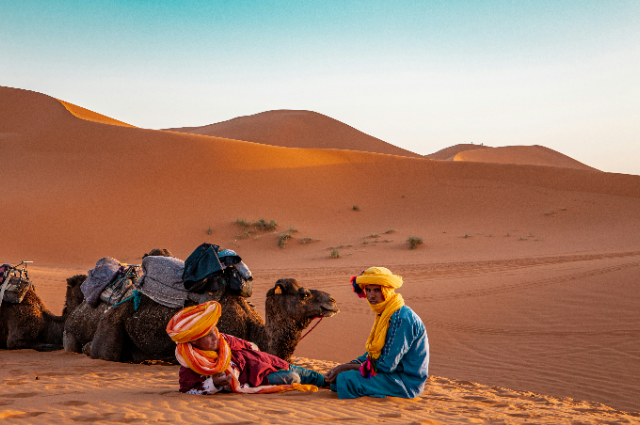
The Tuareg call themselves “Kel Tagelmust,” which means “people of the veil,” and the veil itself, the tagelmust, is made from indigo-dyed cotton that can stretch to more than 33 feet in length. The tagelmust covers the head and prevents the inhalation of wind-borne sand by its wearers in the Sahara region, and the indigo dye is believed by many of the wearers to be healthy and beautiful, with a buildup of indigo in the skin of the wearer being generally considered to protect the skin and denote affluence. What makes the garment distinct is not primarily its practical function, although that matters in one of the world’s harshest environments, but its role as a marker of manhood itself.
A boy is given his first veil when he turns 20 years old, provided by his father or maternal uncle, and he is obligated to wear it for one week, day and night without parting ways with it even once, in an initiation ceremony called “anagad.” A feast is held where relatives and neighbours are called on to observe the ceremony, and religious scholars recite verses from the Qur’an. From that point onward, the tagelmust is worn only by adult males and taken off only in the presence of close family, with Tuareg men often finding shame in showing their mouth or nose to strangers or people of a higher standing than themselves.
The spiritual dimension runs deeper than practical protection. The tagelmust is an initiation ceremony, spiritual armour, social communication system, and political symbol compressed into ten meters of pounded indigo cloth, serving as protection from desert spirits and marking the moment a boy stops being a boy. The indigo staining that accumulates on a Tuareg man’s skin over years of wearing the veil becomes visible proof of his status and adherence to tradition—a literal embodiment of cultural identity that cannot be faked or washed away quickly. This is why Europeans gave the Tuareg the nickname “Blue People” for this colourful reason, as the rich indigo pigment often rubs off onto their skin, temporarily tinting it blue.
Where Women Hold the Tent and the Power
What makes Tuareg gender roles genuinely exceptional in the Islamic world is not the male veiling itself, but what accompanies it: a matrilineal system where women, not men, control the most important assets. Descent and inheritance often pass through the mother’s line; tents, livestock, and jewellery belong to women. Men may travel for trade or war, but the tent, the home, is hers. The tent is not a minor detail in nomadic life; it is the entire structure of the family, the home base to which everything returns.
The matrilineal principle of transmission from mother to daughter works for inheritance, land rights and property considered as an inalienable asset, and women keep the cattle from which they obtain fresh milk, curds, butter and cheese, using the hides for crafts. This means a woman’s wealth and security do not depend on a husband’s goodwill or a father’s favour. She inherits from her mother, passes her property to her daughters, and controls her own economic life independently. Most Tuareg women are not secluded, can visit and travel freely, can represent themselves legally, have a right to initiate divorce, and inherit, own and manage their own property, which has traditionally included livestock, date palms, and in a few cases, houses.
Divorce itself is handled in a way that would shock many neighbouring societies. Upon divorce, the women keep all their possessions, including the children and tent, and men move out of the house, with women able to initiate the processes that lead to divorce, and in society, divorce is not a stigma or shame. A man leaving a marriage returns to his mother’s tent with little more than his camel, while the woman retains everything she brought into it.
The Myth and the Compromise
Tuareg matriliny did not arrive in a vacuum. The introduction of Islam in the seventh century A.D. had the long-term effect of superimposing patrilineal institutions upon traditional matriliny. Islamic inheritance law, strictly applied, gives two-thirds of property to male heirs and one-third to female heirs. The Tuareg, however, have refused to completely abandon their older system. Alternative inheritance forms, stemming from ancient matriliny, include “living milk herds” (animals reserved for sisters, daughters, and nieces) and various pre-inheritance gifts, which work to restore balance and keep women’s economic independence intact in practice, even if formal Islamic law sits theoretically above it.
This cultural stubbornness has deep roots. Matrilineal myths are widespread among many Tuareg groups, with cultural vestiges today in the high social prestige and economic independence of women, manifested in inheritance and descent, mythology and ritual, counterbalancing more recent Islamic elements in the culture. The mythology itself, stories of clans descended from daughters of the same mother serves to legitimise women’s power in a way that makes it feel inevitable rather than negotiable.
Why This Matters Beyond the Sahara
The Tuareg case matters because it demonstrates something that anthropology sometimes struggles to convey: gender roles are not dictated by religion alone, and matrilineal systems can persist within Islamic societies if the cultural infrastructure supporting them is strong enough. A Tuareg woman’s freedom and economic power do not come from a rejection of Islam, but from a pre-Islamic inheritance system that Islam was layered on top of without completely erasing. The veil worn by Tuareg men is not and has never been about controlling female sexuality. It is about male honour, spiritual protection, and the transition from boyhood to manhood in one of the world’s most demanding environments.
In an era when veiling is often discussed through a single lens in global conversations about Islamic feminism and women’s rights, the Tuareg case offers a corrective: a living example of a Muslim society where the veil belongs to men, where women own the homes and the animals, and where gender power runs in a direction that still surprises and challenges assumptions about what Islamic culture must look like.
References:
- Casajus, Dominique. “La tente dans l’essuf.” Paris and London: Cambridge University Press, 1987.
- “Tagelmust.” Wikipedia, accessed 2026.
- Ihediwa, Helen. “The Tuareg | The Tagelmust.” Indigenous Grid, June 2026.
- Duveyrier, Henri. “The Tuareg of the Sahara.” 1894. Referenced in Encyclopedia.com article “Tuareg,” accessed 2026.
- Ferroukhi, Nadia. “Algeria, Touareg: Matrilineality and Women’s Power.” Personal research documentation, 2023.
- Rasmussen, Susan. “Susan Rasmussen on the Tuareg.” Afropop Worldwide, September 15, 2022.
- “In Sahara Desert’s Tuareg Tribe, Islamic Women Rule The Roost.” Homegrown.co.in, April 29, 2022.
- Encyclopedia.com. “Tuareg.” Social Sciences and Law: Anthropology and Archaeology, accessed 2026.
- Yaden Africa. “Tuareg: Lineage, Inheritance, and Social Autonomy.” African Clothing and Jewellery Database, accessed 2026.
- JINHAGENCY. “Tuareg Women Play Prominent Roles in Social Life.” News Centre, June 6, 2022.
. . .