
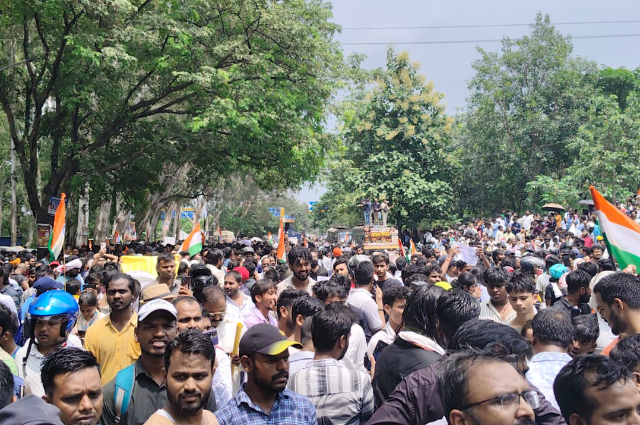
A Movement Born From an Exam Paper
For more than two weeks, the grounds of Jaipal Singh Munda Stadium in Ranchi have been occupied by students and job aspirants demanding accountability over alleged irregularities in Jharkhand’s state recruitment examinations. The protest, which began with a march on 25 July, centres on the 14th Combined Civil Services Examination conducted by the Jharkhand Public Service Commission, along with a wider set of exams run by the Jharkhand Staff Selection Commission. Protesters allege paper leaks, procedural fraud, and a lack of transparency severe enough to have compromised exams that thousands had spent years preparing for.
Their core demands are specific: a Central Bureau of Investigation or judicial inquiry into the alleged irregularities, cancellation of the disputed JPSC preliminary examination, and accountability for those responsible. One recurring point of contention is the involvement of TSR Data Processing Private Limited, an IT contractor used to help conduct the examinations that was blacklisted in 2024, a detail protesters say should have disqualified it from any role in this year’s recruitment process.
A Movement Splitting Into Factions
What makes the Ranchi protest unusual, compared to similar student movements elsewhere in India this year, is that it hasn’t remained a single, unified front. The demonstration has fractured into two separate hunger-strike camps, occupying opposite ends of the same stadium ground. One stage is led by three leaders aligned with the regional Jharkhand Loktantrik Krantikari Morcha, a political party. The other belongs to a group of unaffiliated aspirants who have organised themselves under the banner of the JPSC-JSSC Reform Manch.
The split traces back to a breakdown in an earlier understanding between the two camps. According to reporting on the movement, the two sides had originally agreed that no political party or organisation would be allowed to become the face of the protest, an agreement meant to keep the movement independent of partisan interests. That arrangement collapsed amid disagreements over tactics and leadership, with the Reform Manch accusing the JLKM-aligned camp of attempting to co-opt the movement for political advantage, while the JLKM side has pushed back with its own accusations against the Reform Manch. The result is two parallel hunger strikes, running simultaneously, technically on the same side of the same cause, but no longer coordinating with each other.
There’s also a smaller, quieter thread running alongside the two larger camps: at least one protester has been fasting independently of both groups, lying beneath a statue of Jaipal Singh Munda at the stadium, his own personal grievance tied to a stalled government appointment rather than the broader exam controversy. It’s a detail easy to miss next to the louder factional dispute playing out around him, but it’s a reminder that behind the organised camps sit individual people whose stakes in this movement are deeply personal.
Politicians the Students Say They Didn’t Invite
Despite students repeatedly insisting they want the movement to remain apolitical, political parties have shown up regardless. Members of the Akhil Bharatiya Adhivakta Parishad held independent marches and burned an effigy of Chief Minister Hemant Soren. Protesters affiliated with the Reform Manch attempted to burn effigies of both Soren and Congress MP Rahul Gandhi, an act that led to what protesters describe as physical confrontations with workers from the ruling Jharkhand Mukti Morcha, who allegedly snatched the effigies and assaulted demonstrators, including women, during otherwise peaceful rallies. Leaders from the National Students’ Union of India and the Indian Youth Congress have also turned up at the stadium, while BJP figures, including MP Nishikant Dubey, have publicly backed the students’ demands while accusing the state government of stalling on dialogue. Congress leaders, for their part, have claimed the government is already working toward a resolution through talks.
Organisers on the ground have responded to this political crowding by publicly telling party representatives they aren’t welcome at the protest site, a stance consistent with the movement’s founding intention to stay independent of any single party’s agenda. Whether that message actually keeps politicians away remains to be seen, given how much political capital both the ruling JMM and opposition BJP appear to see in aligning themselves, even loosely, with a protest this large and this popular.
Arrests Mount as the State Investigates
Alongside the protest, Jharkhand’s Crime Investigation Department has been conducting its own inquiry into the alleged exam irregularities, and that investigation has already produced 19 arrests. The scale of that number, growing steadily as the protest continues, has done as much to fuel the movement’s momentum as any single rally or hunger strike, giving protesters concrete evidence that something was genuinely wrong with the examination process, even as they keep pushing for the CBI investigation they say is the only way to get a truly independent accounting of what happened.
State officials have offered to open talks with protest leaders, but those overtures have been rejected in their current form. Students have made clear they won’t accept a closed-door format, insisting instead on a transparent process that keeps the public informed — a position that reflects the movement’s broader distrust of institutional processes conducted out of public view, given that opacity is precisely what triggered the protest in the first place.
An Echo of Delhi, With a Different Ending So Far
Observers have drawn comparisons between the Ranchi protest and the Cockroach Janta Party movement that convulsed Delhi earlier this year, and the parallels are real: both began with a specific grievance around examinations and institutional accountability, both drew large youth followings that grew far beyond their original organiser's expectations, and both have had to navigate the awkward reality of political parties trying to attach themselves to a movement that insists it wants nothing to do with them.
Where the two diverge is in how they’ve held together internally. The CJP movement, for all the police violence and internal confusion it faced, remained a single, largely unified campaign under one recognisable leadership structure throughout its most intense period. The Ranchi protest, by contrast, is fracturing even as it grows — two competing hunger strikes, sharp mutual accusations between former allies, and a lone protester fasting alone beneath a statue, all technically pursuing the same goal from different corners of the same stadium. Whether that fragmentation weakens the movement’s leverage with the state, or simply reflects the genuine difficulty of keeping thousands of independent aspirants unified behind a single voice, is likely to become clearer as the standoff with Jharkhand’s government continues.
References:
- Brut India. “Jharkhand Student Protest: What We Know So Far About The Viral Answer Sheet, Hunger Strike And CBI Demand.”
- The Quint. “Jharkhand JPSC-JSSC Protest in Ranchi: Student Groups Split Over Exam Irregularities, Hunger Strikes and CBI Probe Demands.”
- Wikipedia. “2026 Jharkhand student protests.”
- Organiser. “JPSC-JSSC exam row: Jharkhand students show the real way to protest,” August 23, 2026.
- The Print. “Anatomy of Jharkhand protests: 2 stages, 8 on hunger strike, a quest to be ‘non-political.’”
- Free Press Journal. “JPSC-JSSC Protest Triggers Political Clash Between BJP And JMM In Jharkhand.”
- Amar Ujala. “Jharkhand: JPSC-JSSC विवाद पर सियासी संग्राम, BJP ने सरकार को घेरा; कांग्रेस बोली- बातचीत से निकलेगा हल,” August 17, 2026.