
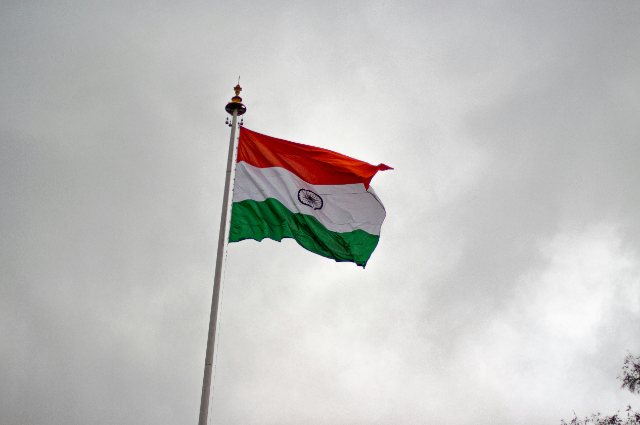
A Song Written Before the Country It Represents
Every time India’s national anthem plays, it names a specific set of regions: Punjab, Sindh, Gujarat, Maratha, Dravida, Utkala, and Banga, before sweeping on to the Vindhya and Himalaya ranges and the Yamuna and Ganga rivers. Absent from that list is Rajasthan—along with Kashmir, Mysore, Kerala, and several other regions that today form some of India’s largest and most prominent states. For a country whose anthem is meant to represent its full geography, that gap tends to catch people off guard the first time they notice it.
The explanation is less mysterious than it might seem, though it does require understanding when and why the anthem was actually written. Rabindranath Tagore composed the original Bengali poem, Bharoto Bhagyo Bidhata, in 1911, decades before India’s independence and long before its modern state boundaries existed. At the time, the regions Tagore named were the ones directly under British colonial administration. Rajasthan, along with places like Kashmir, Mysore, and Kerala, existed then as princely states—semi-autonomous territories ruled by local monarchs under British paramountcy rather than direct colonial governance. Tagore’s poem, several historical accounts suggest, was reflecting the map of British India as it existed in 1911, not the map of princely India, and Rajasthan simply fell on the wrong side of that administrative line.
There’s a second layer to the story that sharpens it further. Tagore wrote the poem for a specific occasion: the 1911 visit of King George V and Queen Mary to Calcutta for the Delhi Durbar. Accounts differ on how directly the poem was intended to honour that royal visit versus serving other purposes, and the question has remained a live one in Indian public debate for decades. What isn’t disputed is that the anthem’s language, drawn from a 1911 political map focused on directly governed British provinces, was never built to be an exhaustive list of Indian regions—which is precisely why so many present-day states, Rajasthan included, don’t appear in it.
Public frustration with the gap has surfaced periodically, particularly the anthem’s continued reference to Sindh, a region that became part of Pakistan after Partition in 1947, while leaving out large parts of modern India. Efforts to revise the wording have gone nowhere, largely because doing so would mean altering a specific literary work by one of India’s most revered poets—a step most commentators treat as effectively off the table, whatever the map says today.
A Very Different Kind of Absence
More than a century after Tagore wrote that poem, another gap in India’s national story has opened up — this one measured in currency markets rather than verses. Through 2026, the Indian rupee has depreciated somewhere between 7 and 8 per cent against the US dollar, touching record lows near 96 to the dollar during multiple trading sessions this year. That decline has made the rupee Asia’s worst-performing currency for a second consecutive year.
The pressure driving that slide isn’t coming from a single source. A steep 50 per cent US tariff imposed on a wide range of Indian exports, including textiles, gems and jewellery, leather goods, and machinery, has weighed heavily on the currency’s outlook, alongside sustained foreign investor outflows from Indian equity and bond markets and broader dollar strength across emerging markets generally. Oil compounds the pressure too: India imports roughly 90 per cent of its crude oil needs, almost all priced in dollars, so a weaker rupee makes those imports more expensive, feeding back into inflation and further currency weakness in a difficult cycle.
None of this represents a sudden break from the past, either. Since India’s 1991 economic liberalisation, the rupee has weakened against the dollar by roughly 3.5 to 4.5 per cent a year on average, a slow drift most economies with India’s growth profile and trade patterns experience over time.
What Makes This Year Genuinely Different
If 2026’s rupee weakness were purely about the dollar, it would fit neatly into that three-decade pattern. What breaks the pattern is a second, more specific data point: the rupee has also lost close to 12 to 13 per cent of its value against the Pakistani rupee since May 2025, even as Pakistan’s own currency, battered badly during its 2023 crisis, has stabilised under an IMF-backed programme. On 7 May 2025, one Indian rupee bought around 3.32 Pakistani rupees; by May 2026, that had fallen to roughly 2.90.
It’s worth being precise about what that comparison does and doesn’t mean. The Indian rupee still buys noticeably more Pakistani rupees than the reverse, meaning India’s currency remains, in absolute terms, the stronger of the two by a wide margin. Economists have also cautioned against reading too much into the bilateral figure directly, since both currencies are priced primarily against the dollar rather than traded meaningfully against each other, given how limited direct India-Pakistan commerce actually is. The bilateral rate is, in that sense, a derived number rather than a real market signal of head-to-head economic competition.
Even accounting for that caveat, though, the direction of travel is hard to dismiss. A currency that’s supposed to be structurally stronger losing ground specifically against a currency that was in crisis just three years earlier suggests the pressure on the rupee isn’t purely a story about global dollar strength or generic emerging-market headwinds. Something more India-specific appears to be layered on top of the broader trend — a reminder that even a currency with a clear structural advantage isn’t immune to the kind of pressure usually associated with its weaker regional counterparts.
Two Gaps, One Pattern
Neither of these stories is really about a missing word in a song or a few percentage points on a currency chart. Both are examples of something built at one moment in India’s history running up against a very different reality decades later — an anthem drawn from a 1911 map of British provinces, still sung today across a country whose boundaries have been completely redrawn since independence; and a currency shaped by three decades of gradual, predictable depreciation, now facing pressures specific enough to break from that decades-long pattern. In both cases, the gap between what was written into the system long ago and what the country actually looks like today is exactly where the more interesting story lives.
References:
- SabrangIndia. “We, the People of India, are markedly absent in our national anthem,” March 26, 2018.
- Wordzz. “Regions Mentioned in Indian National Anthem,” June 17, 2023.
- Sankalp India Foundation. “Facts about ‘Jana Gana Mana.’”
- Quora. “Why is the name of Rajasthan not mentioned in the national anthem Jana Gana Mana?”
- Business Standard. “Rupee weakens to record closing low, approaches 96 against the dollar,” May 13, 2026.
- Multibagg AI. “Indian rupee at record low: what Rs 96 means,” May 20, 2026.
- India Macro Indicators. “Rupee at Record Low in 2026: What Indian Investors Should Know,” June 15, 2026.
- The Thursday Times. “India’s rupee is losing to Pakistan’s. One year after Operation Sindoor,” May 23, 2026.
- Trading Economics. “Rupee Slides Toward Record Lows as US Tariffs Hit.”