
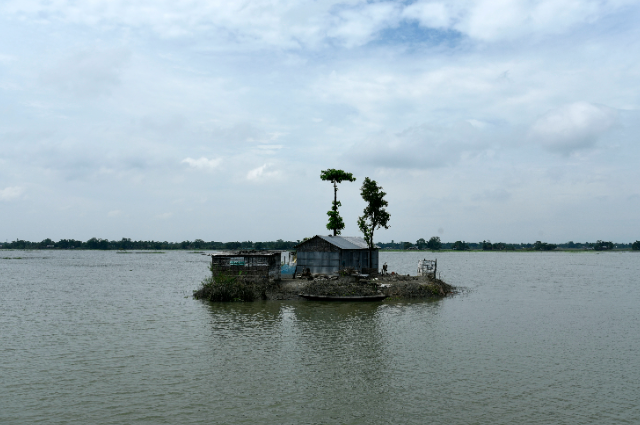
Every year, around the time of the monsoon, the most awaited season of the country, India faces its own loss through massive floods. This time, the horrifying dread has caught the state of Assam. Tucked away from the mainland, the North-Eastern state has been currently suffering severe repercussions of unusual floods, putting the lives of many in peril and causing misfortune.
Since mid-July 2026, Assam has been facing its worst monsoon, with heavy, unprecedented rainfall accumulating heights of floods, killing thousands of people and livelihoods each passing day. The torrential rain, which started on July 18th, didn’t seem to stop with a downpour; rather, it extended its might for the next three continuous days. The accumulating rain, devoid of an escape, pursued its course through Upper Assam, quickly making its way into the locality, engulfing the unprepared civilians and destroying their homes, resulting in immediate deaths. Agricultural fields along with multiple livestock were also swept away by the strong water currents, with roads and solid grounds submerged underwater. As per the current reports, almost 97 people have lost their lives, with over 1.68 lakh people affected in 11 districts, almost 900 villages damaged, and 15,000 croplands destroyed.
The Assam floods commenced precisely with Nagaland, Assam’s neighbouring state, facing excessive rainfall, ceaseless for 72 to 48 hours. The hill districts of Nagaland such as Mokokchung, Wokha, Mon, and Longleng were soon overflowing with rainfall, which eventually continued down the foothills of Upper Assam. The situation was aggravated with the local rivers of Assam - Dhikou, Disang, Burhi, Dihing, and Dhansari – and the principal river Brahmaputra, which were already brimming with the seasonal monsoon, conjoining their forces altogether.
This is the second time in a span of seven years that Assam has been victim to such a tragedy. Back in 2020, the state had faced a similar disaster with the Brahmaputra river overflowing due to excessive monsoon rains, causing 149 deaths and affecting 5 million people. The disaster had coincided with the COVID-19 pandemic, posing a gruelling time of survival for the people. The condition had prevailed for more than two months, causing landslides and destroying major crops across the state. However, 2026 has proved to be much more alarming, as the tributaries, along with the major and local rivers, are overflowing with water due to non-stop rain, affecting places that are not usually victims of such.
Assam is a heavily agriculture-dependent state with 70% of its population relying on it for livelihood. The state specialises mainly in the cultivation of Tea, producing a wide variety of tastes and flavours alongside cultivating major crops such as Paddy, Maize, Pulses, potato, and Wheat, citrus fruits, and leafy vegetables, contributing to 38% of State Domestic Product (SDP) and 19% to overall Gross Domestic Product (GDP) of the country. This particular boon of the state is aided by the tropical monsoon season, which typically lasts from June to October every year. However, residing on the banks of the major river, Brahmaputra, has made the state susceptible to yearly moderate floods.
Hence, Assam’s annual floods are not a novel phenomenon. According to the report, in the past few years, beginning with 2018, accounting for the great flood of 2020, and the current scenario, there has been a shift in the rainfall pattern of the state, accounting for flash floods instead of moderate floods. The rainfall during monsoon, as observed, has been increasing rapidly in volume daily, with water accumulating really quickly, overflowing the nearby banks and rivers, causing the flood disaster. Ecologists and related environmental experts have linked the condition to the growing repercussions of climate change, such as temperature rise and growing deforestation in the region.
In 2023, in the Gross Domestic Climate Risk report, Assam was recorded as one among the 50 regions susceptible to climate change in the country. Given Assam’s and the North-Eastern states ' geographical location, they are heavily exposed to the Indian Himalayas and the Tibetan Mountains, which are two of the most important landmarks that play a crucial role in the scientific El Niño phenomena that drive the monsoon climate. But due to rising global warming, the global weather pattern has shifted drastically, affecting the temperature differences of the sea and their subsequent water cycle. Hence, this has caused the El Niño phenomenon to contribute to a weaker monsoon, causing unpredictable, erratic rainfall.
A study published in the United Nations Office for Disaster Risk Reduction (UNDRR) by Wahid Bhat lays down the cause of the increasing human intervention and the lack of proper disaster management as the contributing factors to the devastating floods in the region. According to the Global Forest Watch (GFW), the North-Eastern region of India alone has recorded a loss of 324 hectares of tree cover from 2001-24, accounting for a 14% global forest loss, imposing a serious environmental threat. Deforestation, urbanisation and the extension of farming fields were highlighted as the top reasons for the failure. In the Goalpara district of Assam, the Gonbina Reserved Forest was reportedly encroached by 2,178 individuals, converting it to dryland agriculture to meet the increasing population demands. Similarly, the Behali Reserve Forest (BRF) in Biswanath district, spanning over 14,000 hectares were reduced to 8,000 hectares from 1994-2021 due to illegal logging and encroachment. These heinous actions put civilians at risk as the soil, which is upheld by the tree roots, becomes limp, causing landslides, as well as minimising the effect of water absorption during floods.
Currently, the Assam State Disaster Management Authority (ASDMA) has set up 39 relief camps and 16 relief distribution centres, sheltering 74,000 displaced people. The Chief Minister of Assam, Himanta Biswa Sarma, has been playing an active role, visiting the devastated districts and attending to the displaced civilians directly. He has assured maximum support by making sure that each and very need of the civilians is attended to and necessities such as clothes and food are made available to the people. Furthermore, he has advocated for a door-to-door survey analysis from door to door starting from 9th August in order to ensure relief aid has reached the people. Although the Central Government has maintained silence, the National Disaster Response Force (NDRF), State Disaster Response Force (SDRF), along with the Assam Police, National Army Forces, and Fire and Emergency Services have been working in conjunction, rescuing trapped civilians and uncovering dead bodies. Many social media influencers such as Bhaskar Dutta and CarryMinati, and multiple NGOs have been taking an active role in collecting funds and providing basic amenities for the affected Assamese people.
Meteorologists have issued orange and yellow warnings for the rest of the six North-eastern states, with severe rainfall predicted for the upcoming days. Civilians of the region have been advised to take active precautions due to the unpredictability of the situation, safeguarding their families and preparing for any emergency situation.
References:
- Assam Flood Situation Grim: 1.6 Lakh People Affected As Toll Reaches 95 | Times Now
- NGOs, actors, influencers join hands to help Assam's flood victims
- What's really behind Assam's worsening floods? | PreventionWeb
- The Agricultural Sector in Assam: Its Importance
- Rapid urbanisation, large-scale deforestation pushing Assam towards climate catastrophe | Guwahati News - The Times of India
- Assam Flood 2026 – Everything You Need to Know – Responsible Yatri
- Assam Flood 2026: Death Toll and Relief Update | Recent Events | The United Indian
- Assam's Behali Reserve Forest Designated As 'Wildlife Sanctuary'
. . .