
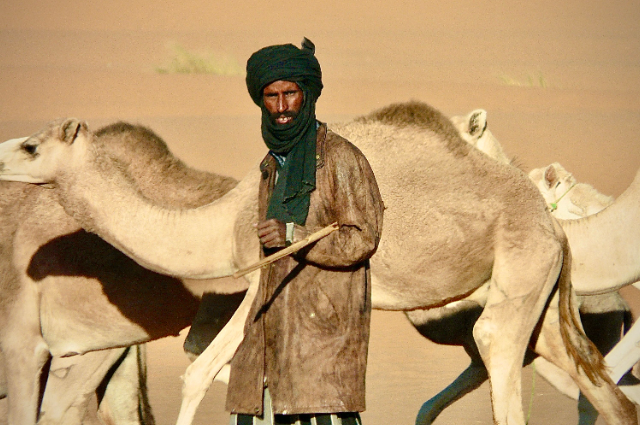
Who veils their face in the desert? Of course, a woman! No, you are wrong. Not in the Sahara. Under the blazing light of the sun, it is not the women but the men who veil their faces.
Among the fine pristine grains of the Sahara, you will find men clad in deep blue, galloping their way through the desert or perhaps sharing a cup of tea in the midst of their tents.
The ‘Tureag Tribe ’, also nicknamed the ‘Blue Men of the Sahara’, are a group of nomadic pastoralists that occupy the Western and Central Regions of the Sahara Desert. The men of this particular tribe draw their distinctive identity by adorning their traditional attire called ‘Tugelmust’.
The ‘Tugelmust’ or ‘Cheche’ is a long strip of indigo cloth that is attached to a turban. The veil that suspends from the turban is tightly wrapped in an intricate pattern around the head, forehead and the lower face of the men, leaving only the blazing eyes exposed. This particular identity, however, does not just stem from religious beliefs as popular opinion goes. Tureag men, being brought up in a matriarchal lineage, are educated on a morally strict code of conduct. Since childhood, these men are taught the fundamental values of honour, bravery, generosity, and respect for elders with utmost importance. They are firmly expected to abide by them with reverence and solidarity. This is what makes the men of Tureag different from other neighbouring tribes.
The Tugelmust is bestowed upon young boys at a ripe age of seventeen or eighteen with a special ceremony called ‘Angad’. The feast calls in close relatives and kin from the neighbouring tribes to witness the special initiation. A goat or sheep is killed traditionally, and a verse from the holy book of the Quran is recited by the elderly scholars, upon which a veil is presented to them by the father or maternal uncle. After the ceremony, the boys are obliged to wear the turban along with the veil for a whole week, day and night, without unveiling them. By the end of the seven days, the Indigo colour from the linen has slowly crept into their natural pigment, marking their venture into manhood officially. This ‘permanent marker’ is supposed to be worn all the time, especially in public and in front of elders, removing them only in private gatherings, and occasionally for tea and food.
Why the colour indigo? In many parts of Africa, the colour indigo holds much greater prominence and symbolism beyond wealth and status. For example, in Nigeria, indigo-dyed clothing, also known as ‘Adire ’, is worn as a form of visual language, where proverbs and spiritual symbols are induced into the colour linen. Similarly, in Mande/Mali, the indigo-dyed cloth is believed to bring auspiciousness to the bride during weddings, and ward off evil spirits. Hence, indigo is just more than a mere colour for the inhabitants of the continent. Its bright intonation in Tuareg is a loud perception of their knit identity, labelling them as the children of the desert. The colour appears to be dark from afar, and can only be witnessed in true colour when observed closer, making the linen unique among its kind. The choice also protects the men physically, as its pigment acts as a strong shield against the UV rays that burn the desert from morning to mid-afternoon. As time passes by, the Tuareg men add a little glimmer to their style by attaching a piece of jewellery to the veil, making it more radiant.
However, it is not only the men who shines but; the Tuareg women also embody a colour of their own. Similar to the Tugelmust, which is given to the boys at a specific age, the ‘Tesirnest’ is given to women right after their marriage. But unlike the Tugelmust, the Tesirnest is not a sign of compulsion and permanence. The Tuareg women are the central pillars of the tribe. Following a matrilineal culture, the women hold immense societal and economic power in the tribe. Women enjoy unrestrained freedom to the extent of owning livestock, initiating divorce, and having multiple sexual partners. Hence, this particular veil is not an obligation for women as it is for the men. The ‘Tesirnest’ or ‘Bukar ’ is worn over their flowy gown, tied across the shoulders, around the head, and can be veiled during special ceremonies such as weddings, naming ceremonies, or religious holidays. Women can also choose to cover for occasional protection from the sun or for privacy if needed.
Compared to other tribes, this particular distinction is unique to the Tuareg themselves. Even though in neighbouring tribes like the ‘Moors’ and ‘Haurs’, men cover themselves sporadically to protect themselves from fierce wind and harsh weather. But it is not a symbol of permanence and lifelong commitment like the Tugelmust. Women also distinguish themselves with the matriarchal structure, which is, in a large number, unique to the tribe itself. This particular reverse distinction has caught many people off guard, stripping them of the existing stereotypes and clichés around the world. The Tuareg tribe is an example of how, despite being away from the mainland and the prevailing stereotypes and clichés, there is always a place in the world that proves you wrong.
Currently, the Tuareg tribe possess a population of approximately 2 million people. The majority of them stay within the constraints of the Sahara, practising nomadic activities, and engaging in craft work like jewellery making, leatherwork, and woven mats. But several people also seek greater opportunities by migrating to cities, carrying the remnants of their kinship.
References: