
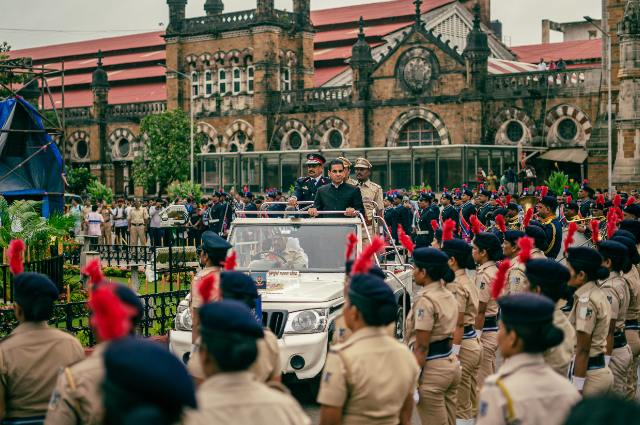
The woman who chose the police uniform
Some careers begin with a clear plan. For D. Roopa Moudgil, the journey towards the police service was shaped by inspiration, determination, and a strong wish to do something different. Roopa Moudgil belongs to the 2000 batch of the Karnataka cadre of the Indian Police Service. She secured All India Rank 43 in the UPSC Civil Services Examination. This rank could have allowed her to enter the IAS, but she chose the IPS instead.
Her interest in policing was reportedly influenced by her NCC days and by the example of former IPS officer Kiran Bedi. For Roopa, the police uniform was not simply another government job. It represented the kind of public service she wanted to enter. She went on to become one of the earliest prominent women IPS officers from Karnataka and later became known for taking up assignments that often placed her in difficult situations.
Her career has also been marked by a large number of transfers. Various media profiles have reported that she has faced more than 40 transfers or postings over roughly two decades, although the exact count varies depending on what is included as a transfer; transfers alone do not explain why Roopa Moudgil became a widely discussed name.
Her reputation grew because some of her major assignments brought her into direct contact with questions involving political influence, police administration, and the use of government power. One example came years before her biggest national controversy. During her service, she was involved in the arrest of then Madhya Pradesh Chief Minister Uma Bharti in connection with a court matter. The incident became one of the early examples associated with her career of taking action in politically sensitive situations. For Roopa, however, the most difficult chapter was still ahead.
When VIP treatment inside a jail became a national issue
In 2017, Roopa Moudgil was posted as Deputy Inspector General of Prisons in Karnataka. The posting would last only a short time, but it would become the most famous chapter of her career. At Bengaluru’s Parappana Agrahara Central Prison, AIADMK leader V. K. Sasikala was serving a sentence in the disproportionate-assets case. Roopa inspected the prison and later submitted a report alleging that Sasikala had received special treatment inside the jail.
Her report contained serious allegations. It referred to facilities and arrangements that, according to Roopa, were not available to ordinary prisoners. The report also alleged that money had been paid to facilitate such treatment. The allegations quickly became national news.
But there was another side to the story, and it is important to include it. The then Director General of Prisons, H. N. Satyanarayana Rao, rejected Roopa’s allegations and described them as baseless. The Karnataka government subsequently ordered an inquiry into the matter. That meant the controversy was not simply a story of one officer making an allegation. It became a dispute involving different officials, competing claims and an official investigation. Then came the transfer.
Roopa was moved out of the prison department only 17 working days after taking charge, according to contemporary reports. Her transfer added another layer to the controversy because it happened soon after her report became public. For many people, this episode changed the way they viewed her. Supporters saw her as an officer willing to question VIP treatment. Critics and officials involved in the matter disputed her allegations and questioned the basis of her claims. Whatever view one takes of the episode, one fact is difficult to ignore: a relatively short prison posting had turned Roopa Moudgil into a nationally recognised police officer, and it also established a pattern that would follow her career—whenever she took a strong position, her actions often attracted both public attention and disagreement.
More than a prison controversy: her many unusual assignments
The Sasikala episode is probably the most remembered part of Roopa Moudgil’s career, but it is not the only unusual chapter. At one stage, while working in Bengaluru’s police administration, she took action regarding police personnel being used as security for politicians beyond their authorised entitlement.
According to Roopa’s own account, she identified 216 unauthorised gunmen attached to 82 politicians and moved to withdraw them. The episode reflected one of the recurring themes in her career: questions about how government resources are used and whether powerful people receive privileges that ordinary citizens do not. Another important part of her career was her work in cybercrime.
As technology changed the nature of crime, police departments across India had to develop specialised cyber-crime units. Roopa became associated with this new area of policing and has been described in several profiles as the first woman police officer in India to head a cyber-crime division. This was significant because cybercrime required a different approach from traditional policing. Crimes were increasingly moving from streets and physical locations to computers, phones and online platforms.
Roopa’s career therefore crossed several very different areas of policing—from law and order to administration, prison management and cybercrime. Another major milestone came in 2020, when she became Karnataka’s first woman Home Secretary. The post placed her at a much higher administrative level and reflected the progression of a career that had already included several unconventional assignments.
She was also appointed as Karnataka’s first woman IGP of the Railway Police, according to contemporary reports. Alongside these professional milestones, she received the President’s Police Medal for Meritorious Service.
Yet her career was never free from controversy. Her public dispute with IAS officer Rohini Sindhuri became another major episode. The disagreement developed into a legal dispute and attracted considerable media attention. That controversy showed another side of public service: even officers with senior positions can become involved in institutional and personal disputes that eventually reach the courts.
The career continues, but the controversies continue too
Roopa Moudgil’s career cannot be understood only through her “firsts”. Behind those milestones is also a record of transfers, disputes and allegations. The disagreement with Rohini Sindhuri continued through legal proceedings. In 2026, the matter remained before the courts, and the Supreme Court appointed former judge Justice Kurian Joseph as mediator in an effort to resolve the dispute.
There was another controversy in 2025. Senior IPS officer Vartika Katiyar made allegations concerning the placement of files and documents in her office. The allegation involved Roopa, but it is important to describe it as an allegation, rather than a fact. Roopa denied wrongdoing.
The episode was followed by administrative changes. Roopa was transferred from the Internal Security Division and posted as Managing Director of the Karnataka Silk Marketing Board. For someone whose career has already included police stations, prisons, cyber crime, railway policing and the Home Department, another transfer became yet another chapter in an unusually mobile career.
This is perhaps what makes Roopa Moudgil’s professional story different from a simple list of achievements. She has broken several institutional barriers. She became associated with important firsts for women in Karnataka policing, headed a cyber-crime division, became the state’s first woman Home Secretary and received recognition for her police service.
At the same time, some of the biggest moments of her career have come with disagreement, official inquiries, court cases or transfers. Her story therefore has two sides. One is about breaking barriers in a traditionally male-dominated police system. The other is about the complications that can come when a senior officer’s decisions become part of public and institutional disputes.
And perhaps that is the most interesting part of Roopa Moudgil’s journey. Her career is not simply a story of how many posts she held or how many times she was transferred. It is a story of an officer whose name repeatedly appeared whenever questions of policing, administration, power, and accountability came together.
References:
- Indian Express — Roopa Moudgil profile Indian Express profile https://indianexpress.com
- Outlook India — career and background Outlook India profile https://www.outlookindia.com
- Indian Express — Sasikala prison controversy https://indianexpress.com
- Indian Express — Roopa’s transfer https://indianexpress.com
- India Today — Sasikala VIP-treatment allegations https://www.indiatoday.in
- New Indian Express — response from prison chief https://www.newindianexpress.com
- The News Minute — Roopa Moudgil and the 216 security personnel issue https://www.thenewsminute.com
- Elets — Karnataka Railway Police gets first woman IGP https://egov.eletsonline.com
- Outlook India — Roopa Moudgil’s career https://www.outlookindia.com
- Indian Express — 2025 complaint and transfer https://indianexpress.com
- Indian Kanoon — Karnataka High Court proceedings https://indiankanoon.org
- Indian Kanoon — Supreme Court proceedings https://indiankanoon.org