
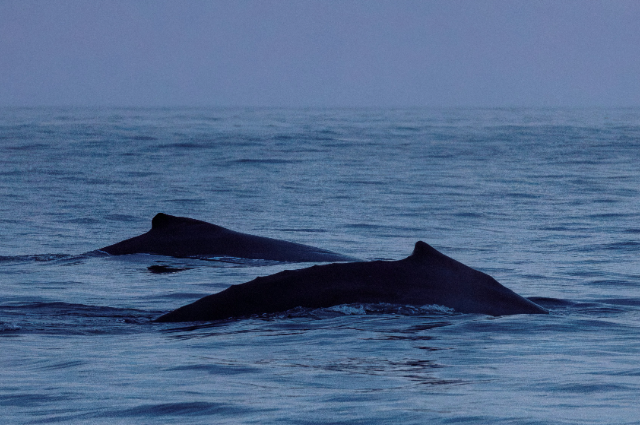
The Biggest Animal Has a Surprisingly Small Climate Role
The blue whale is the largest animal known to have ever lived on Earth. It can grow to around 30 metres long and weigh well over 100 tonnes. Its enormous size makes it look like a creature from another world. But the interesting part of the blue whale’s story is not only its size. Far away from the whale’s huge body is another group of tiny organisms that plays a major role in the Earth’s climate — phytoplankton.
Phytoplankton are microscopic organisms that live mainly near the ocean's surface. Like plants on land, many of them use sunlight and carbon dioxide to grow through photosynthesis. They form the foundation of many marine food chains and are also an important part of the global carbon cycle.
The ocean absorbs a large amount of the carbon dioxide produced by human activities. Phytoplankton are one of the important biological parts of this process because they take up carbon dioxide during photosynthesis. Some of the carbon eventually becomes part of marine food webs, while some can be transported into deeper water through the biological carbon pump. This is where whales enter the story. At first, it may sound strange to connect the world’s largest animal with microscopic organisms. But whales can move nutrients around the ocean in ways that benefit phytoplankton. Scientists call one of these processes the “whale pump.”
Whales often feed at depth and later come back toward the surface. When they release nutrient-rich waste near the sunlit surface, they return nutrients such as nitrogen and iron to an area where phytoplankton can use them. In other words, a whale can take nutrients from one part of the ocean and help make them available somewhere else. And sometimes, the smallest part of the whale’s story can have an important effect on the biggest environmental system.
What Is the “Whale Pump”?
The ocean may look like one huge body of water, but nutrients are not equally available everywhere. This is especially important for iron. In some parts of the ocean, there is plenty of nitrogen and phosphorus, but phytoplankton still cannot grow as much as they could because there is not enough usable iron. The Southern Ocean is one of the best-known examples of this problem. Whales can help move some of this iron.
Baleen whales eat large amounts of food such as krill. When they digest their food, some of the nutrients they have consumed are released again through their waste. Research has found that whale faeces can contain extremely high concentrations of iron compared with surrounding seawater. A study reported in Nature Climate Change found that whale faeces collected from baleen whales contained, on average, about 10 million times more iron than Antarctic seawater. That does not mean the entire ocean suddenly becomes filled with iron whenever a whale defecates.
The important point is that the whale is concentrating nutrients and releasing them in a form and location where they can potentially become available to organisms living near the surface. This is why scientists use the term whale pump. A whale feeds in nutrient-rich deeper waters and then comes to the surface. Its movement and waste can help recycle nutrients into the sunlit part of the ocean. And sunlight is extremely important.
Phytoplankton living in the surface ocean need sunlight to carry out photosynthesis. If important nutrients are available, their growth can increase.
More phytoplankton can mean more carbon being taken from the atmosphere into the ocean’s biological system. However, scientists also point out that the process is complicated. The amount of carbon ultimately stored depends on many factors, including the type of phytoplankton, the region, ocean conditions and whether the carbon is actually transported to deeper waters. So whale poop is not a magic solution to climate change. It is one small but fascinating part of the much larger ocean carbon cycle.
From Whale Waste to Carbon
So how can whale waste possibly be connected with climate change? The answer begins with photosynthesis.
Phytoplankton use sunlight and carbon dioxide to produce organic matter. When phytoplankton grow, they take carbon dioxide from the surrounding water, which is connected to the atmosphere through air-sea exchange. Some of this biological material is then eaten by other marine organisms.
A portion of the carbon can eventually sink deeper into the ocean. This movement is part of what scientists call the biological carbon pump. The deeper the carbon travels, the longer it may remain away from the atmosphere. But this process is not automatic. Much of the carbon is recycled near the surface, so only a fraction becomes long-term ocean storage.
This is why researchers are careful about claiming that whales themselves remove a specific huge amount of carbon from the atmosphere. A 2023 review in Frontiers in Marine Science explained that the whale pump can increase the availability of nutrients such as iron and potentially stimulate phytoplankton production. But it also stressed that the actual amount of additional carbon sequestration caused by whales is still uncertain and varies between ocean regions.
Research has nevertheless found some striking possibilities. One modelling study discussed in that review estimated that, before large-scale whaling, four Southern Ocean baleen whale species could have contributed to the capture of up to about 0.215 pentagrams of carbon per year through whale-driven nutrient cycling. But this is a model-based estimate for a particular historical ecosystem, not a simple global number that can be applied to every whale today.
More recent research has also found evidence that whale faeces contain forms of iron that can remain available to marine organisms. A 2025 study published in Communications Earth & Environment examined whale faecal samples and found high concentrations of dissolved iron and other compounds that can influence the availability of these nutrients. The researchers said industrial whaling reduced this natural nutrient-recycling mechanism by more than 90%. So the connection is quite simple:
Whales eat → whales recycle nutrients → phytoplankton receive nutrients → phytoplankton grow → carbon enters the marine biological system. The actual climate effect is much more complicated, but the basic connection is scientifically interesting.
Why Saving Whales Can Also Help the Ocean
For centuries, whales were hunted on a massive scale for oil, meat and other products. Commercial whaling dramatically reduced populations of many large whale species. This not only removed individual animals from the ocean. It also removed large animals that were participating in nutrient movement and marine food webs.
A 2025 study noted that around 1.5 million baleen whales were killed in the Southern Hemisphere during the 20th century, including more than 95% of the largest fin and blue whale populations. When whale populations fall, the amount of nutrients they move and recycle can also fall.
This does not mean that restoring whale populations alone can solve global warming. Human greenhouse-gas emissions remain the main driver of modern climate change, and reducing those emissions is essential. But whale conservation can have benefits beyond simply protecting an endangered animal.
Whales are part of complicated marine ecosystems. They eat large amounts of prey, transport nutrients, support food webs, and store carbon in their bodies. When whales die and their bodies sink to the seafloor, the process known as a whale fall can also transfer carbon and nutrients into deep-ocean ecosystems. NOAA notes that whales can store substantial amounts of carbon in their bodies, and whale falls can move that stored carbon to the ocean floor.
This makes the whale a very unusual part of the climate story. A blue whale may be enormous, but its role isn't based only on the carbon stored in its body. It is also connected to what happens around it — the nutrients it moves, the organisms it supports and the carbon cycle it becomes part of.
The idea of the whale pump therefore gives conservation a different meaning. Protecting whales is not a replacement for cutting fossil-fuel emissions. It is better understood as protecting a natural ecosystem process that has been weakened by human activity.
The next time a whale rises to the ocean surface, it may look like just a giant animal coming up for air. But beneath that simple movement is a much bigger story — one involving iron, microscopic phytoplankton, carbon and the health of the ocean.
And perhaps that is the most surprising lesson of all: sometimes the fight against climate change is connected to things as small as microscopic plankton — and as unexpected as whale poop.
References:
- Nature Climate Change — “The whale story” Important source for the iron concentration in whale faeces and the original whale-pump research. Nature Climate Change — The whale story https://www.nature.com
- Frontiers in Marine Science — “Do whales really increase the oceanic removal of atmospheric carbon?” Very useful for explaining both the potential and the scientific uncertainty around whale-driven carbon sequestration. Frontiers — Whale carbon removal review https://www.frontiersin.org
- Nature — Natural iron fertilisation and carbon sequestration in the Southern Ocean. Background on why iron can be important for phytoplankton and carbon cycling. Nature — Natural iron fertilisation https://www.nature.com
- Communications Earth & Environment — 2025 whale-excrement study. Recent research on iron availability in whale waste and the effects of historical whaling. Nature — Organic ligands in whale excrement https://www.nature.com
- NOAA Fisheries — Whales and carbon sequestration. Useful background on carbon stored by whales and whale falls. NOAA Fisheries — Whales and Carbon Sequestration https://www.fisheries.noaa.gov