
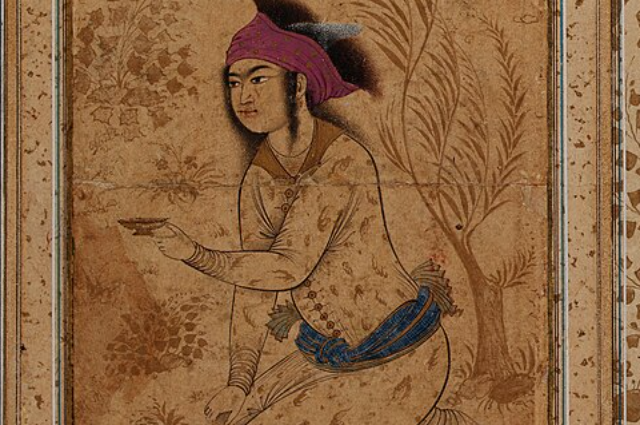
In 1928, a Lahore publishing house produced a lavish illustrated edition of the Diwan-i-Ghalib, the collected verse of Mirza Ghalib. Known as the Muraqqa-i-Chughtai, it paired Ghalib's poetry with roughly fifty plates by the Lahore painter Abdur Rahman Chughtai. Trained at the Mayo School of Arts, Chughtai developed a distinctive visual language drawing on Persian and Mughal traditions, fluid lines, and the watercolour wash technique associated with the Bengal School. The book carried a foreword by Muhammad Iqbal and an introduction by James Cousins, and its publication helped establish Chughtai's reputation beyond Lahore.
This cultural history has nothing to do with Partition, and that fact matters. Before it became a family's remnant, the Muraqqa-i-Chughtai belonged to a living and confident cultural world built from Urdu poetry, Lahori publishing houses, and the emergence of modern Indian painting. A world in which a poet long dead and a painter finding his voice could be bound together in a single volume and sent out to be admired. It was a beautiful and celebrated book. Nothing about its creation suggested that it would one day be asked to carry a heavier kind of meaning.
Among the households in Lahore that owned a copy were Basant Kishan Khanna and his wife, Leelavati. The available accounts do not record how the book came into their possession. What is known is narrower and more personal: the book was Leelavati's, and among her possessions it was the one she treasured most. Before 1947, it was simply part of an ordinary domestic life in Lahore. There was nothing yet to distinguish it from any other cherished possession in any other Lahore home. That distinction would be created by what came next.
On 14 August 1947, Basant Kishan Khanna and Leelavati gathered their children and left their home in Lahore, believing that the departure was temporary rather than final. Because they expected to return, they carried very little with them. What survives of that particular departure is mostly silence.
Among the few remnants that survived from the Khannas' Lahore life was Leelavati's copy of the Muraqqa-i-Chughtai.
Partition displaced people on a scale that remains difficult to hold fully in mind. Millions crossed the newly drawn borders in both directions within a matter of months, often carrying only what they could manage. Behind them, homes and possessions were left behind, including furniture, shops, books, and private libraries.
In East Punjab, the government moved quickly to take charge of abandoned property, and books were no exception. Historian Mrinalini Venkateswaran's research into the administrative archives of post-Partition Punjab describes how the East Punjab government treated belongings left by departed Muslim residents as evacuee property. Officials in Jullundur reported large quantities of books and manuscripts at Karnal, Kunjpura, and Panipat, and the province's Historical Records Office was instructed to examine the material, retaining what was considered suitable and eliminating portions deemed irrelevant to the archives.
Books and manuscripts became one more category of property to be inventoried, sorted, and appropriated by the state. A book left behind could enter a bureaucratic system that determined whether it was worth preserving.
Set against a landscape of this scale, in which private collections could become government inventory, Leelavati's single cherished book appears almost impossibly small. Nothing in the surviving record indicates that her copy passed through an evacuee property office, nor do we know precisely how it survived the family's displacement. What can be said is simpler: amid an upheaval that separated countless people from their possessions, one particular book remained part of one family's material history.
It is tempting to ask how this particular book survived, whether Leelavati carried it when the family fled or whether it reached her later by some other route. The honest answer is that this cannot be known. A more answerable question can be asked in its place: How do ordinary possessions become extraordinary once the life that surrounded them has changed?
Writer Aanchal Malhotra has spent years documenting objects connected to families displaced by Partition, along with the histories attached to them. Her work uses both precious and mundane personal belongings as catalysts for memory, uncovering family histories of loss, displacement, belonging, and identity. A key, a length of cloth, a piece of jewellery: the significance of such objects can extend far beyond monetary value. The object becomes an anchor to a life that otherwise survives largely through memory.
The Muraqqa-i-Chughtai carries an additional layer. An heirloom can evoke a place through association, but this book was itself a product of the cultural world in which the Khannas had lived: published in Lahore, illustrated by a Lahore artist, and built around poetry already embedded in the literary life of the subcontinent.
Decades later, Rajni and Padam Rosha loaned Leelavati's copy of the Muraqqa-i-Chughtai to the Partition Museum in Amritsar.
Something changes when a private object of this kind enters a museum.
Until then, the book belonged to a family's personal history. Within a Partition collection, it becomes available to people who never knew Leelavati, who cannot ask her why she cherished it, and who encounter it as a fragment within a much larger history. In this way, memory moves outward: from one woman to her family, from the family to an institution, and from the institution to the wider public.
This outward movement also shows how objects can contribute something different from official records to the history of Partition. Government records preserve the scale of Partition in the currency that governments keep, which is to say dates, migration figures, legislation, and the administrative machinery of new borders. An object like this book offers something different: the plain fact that a specific person owned it and cherished it. Behind the migration figures was a woman for whom this particular book mattered.
Setting aside 1947 itself—the violence, the political negotiations, the men who drew the border and the people who crossed it—it is worth looking once more only at the book. It was made in Lahore in 1928, out of a poet's verse and a young painter's still-forming style. It became one woman's most cherished book. Her family left Lahore in 1947 believing they would return. The book survived as part of the family's material history and eventually entered the public memory of Partition through the museum.
There is a common assumption that historical evidence must be created for documentation, whether as a government file, a photograph taken to record an event, or a testimony given because someone understood it would matter later.
Yet some of the most telling evidence becomes historical only by accident. The Muraqqa-i-Chughtai was not printed in 1928 to bear witness to a Partition that no one could yet have imagined, and Leelavati did not treasure the book because she foresaw a museum case in Amritsar in the future. History happened to the object afterwards, in much the same way that history happens to a person, and it left the book holding far more meaning than anyone who made it had ever intended it to carry.
References:
- https://www.tarunartgallery.com
- https://artsandculture.google.com
- https://www.rereeti.org
- https://www.thefridaytimes.com
- https://www.aanchalmalhotra.com/writing-remnants/
- https://doi.org/10.1017/S0026749X22000580