
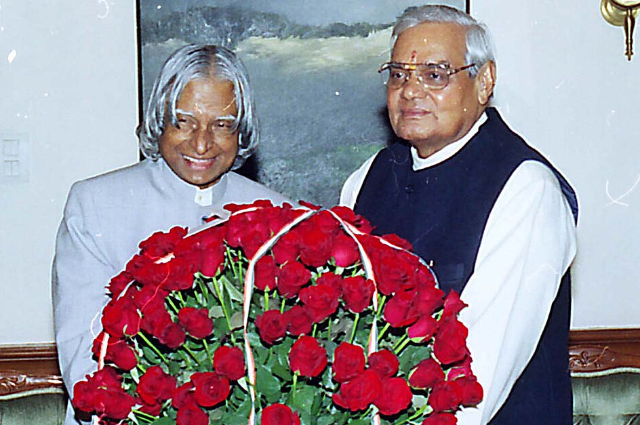
A Dream Born in a Small Town
Every extraordinary journey has an ordinary beginning. Some begin in wealthy families, some in famous institutions, and others in places where opportunities are limited but dreams remain unlimited.
In the small island town of Rameswaram, Tamil Nadu, a young boy once helped distribute newspapers to support his family's modest income. His mornings were not always spent preparing for school or enjoying childhood activities. He also had responsibilities that taught him the value of hard work at an early age.
Nobody could have easily predicted that this boy would one day become a leading aerospace scientist, guide India's space and missile programmes, and eventually occupy Rashtrapati Bhavan as the President of India.
His name was Avul Pakir Jainulabdeen Abdul Kalam, popularly remembered as Dr A.P.J. Abdul Kalam.
His journey was not simply a story of professional success. It was a story of education, discipline, family values, determination, and an extraordinary belief in the power of dreams.
A Childhood Without Luxury but Full of Values
A.P.J. Abdul Kalam was born on 15 October 1931 in Rameswaram, a small town in Tamil Nadu known for its religious and cultural significance.
He belonged to a modest Tamil Muslim family. His father, Jainulabdeen, owned a boat and was known for his wisdom and simple lifestyle. His mother, Ashiamma, was remembered for her kindness and generosity.
The family did not possess great wealth, but Kalam grew up in an environment where honesty, discipline, kindness, and respect for others were important values.
His childhood was different from that of many children today. He did not have access to every comfort or educational resource. Books were not easily available, and his family had to manage its responsibilities carefully.
However, his circumstances never completely limited his curiosity.
He developed an interest in learning and became particularly fascinated by mathematics and the world around him. His childhood environment also introduced him to people who encouraged him to read, ask questions, and think beyond the boundaries of his surroundings.
The foundation of his future was gradually developing, even though he was still a young schoolboy.
The Newspaper Boy Who Learned Responsibility
One of the most memorable parts of Kalam's childhood was his involvement in newspaper distribution.
His cousin, Samsuddin, was the sole newspaper distributor in Rameswaram. During the Second World War, changes in railway operations affected the way newspapers reached the town.
The train no longer stopped at Rameswaram station in the usual way. Newspaper bundles had to be thrown from the moving train, and someone was needed to collect them.
Kalam helped his cousin with this work.
This became his first experience of earning money. In his autobiography, Wings of Fire, he recalled the pride he felt when he received his first wages.
It was not simply about earning a small amount of money. It was about discovering responsibility, independence, and the satisfaction of contributing to family needs.
His work did not replace his education. He continued attending school and studying while managing his responsibilities.
For many people, newspaper distribution might appear to be an ordinary activity. But for young Kalam, it became an early lesson in discipline and commitment.
He learned that dignity does not depend on the nature of one's work. Honest effort deserves respect, regardless of how small the task may appear to others.
Education: The Door He Refused to Close
Kalam understood that education could open doors that circumstances might otherwise keep closed.
He continued his schooling in Rameswaram and later pursued higher education with considerable dedication.
He studied physics at St. Joseph's College in Tiruchirappalli. His interest in science gradually became stronger, leading him towards aeronautical engineering at the Madras Institute of Technology.
Choosing this field was an important turning point in his life.
Aeronautical engineering required technical understanding, patience, and the ability to approach complicated problems. It was a demanding academic path, but Kalam continued working towards his ambition.
His journey reminds us that education is not merely about collecting certificates or securing marks. It is also about developing curiosity, learning to solve problems, and discovering what we can contribute to society.
Not every student begins with equal resources. Some have access to advanced facilities, while others must work with limited opportunities.
Yet, access to education, encouragement from teachers, and personal determination can make a meaningful difference.
Kalam's life demonstrates how education can become a powerful instrument of personal and national development.
When Challenges Became Lessons
Success rarely follows a perfectly straight path.
Kalam also experienced disappointment during his journey. One of his ambitions was to become a fighter pilot in the Indian Air Force. However, he narrowly missed the selection.
For someone who had worked towards a particular dream, this was a significant setback.
But this experience did not bring his journey to an end.}
He continued developing his knowledge and eventually entered the world of aerospace research.
This part of his life offers an important lesson: sometimes, the opportunity we expect does not arrive, but that does not mean every future opportunity has disappeared.
A setback can force us to reconsider our direction, develop new abilities, and discover possibilities we had not previously considered.
Kalam's professional journey demonstrates the importance of continuing to learn even when circumstances do not match our expectations.
His life was not defined by one unsuccessful opportunity. It was shaped by the many efforts that followed.
From a Young Student to a Scientist
In 1960, Kalam began his professional career at the Defence Research and Development Organisation (DRDO).
Later, he joined the Indian Space Research Organisation (ISRO), where he became closely associated with India's developing space programme.
One of his major contributions was his leadership as Project Director of India's first indigenous Satellite Launch Vehicle, SLV-III.
In July 1980, this launch vehicle successfully placed the Rohini satellite into near-Earth orbit.
It was an important achievement in India's scientific development.
For a country working to strengthen its technological capabilities, this success represented more than a scientific milestone. It demonstrated the possibilities of national research, cooperation, and long-term investment in knowledge.
Kalam later became closely associated with India's missile development programmes and earned the popular title of the Missile Man of India.
His journey from a modest childhood in Rameswaram to the world of advanced scientific research was remarkable.
However, his achievements were not the result of individual effort alone. He consistently acknowledged the contributions of teachers, colleagues, mentors, and institutions that helped shape his professional life.
The Importance of Teachers and Mentors
Behind many successful individuals are people whose contributions are not always visible to the world.
In Kalam's life, teachers and mentors played an important role.
They encouraged him to think independently, develop scientific curiosity, and remain committed to learning.
His childhood experiences also exposed him to people from different religious and social backgrounds. These relationships influenced his understanding of harmony, mutual respect, and the value of shared humanity.
This is particularly important in a society where differences sometimes become reasons for misunderstanding.
Education should not only prepare students for employment. It should also help them become responsible citizens who respect others and contribute positively to society.
A teacher may never know how far a student's journey will eventually reach. A few words of encouragement, a meaningful lesson, or an opportunity to explore an interest can influence an entire future.
Kalam's story reminds us that the influence of education often extends far beyond the classroom.
The Newspaper Boy Enters Rashtrapati Bhavan
On 25 July 2002, A.P.J. Abdul Kalam became the 11th President of India.
The journey from a young newspaper distributor in Rameswaram to the President of the world's largest democracy was extraordinary.
He served as President until 25 July 2007.
But what made Kalam particularly admired was not simply the position he occupied. It was his approach to people, especially young students.
He regularly interacted with students and encouraged them to develop scientific curiosity, think independently, and contribute to India's development.
Even after achieving national recognition, he remained associated with education and public service.
His simplicity and willingness to communicate with ordinary people helped him earn the affection of millions.
For many young Indians, he became an example of what education, determination, and responsible leadership could achieve.
His story also represents an important democratic possibility: a person's beginnings do not have to determine the highest position they can reach through knowledge, effort, and public contribution.
A Story That Goes Beyond Personal Success
It would be easy to describe Kalam's life only as a journey from poverty to the presidency. But such a description would miss some of its most meaningful lessons.
His story is also about the relationship between individual ambition and social responsibility.
He did not limit his interests to professional recognition. He believed that knowledge should contribute to the development of society.
His scientific work, public service, books, and interactions with students reflected his continuing interest in India's future.
He demonstrated that achievement becomes more meaningful when it creates opportunities for others.
A young student who receives encouragement today may become a teacher, scientist, researcher, or responsible citizen tomorrow.
Therefore, investing in education is not simply an investment in one person's future. It is an investment in the future of society.
Kalam's life encourages us to look beyond immediate success and consider what we can contribute to the people around us.
What His Journey Teaches Today's Generation
Today, many young people face different kinds of challenges.
Some struggle with financial limitations. Others experience academic pressure, uncertainty about their future, or a lack of guidance.
Social media also creates an environment where people frequently compare their progress with the achievements of others.
In such circumstances, Kalam's journey offers several important lessons.
First, our beginnings do not define our entire future. Where we start is important, but it does not have to determine where we finish.
Second, education requires patience. Learning is a continuous process, and meaningful progress often takes years of effort.
Third, honest work deserves dignity. No responsibility should be considered inferior simply because it does not bring recognition or wealth.
Finally, failure should not become the final description of a person's abilities. Disappointment can be an opportunity to learn, reconsider, and move forward.
These lessons are relevant not only to students but also to parents, teachers, institutions, and society.
Young people need more than motivational speeches. They need access to quality education, supportive environments, opportunities to develop their abilities, and people who believe in their potential.
He Never Sold His Dreams
A.P.J. Abdul Kalam's life began in a modest home in Rameswaram. His childhood included responsibilities that many people might overlook, including helping his cousin distribute newspapers.
Years later, he became one of India's most respected scientists and its 11th President.
The distance between those two stages of his life was covered through education, discipline, perseverance, guidance, and an enduring commitment to learning.
His story reminds us that a person's present circumstances should never become the only measure of their future possibilities.
Not every child has the same opportunities, and not every dream follows the same path. But every child deserves the chance to learn, grow, and discover what they are capable of achieving.
Perhaps the most important part of Kalam's story is not that a newspaper boy became President. It is that a young boy continued to value education and knowledge despite the limitations around him.
The newspapers he helped distribute carried news of the world to the people of his town. His own journey eventually became a story that inspired generations.