
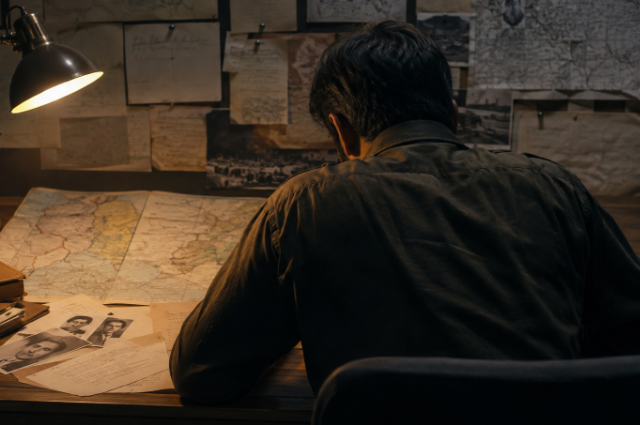
Ravindra Kaushik, known as the Black Tiger, was a legendary R&AW undercover agent, former theatre actor, and military major. He excelled in living an u suspect able way of life when undercover and had strong Theatrical roots. He was spotted for his exceptional acting and disguise skills during national youth t festivals in India.
He stepped into Pakistan as a spy with a brand new identity. He infiltrated Pakistan in 1975 under the deep-cover alias Nabi Ahmed Shakir. He graduated from Karachi University with a law degree and successfully joined the Pakistan Army, eventually rising to the rank of Major. He was very brilliant and excelled in making strategies.
He passed vital news and classified information regarding Pakistani troop movements, defense strategies, and military accounts back to the Indian intelligence. Ravindra Kaushik was given the title "The Black Tiger" by Prime Minister Indira Gandhi in recognition of his extraordinary bravery and invaluable intelligence services.
The moniker became his official code name within the Research and Analysis Wing (R&AW) due to specific milestones in his career. He had contributed many valuable intelligence deliveries, such as between 1979 and 1983, Kaushik passed critical, high-level reports regarding Pakistani troop movements, defense strategies, and their clandestine nuclear program at Kahuta.
He had performed a Major Operation in 1979. According to accounts from his family and intelligence circles, they say that Kaushik had executed it in a very highly successful and high-risk intelligence way. His ability to plan strategies brilliantly reportedly saved the lives of thousands of Indian soldiers by fortunately putting a stop to the enemy military offensives before they could happen.
His name reflected his fierce, stealthy, and solo nature, and his ability to operate deeply and seamlessly inside the highest ranks of a hostile nation's military apparatus without ever being detected by his very own clever strategies. In 1983, a fellow RAW agent was captured, tortured and exposed Kaushik. Kaushik was then arrested, tortured, and sentenced to death and later spent his life in prison.
India never publicly acknowledged him. He spent around 16 years in Pakistani jails. He once got tuberculosis which led to his death in 2001. He never returned home. India's Research and Analysis Wing (R&AW) spotted Ravindra Kaushik at a national-level theatre event in Lucknow. His exceptional mono-act performance as an Indian soldier under interrogation impressed scouts.
He was recruited at age 23; he underwent intense training in Delhi. He learned Urdu, studied Islamic religious texts, and deeply familiarised himself with Pakistani geography. To make his identity seem even more realistically Pakistani, he married a Pakistani woman named Amanat and fathered a son, hence keeping his true origins entirely hidden away from the local community.
In September 1983, R&AW sent a low-level operative named Inayat Masiha across the border to establish physical contact with Kaushik. The Pakistani intelligence agencies (especially the Inter-Services Intelligence) caught Masiha as he crossed into Pakistan. Under intense interrogation and torture, Masiha broke and confessed his purpose.
Pakistani officials forced him to proceed with his meeting layout to catch Kaushik as well. Masiha then went to a designated public park in Multan to meet Kaushik. The park was heavily surrounded by Pakistani intelligence agents, who immediately arrested Kaushik the moment he acknowledged Masiha.
Despite two years of brutal torture at an interrogation centre in Sialkot, Kaushik refused to break his silence or reveal any secrets about the Indian intelligence system. This proves his dedication and w. The tragic reality of Ravindra Kaushik’s final years came to light through secret letters he managed to smuggle out of Pakistani prisons to his family in India.
He had asked a heartbreaking question in one of his final letters, he penned a line that remains a symbol of his sacrifice: "Is this the reward a person gets for sacrificing his life for a big country like India?". His family became victim to that of severe tragedy, the letters confirmed that he was alive but enduring horrific torture.
Upon receiving the first letter, his father (a retired Indian Air Force officer) suffered a fatal heart attack from the shock.
Due to the nature of deep-cover espionage, the Indian government could not legally acknowledge his existence. His mother, Amladevi, and brother spent decades sending pleas to Prime Ministers, but received no official diplomatic support or acknowledgement.
The massive release of the action thriller film Dhurandhar (2025) directed by Aditya Dhar renewed immense public interest in real-life espionage and undercovers. Media coverage explicitly compared the storyline in the film to the raw reality of what Kaushik faced. Today, Ravindra Kaushik’s legacy is defined as the gold standard of deep-cover espionage in India.
He represents both the aspects of patriotic sacrifice and the tragic, sobering cost of human intelligence operations. Unfortunately, he has never received official military honours or public acknowledgement from the Indian government. However, his legacy endures powerfully in the public domain through several avenues such as films, online platforms and the media.
Sources: