
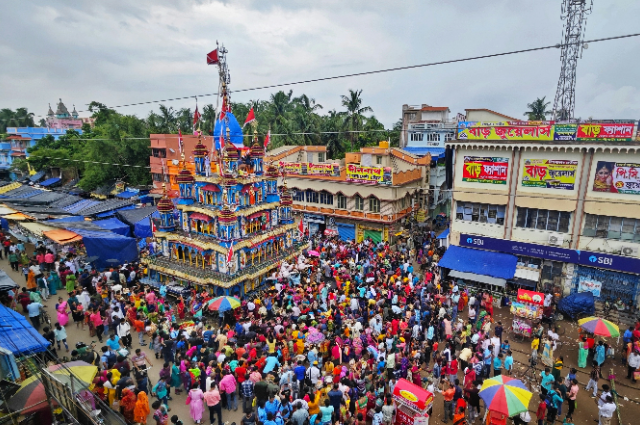
The Jagannath Rath Yatra is a famous annual Hindu chariot festival that happens in Puri, Odisha, featuring the deities Lord Jagannath, Balabhadra, and Subhadra, as they embark on a journey towards the Gundicha Temple. The deities are the key features of this Yatra; Lord Jagannath, his brother Balabhadra, and sister Subhadra ride on three massive, newly built wooden chariots.
The journey occurs when the devotees pull the heavy wooden chariots along the Grand Road (Bada Danda) from the 12th-century Jagannath Temple to the Gundicha Temple, where the deities stay for a week. After nine days, the return journey back to the main temple is called the Bahuda Yatra. There is a sacred ritual where the titular king of Puri sweeps the path in front of the chariots with a golden broom to show that everyone is equal before God.
Then the Pahandi happens, which is the ceremonial and rhythmic moving of the deities out of the main temple onto their respective chariots. The Grand Chariot is known as the Nandighosa, which is Lord Jagannath's chariot, which stands roughly 45 feet tall with 16 wheels. The Taladhwaja is Lord Balabhadra's chariot which features 14 wheels. The Darpadalana is Devi Subhadra's chariot, which runs on 12 wheels.
The historical origin of the Jagannath Rath Yatra in Puri is a unique blend of ancient tribal worship, textual mythology, and medieval royal history. The tribal roots (pre-history) state that the indigenous deity, long before the wooden idols and massive chariots existed, the deity was worshipped as Nila Madhava (the blue stone deity) by a forest-dwelling Savara tribal chief named Visvavasu.The Living Symbol exists even today, a special group of non-Brahmin, tribal-origin priests called Daitapatis takes full charge of the deities during the Rath Yatra, reinforcing that the festival’s true roots are tribal and egalitarian rather than exclusively orthodox.
The textual origin (The Puranas) state that the origin of the festival traces back to that of King Indradyumna: According to the Skanda Purana (the Purushottama Kshetra Mahatmya), a legendary king named Indradyumna wanted to see Vishnu. After Nila Madhava vanished, the Lord reappeared as a giant, divine log floating in the sea. The idols of Jagannath, Balabhadra, and Subhadra were carved from this log. The Skanda Purana explicitly mandates placing these wooden forms onto chariots so that all humanity can see them.
The medieval expansion (12th to 15th century CE) traces its origin back to the imperial temple. While the tradition is ancient, the festival assumed its current, massive structural scale under King Anantavarman Chodaganga Deva of the Eastern Ganga Dynasty, who began building the current Puri Jagannath Temple in the 12th century.The ritual of the golden broom is as follows, in the 15th century, during the Suryavamshi Gajapati period, King Kapilendra Deva and his successors institutionalized the Chhera Pahanra ritual.
During this ritual, the ruling King sweeps the chariots with a golden broom. This historical act established that the king is merely a servant of the Lord, hence solidifying the festival as a symbol of social equality. The construction of the Puri Rath Yatra chariots is a massive, strategically timed engineering feat managed entirely by hand without modern architectural blueprints, measuring tapes, or power tools.
The exact breakdown of how these towering shrines are built each year includes factors such as the strict 58-day timeline ram navami (log slicing),the first logs of dhaura wood are ceremonially cut at the government sawmill after receiving divine permission (Agyanmala) from the temple. Then comes the akshaya tritiya when the construction begins. The building process officially starts on the Rath Khala (construction yard outside the royal palace).
Priests perform a holy fire ritual and bless the chief carpenters with miniature golden axes. This in turn leads to the happening of the bhaunri festival (axle assembly) Exactly 42 days later, a total of 42 massive wheels are fitted onto their principal wooden axles. The total duration of the entire process takes exactly 58 days to complete.Over 1,000 heavy logs are sourced from specific forest divisions (historically the princely states of Dasapalla and Ranpur).
Only specific varieties of native timber are used based on their unique structural functions, for instance, the phasi wood is used for the heavy-duty wheels because it resists splitting under pressure.Dhaura and Asan woods form the primary structural framework and the main axles. Simili wood is preferred for the main body platform due to its lightweight nature.Over 200 traditional craftsmen—divided into Maharana (carpenters), Bhoi (log handlers and assistants), and Rupakaras (wood sculptors)—work entirely from generational memory.
Components like the wheels (Chaka), axles (Danda), and platforms (Bhumi) are held together using interlocking wooden joints and hand-carved pegs. Instead of modern measuring tape, craftsmen use a Kala Suta—a black thread wrapped around a stick used as an age old scaling system. Hand drills, axes (Barishi), and wooden mallets (Mugdara) are used exclusively to shape the heavy timber.
The towering structures are wrapped in over 1,200 meters of bright, hand-stitched cloth crafted by a specialised team of hereditary tailors. Wood sculptors hand-carve and paint 9 subsidiary deities (Parsva devatas), a wooden charioteer (Sarathi), and 4 wooden horses for each cart using vibrant, traditional folk art styles.
The coir pulling ropes consist of four thick ropes, each 250 feet long and 8 inches in diameter, and are manufactured entirely out of durable coconut fiber and securely fastened to the heavy front axles.Today, devotees carry forward the Rath Yatra festival through the public pulling of massive wooden chariots, chanting sacred hymns, and global processions. Millions gather in places like Puri and participate via international and virtual celebrations.
Millions grab the long ropes (roshi) to pull the raths of Lord Jagannath, Balabhadra, and Subhadra, believing it washes away sins and grants salvation.The air echoes with "Jai Jagannath," accompanied by the beating of drums, cymbals, and devotional dancing. Organizations like ISKCON host localised Festival of Chariots events across dozens of international cities spanning North America, Europe, Asia, and Africa.
Sources:
- www.instagram.com
- www.facebook.com
- www.thehindu.com
- www.mytravaly.com
- www.svastika.com
- www.wikipedia.com
- www.economictimes.com
- www.bbc.co.uk