
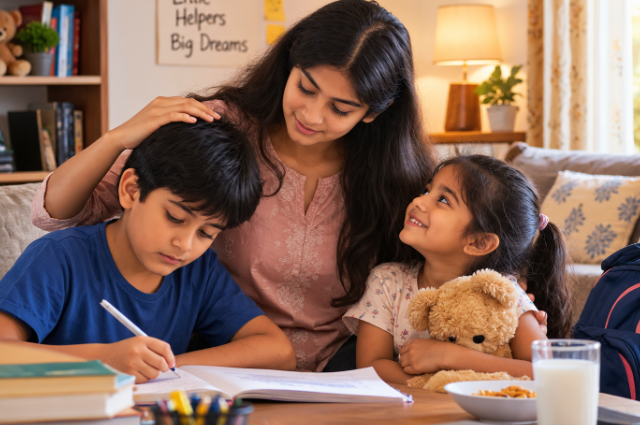
An elder daughter’s journey through responsibility, restrictions, generational change, and the emotional security we hope to create.
Growing up does not always begin with a birthday, a new class, or the freedom to make our own decisions. Sometimes, it begins quietly—with responsibility.
For many elder daughters, growing up can start with small things: cleaning a room after younger siblings have made a mess, helping them learn to read and write, getting them ready for school, managing their routines, or simply being expected to understand things before everyone else does.
Being the first child can feel special. For a while, you are the centre of attention. Then a younger sibling arrives, and although the love in the family may remain equal, the responsibilities begin to change.
You begin to hear things like, “You are the elder one.”
And slowly, being the elder one becomes more than being older.
It becomes carrying.
A 2025 qualitative study on Indian firstborn daughters found that elder daughters are often expected to be mature, guide younger siblings, balance family expectations with personal goals, and sometimes function as a second or third parental figure. The study also identified psychosocial stressors associated with these expectations.
I understand this not only as a concept, but as an everyday reality.
Sometimes, even with younger siblings, you become the person trying to make them move forward. You promise them a reward if they reach a certain percentage because otherwise they may not study. You know it is technically a form of bribery, but your intention is not to control them. You simply want them to progress.
And when you do not help your mother or do not complete the particular responsibility expected from you, guilt can appear almost automatically.
That is where responsibility starts becoming complicated.
Responsibility itself is not the problem.
The problem begins when responsibility becomes so deeply attached to a person that they start feeling guilty for choosing themselves.
When Responsibility Starts Feeling Like Restriction
For a girl, there can sometimes be a strange feeling of being given two choices: protect someone else's feelings or protect your own freedom.
It can feel as though whichever side you choose, someone may be hurt.
Restrictions exist in almost every household, although their intensity differs. Some families have very few, some have moderate boundaries, and some have extremely strict rules. Historically, girls have often experienced stronger restrictions, especially around mobility, relationships, safety and personal choices.
This does not mean that every restriction is wrong.
Parents often say, “We are doing this for your safety.”
And many times, they genuinely are.
But I believe there is another way to think about safety.
Instead of only building walls around a daughter, we should also build her capability to deal with the world outside those walls.
Teach her what an unsafe situation looks like. Teach her how to respond. Teach her how to say no. Teach her whom to trust and whom not to trust. Teach her how to come home safely.
If she is capable of handling a situation and the circumstances allow it, let her go.
Protection should not always mean prevention.
Sometimes, protection should mean preparation.
This becomes particularly important in middle-class families, where resources, household responsibilities and expectations often have to be balanced carefully. I am not trying to describe every Indian family in the same way, because families differ by region, class, culture and circumstances. But in many households, children are expected to contribute to the functioning of the family while also meeting educational and social expectations.
And when a child fails at something, negative comments can sometimes continue for days.
Parents may not always realise what repeated words can do.
Telling a child that they are useless, incapable, or never good enough may be intended as discipline, frustration, or motivation. But repeated often enough, those words can become part of the child's internal voice.
Responsibility should remain responsibility.
It should not become a reason for a child to lose self-respect.
And if we give a child responsibility, we should also give them some authority, trust and capability to carry it.
Not Every Boundary Is a Cage
At the same time, I do not believe that parents should remove every boundary.
A ten-year-old and a twenty-five-year-old cannot be treated in exactly the same way.
Age matters.
There are restrictions that are necessary:
do not hurt another person, do not steal, do not follow harmful paths, stay away from narcotics, and be careful about unsafe company.
These are not restrictions designed to suppress a child's identity. They are boundaries designed to protect it.
The real question is not whether parents should have authority.
The question is how that authority is used.
A healthy parent-child relationship requires a balance between authority, responsibility, accountability, respect and care.
The relationship between an eldest daughter and her parents can be especially complicated. There can be more arguments because she has been given more responsibilities, but there can also be deep understanding and love.
An elder daughter often becomes the person who knows how to convince her parents, manage family situations, or negotiate between different people because she has been doing it for years.
But younger siblings should also remember something important:
The elder sibling was once young too.
She also needed someone to understand her.
Social media is now full of families and influencers showing what a “perfect” relationship looks like. But a healthy family cannot be measured through social media. It is built through communication that happens when nobody is watching.
The Generation That Wants to Choose
The generation growing up today is not necessarily rejecting family.
It is questioning some of the rules through which family life was previously understood.
Many young women now want education, careers, financial independence and the ability to make meaningful choices about their own lives. Marriage may still be important to them, but it is increasingly not the only definition of a successful life.
Research on Indian gender attitudes shows that traditional expectations remain significant. Pew Research Center's survey of nearly 30,000 Indian adults found that while 58% believed both sons and daughters should be responsible for caring for parents as they age, 39% said this responsibility should primarily fall on sons, while only 2% said daughters should primarily carry it. The same research also found that substantial sections of Indian society continue to support traditional divisions of family responsibilities.
At the same time, the younger generation is asking different questions.
Why?
Why should a cat crossing the road automatically decide whether I should continue with my work?
Why should questioning an elder's reasoning automatically be considered disrespect?
Why should a relative's hurtful behaviour always be tolerated simply because they are family?
I am spiritual, but I do not believe that spirituality requires me to stop thinking logically.
I can respect my elders and still question an idea.
I can love my relatives and still maintain a boundary.
I can listen to advice without surrendering my ability to decide.
This is perhaps one of the biggest changes between generations.
Earlier generations often had to tolerate more because maintaining relationships was closely connected with survival, social expectations and family structure. The current generation is more willing to say, “This is where I stop.”
Not because we do not care.
Because we have learned that our own peace matters too.
We have also become more conscious of our future.
We think about medical expenses, careers, relationships, financial independence and the kind of environment we eventually want our children to grow up in.
We want to be emotionally open and financially capable.
That does not mean we consider our parents wrong.
Our parents grew up with their own realities.
Many of them experienced economic scarcity that our generation may find difficult to imagine. They woke up early, worked physically demanding jobs, studied with very limited resources, lived without electricity or modern conveniences, and still tried to give their children better schools, better clothes, festivals, food and opportunities.
They gave us many things that they themselves did not have.
That deserves recognition.
But material security and emotional security are not the same thing.
And this is where the generational gap becomes visible.
A government publication discussing generational differences in Indian women's mental health similarly notes a shift from older expectations centred on duty, domesticity and family harmony toward younger women's greater emphasis on autonomy, education and professional aspirations. It also describes the tension that can arise when these expectations collide.
Perhaps our parents gave us the financial and material security they understood.
Our generation is now trying to understand the emotional security we also need.
What We Are Still Learning
We are still learning that freedom does not mean having no boundaries.
It means understanding which boundaries protect us and which ones unnecessarily limit us.
We are still learning that responsibility should not require self-erasure.
We are learning that saying “no” does not automatically make us selfish.
We are also learning that parents are human beings, not perfect systems of decision-making. They can be right about one thing and wrong about another. They can love us deeply and still fail to understand what emotionally drains us.
And children can also be wrong.
The solution cannot be that one generation always wins.
The solution has to be communication.
Instead of fear, anger or silence, there can be conversation.
Instead of “because I said so,” there can be “let me explain why I am worried.”
Instead of hiding everything from parents, there can be enough trust for a child to say what is actually happening in their life.
This is especially important for daughters.
A daughter should not have to choose between being loved and being independent.
She should be allowed to become capable without being made to feel guilty for becoming capable
What Are We Becoming?
If I become a parent one day, I want my child to experience something very simple:
“I wanted to do this, and I achieved it.”
I want my child to live according to their abilities and choices rather than spending their entire life trying to satisfy an image of perfection.
If my child is not academically strong, I want to help them discover what they can master instead.
If they have a relationship, I want them to be able to tell me.
I may advise them about what is right and wrong, but I do not want their first thought to be, “I cannot tell my mother.”
I want to be the person they can come to after success and after failure.
- After a breakup.
- After a career setback.
- After a mistake.
- After a trauma.
- After a day when they simply need somewhere to rest their head and cry.
I never want my child to feel that they were emotionally alone because I was too unavailable to listen.
That does not mean there will be no rules.
There will be age-appropriate boundaries.
There will be conversations about safety, morality, responsibility and consequences.
But I want those boundaries to be explained, not simply imposed.
Because I believe a child who understands a boundary is more likely to carry it into adulthood than a child who only fears punishment.
Perhaps that is the kind of parenting our generation is slowly learning to imagine.
Our parents often gave us what they could afford.
We may be able to give our children something different: the combination of material stability and emotional safety.
Of course, every generation will have a gap.
Our parents had one.
We have one.
Our children will probably have one too.
The goal is not to create a world without generational differences.
The goal is to notice the difference early enough to bridge it.
Because responsibility should teach a child capability, not helplessness.
Protection should teach courage, not fear.
Authority should come with accountability.
And love should never make a child question whether they are worthy of being heard.
Growing up, therefore, is not simply about becoming responsible.
It is about learning what to carry, what to question, what to change, and what to pass on differently.
Maybe that is what evolution really means.
Not rejecting the generation before us.
Not blindly repeating it either.
But taking what they gave us, understanding what they could not give us, and consciously building something better for the generation that comes next.
Research References
- Prajith, N., & Bhuyan, B. (2025). Indian Elder Daughters: A Qualitative Study on Roles, Responsibilities and its Influence on Mental Health. International Journal of Indian Psychology, 13(1), 1010–1021.
- Pew Research Center. (2022). How Indians View Gender Roles in Families and Society. Survey of 29,999 Indian adults.
- Central Reserve Police Force. Mind the Gap: How Generational Differences Shape Indian Women’s Mental Health.