
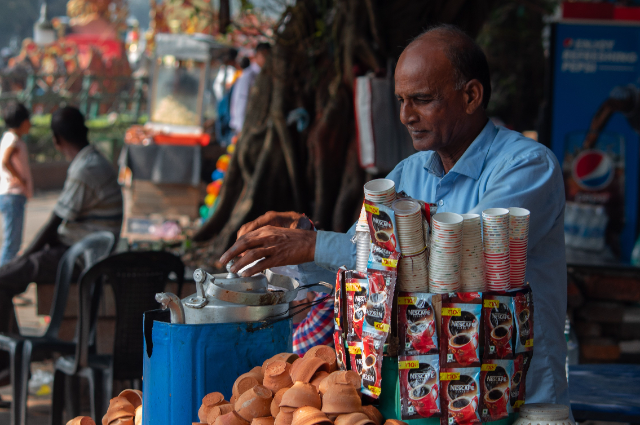
The kettle whistles at exactly 6:15 every morning, the way it has for years now, ever since Govind Kaka set up his stall near the Gandhinagar Metro station in Ahmedabad, Gujarat. Before the sun fully clears the rooftops of the colony, he is already crouched over his stove, stirring tea leaves into boiling water with the same wooden spoon he has used since the beginning — a spoon now worn smooth at the handle, the way a person's palms grow smooth from years of the same work.
He is sixty-one. His hands shake slightly when he pours, but never enough to spill a drop.
For most of the area, he is just "Chai wale Kaka" — the man who sells the best cutting chai for ten rupees, the one who remembers exactly how much sugar each regular customer likes, the one who never raises the price even when the gas cylinder costs more than his weekly earnings. But for thirteen children who live in Shanti Nagar basti, the tin-roofed settlement behind his stall, he is something else entirely. He is Sir.
It started, as most quiet revolutions do, almost by accident.
One evening in 2012, a boy named Prince, maybe eight years old at the time, sat on the wooden bench outside the stall doing nothing in particular — just watching the steam rise, the way children do when they have nowhere else to be. Govind Kaka noticed the boy came back every evening at the same hour. Not to buy anything. Just to sit.
"Ghar nahi jaana kya?" he asked one day. Don't you have to go home?
The boy shrugged. "School chhoot gaya," he said. School is gone. His father had stopped paying the fees after work dried up. The boy didn't sound sad about it — that was the part that stayed with Govind Kaka the longest. He sounded like he had simply accepted it, the way children accept things adults never explain to them.
That night, Govind Kaka did not sleep well. He had left school himself in the fifth standard, when his own father's health failed and someone needed to earn. He remembered exactly what it felt like — not the poverty, but the particular ache of watching other children carry schoolbags while you carried something else.
The next evening, he placed an old slate and a stick of chalk on the bench beside Prince.
"Baith," he said. Sit. "Number sikha du?"
It was not planned. It was not organised. It was one man, one slate, and the gap between the evening rush and closing time.
Word spreads fast in a settlement where everyone lives within shouting distance of everyone else. Within a month, three more children were sitting on that bench after school hours — or after the school hours they no longer had. Within a year, it was thirteen.
Govind Kaka is not a trained teacher. He will tell you this himself, almost apologetically, as if it disqualifies him from what he has been doing for over a decade. He teaches what he knows: counting, basic arithmetic for the market, reading simple Hindi and Gujarati, and — the lesson he seems proudest of — how to write your own name properly, in a hand steady enough that no one can say you signed with a thumbprint.
"Bade school ki baat nahi karta main," he says, wiping down the counter as the last customer of the evening leaves. I don't claim to teach big-school things. "Bas itna chahta hoon ki koi bachcha apna naam likhna na bhoole. Apni ginti na bhoole."
I just want no child to forget how to write their own name. How to count what's theirs.
There is no fee. There has never been a fee. When a local shopkeeper once offered to pay him a small monthly amount to "make it official," Govind Kaka declined, though the extra money would have helped. "Paisa loonga toh majboori ban jayegi," he said. If I take money, it becomes an obligation. "Abhi ye mera shauk hai." Right now, this is something I do out of love.
What he has built has no name, no registration, no signboard. It exists only on a wooden bench, between five and seven every evening, for as long as there is daylight and chalk.
Three of the thirteen children who once sat on that bench have since gone back into the formal school system — one of them, a girl named Meshva, is now in the eighth standard and wants, she says without any hesitation, to become a teacher. Not because anyone told her to. Because it was the only kind of teacher she had ever really known.
Prince, now a teenager, still visits some evenings — not to learn anymore, but to help the younger ones with their letters, sitting exactly where he once sat with nothing to do and nowhere to be.
Govind Kaka does not think of himself as anyone's hero. Ask him, and he will change the subject to whether you want ginger in your tea. But every evening, as the kettle cools and the slate gets wiped clean for tomorrow, thirteen children walk back to Shanti Nagar basti carrying something no one can take from them — not because a government scheme reached them, not because an NGO adopted their settlement, but because one tired, sixty-one-year-old man decided that a boy sitting alone on a bench deserved more than silence.
There are schools with better infrastructure than a tea stall. There are teachers with more degrees than a fifth-standard education. But somewhere in the space between a boiling kettle and a wooden bench, Govind Kaka built something that many well-funded institutions still struggle to create: a place where a child is never made to feel invisible.
And every morning at 6:15, the kettle still whistles — near the Gandhinagar Metro station, in a corner of Ahmedabad most people rush past without noticing — a small, steady reminder that some of the most important lessons in this country are not being taught in classrooms at all.