
The Question That Changed His Life
Harekala Hajabba's lack of formal education shaped how he saw the world.
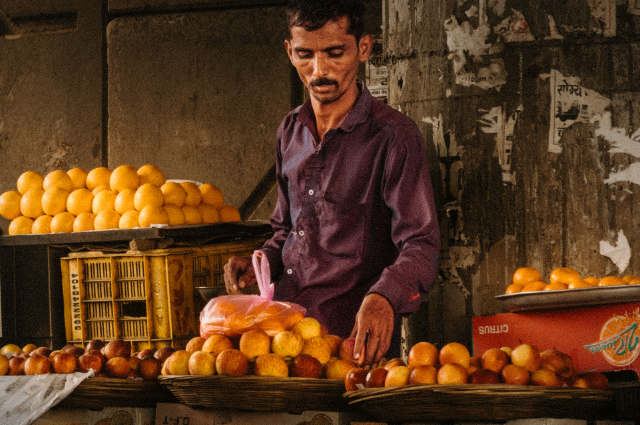
For years, Hajabba earned his living by selling oranges near Mangaluru in Karnataka. He was not a highly educated person, did not have wealth, and did not have a powerful position in society. Yet he carried an idea that was much bigger than his circumstances: children in his village should have access to education.
According to accounts of his life, an encounter with foreign visitors became a turning point. They asked him the price of the oranges he was selling, but he could not communicate with them in English.
For many people, such a moment might pass. For Hajabba, it became a question.
Why should a person be unable to communicate because he never had the opportunity to learn?
Instead of feeling sorry for himself, he began thinking about the children of his village. If he could not change his own childhood, perhaps he could change the future of the next generation.
That thought gradually became a mission.
Saving Small Amounts for a Big Dream
Hajabba was not a wealthy businessman who could simply donate a large amount of money. He was an orange seller. His earnings were limited, and his own life was far from luxurious. Yet he began saving money from his modest income for education in his village.
The idea was simple but difficult: build a school so that children would not have to remain without educational opportunities.
Government material describing his Padma Shri recognition records that he educated poor children in his village, Newpadpu, through the earnings he made selling oranges in Mangaluru. It also records that the school initially operated in a community mosque before developing into a government-supported higher primary school.
What makes this extraordinary is the scale of the sacrifice. He did not wait until he became rich. He did not wait for someone else to solve the problem. He started with what he had.
When a Personal Struggle Became a Community Mission
Hajabba's story is not simply about building a physical school. It is about transforming a personal weakness into a source of strength.
He knew what it meant to grow up without education. Instead of allowing that experience to define him negatively, he used it to understand what other children needed.
His mission was therefore deeply personal. Education, for him, was not merely about examinations or certificates. It represented opportunity. It meant that children could communicate with confidence, understand the world around them, pursue better careers, and perhaps avoid some of the limitations he had experienced.
The school became a symbol of that belief. It showed that a person without formal education could still understand the enormous value of education.
Recognition Came Later
Hajabba's efforts eventually attracted wider attention.
In 2020, the Government of India listed Harekala Hajabba among the Padma Shri awardees in the field of Social Work, Karnataka.
Government material describing his contribution highlights his use of his modest earnings from selling oranges to support education for children in his village. It also notes his efforts to expand educational opportunities for children in the area.
But his recognition did not end the story. The school continued to develop.
In 2024, the school associated with Hajabba's efforts received permission to begin a bilingual Kannada-English medium, with new admissions reported that academic year. The development was significant because it offered local students another educational option without requiring them to depend entirely on private schools.
This is an important part of the story: the dream did not remain frozen in the past. It continued to evolve.
The Real Meaning of Success
Hajabba's life challenges one common definition of success.
We often measure success through money, possessions, job titles, followers, or social status.
But what if success is also measured by the opportunities we create for other people?
By that measure, an orange seller from Karnataka achieved something extraordinary.
He started with very little. He had no large institution behind him. He did not begin with a famous name. He simply recognised a problem and decided that ignoring it was not acceptable.
His approach was not complicated: save what you can, help where you can, and keep going.
That philosophy is powerful precisely because it is accessible to ordinary people.
One Person Can Begin a Change
The story of Harekala Hajabba does not suggest that every individual can solve every social problem alone. It teaches something more realistic: a person can begin.
A small decision can become a larger movement when it is sustained with determination and supported by a community.
Hajabba's school eventually involved local people and government support, showing how an individual's initiative can grow into a broader community effort.
That is perhaps the most important lesson. Change does not always arrive as a grand announcement.
Sometimes it begins quietly—with one person deciding to save a little money, solve one problem, and help one child.
What His Story Teaches Us
Hajabba's journey offers several lessons.
The first is that our circumstances do not have to determine our contribution. A person may not have money, influence, or a high position, but that does not mean they have nothing to offer.
The second is that personal pain can become social purpose. Hajabba experienced the limitations created by a lack of education, but instead of becoming bitter about them, he tried to ensure that future generations would have better opportunities.
The third is that consistency matters more than a dramatic beginning. His achievement was built through years of effort rather than one extraordinary day.
And finally, his story reminds us that education is one of the strongest forms of empowerment. A school does more than provide classrooms. It can give children confidence, knowledge, choices, and a different vision of their future.
The Legacy of an Orange Seller
Harekala Hajabba's story is remarkable because the contrast is so powerful.
A man who once sold oranges at a roadside stall became known across India for promoting education.
A man who struggled with language became a national example of the importance of learning.
A man without great wealth invested his limited earnings in something whose value could not be measured in money.
And a man who could not change his own educational past helped create a different future for children in his community.
The Padma Shri may have placed his name on a national stage, but his greatest achievement is not a medal. It is the possibility created for a child who enters a classroom because someone once decided that education should reach his or her village.
Hajabba's story leaves us with a simple but powerful question:
What can we do with what we already have?
We may not all be able to build a school. But perhaps we can help one student. We may not have thousands of rupees to donate. But perhaps we can give our time, knowledge, books, or encouragement.
We may not be famous enough to change an entire society. But we can still change one person's life.
That is why the story of an orange seller from Karnataka continues to matter.
It reminds us that great change does not always begin with great resources. Sometimes, it begins with a great intention—and the courage to act on it.
References:
- Government of India, Padma Awards 2020 notification — Harekala Hajabba, Padma Shri, Social Work, Karnataka.
- High Commission of India, official Padma Awards profile/material on Harekala Hajabba.
- The Times of India, report on the bilingual Kannada-English medium at Hajabba's school (2024).