
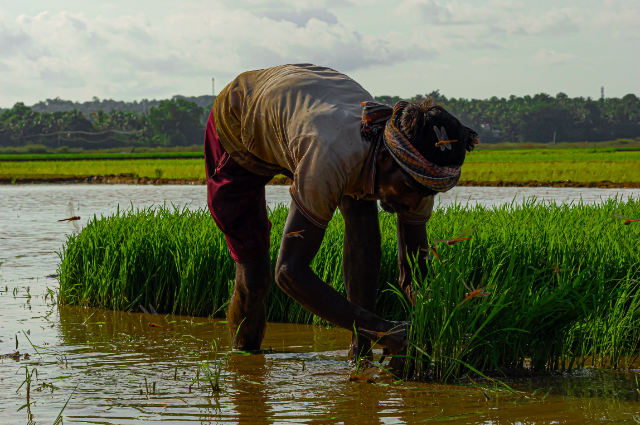
When Farmers Become One Another's Teachers
Agriculture has always required more than land, seeds and rainfall. It demands experience, timely information, patience, and the ability to make difficult decisions under uncertainty. For millions of small farmers, however, these resources are not equally available. A sudden change in weather, an unexpected fall in market prices or an unfamiliar crop disease can destroy months of labour and threaten a family's livelihood.
In such circumstances, farmers often confront problems alone, even when thousands of others face the same difficulties. Information may exist somewhere, but reaching the right person at the right time remains a challenge. Government advisories may not always be sufficiently localised, technological solutions may be inaccessible, and market information may arrive too late to influence a farmer's decision.
Yet an inspiring initiative in Maharashtra demonstrates how this situation can begin to change when farmers decide to learn from one another.
Known as Maitri Vicharanchi, meaning approximately "Friendship of Thoughts", this farmer-led collective began as a modest exchange of agricultural knowledge among a few individuals. Over time, it developed into a digital network connecting thousands of farmers across different regions of Maharashtra. Its experience offers an important lesson: resilience does not always begin with expensive infrastructure or a major institutional programme. Sometimes, it begins when people start sharing what they know.
A Small Beginning with a Larger Vision
The story of Maitri Vicharanchi began in 2015 in western Maharashtra. Bajirav Gagare, a farmer from Mandave Khurd in Ahilyanagar district, was among those who initiated the group. Initially, the idea was straightforward: farmers could communicate with one another, exchange practical experiences and discuss the challenges they encountered in their fields.
The initiative grew from a simple recognition that farmers possess valuable knowledge of their own. They experiment with seeds, irrigation techniques, fertilisers and cultivation methods. Their experience is shaped by local soil conditions, weather patterns and the practical realities of agricultural life.
However, such knowledge often remains confined to individual farms or small communities. A farmer who discovers an effective method may have little opportunity to communicate it to someone facing a similar problem in another village.
Maitri Vicharanchi attempted to overcome this separation.
What began as an informal WhatsApp group gradually developed into a wider knowledge-sharing network. According to a report published by 101Reporters on 30 December 2025, the collective had grown to approximately 6,000 small, marginal and semi-medium farmers across nearly 700 villages in western and northern Maharashtra and the Marathwada region.
Its expansion illustrates the possibilities of a community-driven initiative supported by accessible digital communication. Rather than waiting for knowledge to travel through a formal administrative structure, farmers began exchanging information directly.
Technology with a Human Purpose
One of the most interesting aspects of Maitri Vicharanchi is its use of ordinary digital platforms for an extraordinary community purpose.
WhatsApp messages, audio discussions and online meetings have enabled farmers to communicate across geographical boundaries. They discuss crop selection, irrigation, fertilisers, agricultural diseases, weather conditions and market prices. Questions raised by one farmer can become opportunities for learning among many others.
The importance of this arrangement lies not simply in the technology itself but in how it is used. Digital platforms are often associated with entertainment, personal communication and commercial activities. In this case, they have become informal classrooms in which agricultural knowledge is exchanged through everyday conversations.
Farmers can seek advice when a problem emerges rather than waiting for a scheduled meeting or a formal consultation. Some discussions even take place late at night, when farmers are working in their fields and need immediate assistance.
The collective's experience also challenges the assumption that technological innovation must always originate from major companies or research institutions. Technology can become meaningful when ordinary people adapt it to solve problems that directly affect their lives.
Nevertheless, digital communication should be understood as a supporting instrument rather than a substitute for scientific agricultural research. Its greatest value emerges when practical experience is combined with reliable information and appropriate professional guidance.
Reading the Weather Before It Reads the Harvest
For farmers, weather is not merely a subject of conversation. It is a powerful factor determining whether a season will bring prosperity or financial hardship.
Erratic rainfall, unexpected thunderstorms and prolonged dry periods can disrupt sowing, damage crops and increase cultivation costs. In September 2025, Marathwada received approximately 362.9 millimetres of rainfall, compared with a normal 160.5 millimetres, according to figures cited in the 101Reporters investigation. This represented rainfall around 126 per cent above the long-term average for that month.
For a farmer, such statistics are not distant meteorological observations. They can mean damaged crops, delayed harvesting and uncertainty about the next agricultural season.
Within Maitri Vicharanchi, Vijay Jaybhaye has emerged as an informal weather-information resource. He studies meteorological updates and translates technical information into Marathi, making it easier for farmers to understand forecasts relevant to their districts and agricultural activities.
Instead of relying exclusively on broad geographical descriptions, he communicates information in terms that farmers can connect with their own locations.
This translation of technical knowledge into practical language is significant. Scientific information has limited value when its intended beneficiaries cannot understand or apply it. By making forecasts more accessible, the collective helps farmers consider adjustments to their agricultural schedules.
One reported example concerns Sunil Dhumal, a farmer from Devkarwadi village in Pune district. According to the investigation, weather information shared through the collective helped him prepare his land and complete the planned tomato cultivation in September 2025.
Another example concerns Balaji Sule, a farmer from Nanded district, whose 1.5-acre crop was destroyed by heavy rainfall. Although information alone could not prevent his loss, the support and encouragement he received from fellow members helped him confront the difficult situation. These experiences reveal two dimensions of agricultural resilience: the ability to anticipate risks and the ability to recover when prevention is no longer possible.
Learning to Change: Beyond Traditional Cultivation
Agricultural practices are often shaped by generations of experience. While inherited knowledge can be valuable, changing environmental and economic conditions sometimes require farmers to reconsider established methods.
Sunil Dhumal's experience provides an interesting example.
Growing up in a region where sugarcane cultivation was common, he had become accustomed to traditional cropping patterns. However, through his participation in Maitri Vicharanchi, he began exploring alternative crops and cultivation practices.
According to the published investigation, he decided to allocate four acres to vegetables, including tomatoes, coriander, bitter gourd and ridge gourd.
The decision was not immediately welcomed by everyone around him. His family initially questioned his proposed changes, particularly his use of mulching. Nevertheless, he proceeded with the new approach after learning about it through the collective.
This example demonstrates that agricultural innovation is not simply a matter of introducing new equipment. It can also involve changing attitudes, questioning familiar practices and developing the confidence to experiment.
Farmers are not passive recipients of instructions. They observe, compare, test and adapt. When they have opportunities to discuss their experiences with others, the process of learning becomes more collaborative.
At the same time, every agricultural experiment involves risks. A practice that succeeds on one farm may not produce identical results elsewhere because soil, rainfall, water availability and market conditions differ. Therefore, the most responsible form of peer learning encourages experimentation alongside careful observation and scientific advice.
When Collective Knowledge Becomes Economic Strength
Agricultural production does not end when crops are harvested. For many farmers, selling their produce at a reasonable price is equally challenging.
Market information is often unevenly distributed. Prices may vary between markets, and farmers who lack reliable information can be forced to accept unfavourable offers. Transportation costs, storage limitations and dependence on intermediaries further complicate the situation.
Maitri Vicharanchi has attempted to address part of this problem by encouraging members to exchange information about market prices and potential buyers.
The experience of Bajirav Gagare illustrates the possible economic value of such cooperation.
In a case described by 101Reporters, Gagare was offered eight rupees per kilogram for a cabbage crop in the Sangamner market. After consulting members of the collective, he learned that prices in Nashik were reportedly between fifteen and seventeen rupees per kilogram.
He subsequently connected with buyers in Nashik and sold the produce for twelve rupees per kilogram after accounting for transportation costs. He estimated that the decision saved him approximately sixty thousand rupees.
This example highlights an important principle: information can influence the distribution of economic opportunity.
When farmers share market intelligence, they may become better equipped to compare offers, identify alternative buyers and make informed selling decisions. They can also warn one another about unreliable traders and unfavourable transactions.
However, collective information does not automatically guarantee fair prices. Farmers still face transportation expenses, fluctuating demand, quality requirements and unequal bargaining power. Their experience demonstrates the potential of cooperation, not the disappearance of structural problems in agricultural markets.
A Network That Supports People, Not Only Crops
Perhaps the most meaningful dimension of Maitri Vicharanchi is its contribution to social support. Agricultural discussions often concentrate on productivity, income and technology. Yet farming is also an emotionally demanding occupation. Crop failure, debt, unpredictable rainfall and financial insecurity can create enormous pressure on individuals and families.
For this reason, the collective's role extends beyond exchanging technical information.
The experience of Lalita More, a farmer from Kalvan in Nashik district, illustrates this human dimension. After the sudden death of her husband in 2019, she faced the responsibility of managing her family's agricultural livelihood while raising her children.
Although she had previously assisted with farming activities, she lacked sufficient knowledge of seeds, fertilisers and marketing to manage the work independently.
She gradually began participating in online discussions organised through the collective. Other members shared agricultural information, explained cultivation practices and provided weather-related guidance.
According to the 101Reporters account, More subsequently became capable of managing her farm independently and began sharing her experiences with other farmers.
Her story is particularly significant because it demonstrates how access to knowledge can strengthen personal independence.
A farmer who initially approaches a community seeking assistance may eventually become a contributor to that same community. Learning is no longer a one-way process. It becomes a continuous exchange in which every participant can teach and learn.
This dimension also draws attention to the position of women in agriculture. Women contribute extensively to agricultural production, yet their knowledge and leadership are not always recognised adequately. Initiatives that provide opportunities for women to participate in discussions and decision-making can help make rural development more inclusive.
From Digital Conversations to Real Community
Despite its reliance on digital communication, Maitri Vicharanchi has not remained confined to mobile phones.
According to the 2025 report, members also organise annual physical gatherings. These meetings enable farmers from different districts to meet personally, exchange experiences and establish relationships beyond online discussions.
Around 3,000 farmers reportedly attended the 2024 gathering, according to one of the collective's founders.
Such meetings are important because community relationships cannot always be sustained through digital communication alone. Personal interaction creates opportunities to examine farming practices, discuss difficulties and develop trust.
It also provides a space for members to recognise that their individual struggles are connected to broader agricultural realities.
The movement therefore combines two complementary forms of communication: the speed and accessibility of digital platforms and the trust-building possibilities of face-to-face interaction.
This combination offers a useful model for other rural communities seeking to strengthen cooperation without depending entirely on expensive infrastructure.
The Limits of Collective Action
An honest examination of Maitri Vicharanchi must also recognise what such a collective cannot accomplish.
Sharing information cannot prevent every natural disaster. A weather forecast cannot guarantee that rainfall will occur exactly as predicted, and an online discussion cannot replace irrigation infrastructure, crop insurance, affordable credit or dependable agricultural services.
Likewise, a farmer who receives information about a better market may still lack the transportation facilities or financial resources required to reach it.
Digital participation can also be unequal. Farmers without smartphones, reliable internet access or sufficient digital literacy may struggle to benefit from online networks. Language accessibility and the reliability of information are additional concerns.
There is also a need to distinguish between personal agricultural experience and scientifically verified recommendations. Advice shared among farmers can be extremely useful, but incorrect information about pesticides, fertilisers or disease management may produce unintended consequences.
These limitations do not diminish the value of the collective. Rather, they clarify the conditions under which its work can become more effective.
Community networks should complement public agricultural institutions, universities, research centres and extension services. Stronger partnerships could improve the accuracy of information, expand access to training and help farmers connect their local knowledge with scientific research. The goal should not be to replace institutions with informal networks. It should be to build a relationship in which farmers are recognised as active participants in agricultural development.
A Lesson for Rural India
The experience of Maitri Vicharanchi carries lessons far beyond Maharashtra.
Across India, small and marginal farmers face interconnected challenges involving climate uncertainty, market volatility, limited access to information and unequal economic opportunities. Although these challenges differ between regions, the importance of cooperation remains widely relevant.
A community-based agricultural network can begin with relatively simple steps: identifying knowledgeable local farmers, creating accessible communication groups, sharing verified weather information, discussing market prices and organising regular opportunities for collective learning. However, successful replication requires sensitivity to local conditions. Every region has its own crops, languages, agricultural practices and institutional arrangements. A model developed in Maharashtra cannot simply be transferred to another state without adaptation.
Government departments and agricultural universities could support such initiatives by providing reliable technical information and recognising experienced farmers as partners in extension programmes.
Local organisations could help include women farmers, tenant farmers and people with limited digital access. Cooperatives and farmer-producer organisations could explore ways to connect information-sharing networks with collective marketing and better access to agricultural services.
Most importantly, agricultural policies should recognise that farmers are not merely beneficiaries of development. They are also producers of knowledge and potential innovators.
The Strength of Learning Together
The story of Maitri Vicharanchi is ultimately a story about the power of human cooperation.
Its journey from a small farmers' discussion group to a network connecting thousands of agricultural households demonstrates how shared knowledge can influence everyday decisions. Weather information can help a farmer prepare for rainfall. A conversation can encourage someone to explore a different crop. Market intelligence can help a producer negotiate a better price. A supportive community can give confidence to someone facing personal loss.
None of these developments eliminates the uncertainty inherent in agriculture. Farmers will continue to confront unpredictable weather, changing markets and institutional difficulties. Yet the ability to face these challenges need not remain an individual responsibility.
The deeper achievement of Maitri Vicharanchi lies in the change it represents: farmers who once depended primarily on isolated experience have found opportunities to learn collectively, question established practices and support one another.
In a world where technological progress is frequently measured by sophisticated machines, artificial intelligence and large investments, this initiative offers a quieter but equally important lesson. Technology becomes meaningful when it strengthens human relationships and enables people to solve shared problems.
A farmer's knowledge may begin in a single field, but when it is shared, questioned and improved by others, its value can travel far beyond that field.
Perhaps this is the most important lesson of Maitri Vicharanchi: resilience is not simply the ability to withstand difficulties. It is also the ability to learn together, adapt together and move forward together.
And sometimes, the most powerful agricultural innovation is not a new machine or a new seed. It is a community that refuses to let its members face uncertainty alone.
References:
- Paigude, Shekhar. "Back to Classroom: Maharashtra’s farmers are turning to a peer-run digital collective to navigate climate shocks." 101Reporters, 30 December 2025.
- Bhura, Sneha. "Why farmers are still tuning into Clubhouse." The Times of India, 30 April 2023.
- India Meteorological Department. Rainfall information and meteorological updates for Maharashtra, including the 2025 monsoon season.
- Relevant agricultural research and extension publications on farmer-to-farmer learning, climate adaptation and community-based agricultural knowledge systems.