

Somewhere in India tonight, a mother will begin a sentence at the dinner table with the words “Suno toh…” (listen to this). Somewhere between her first clause and her second, her daughter’s phone will light up. The daughter will nod. She will say, “Haan, haan, bol.” Yes, yes, go on. And she will not hear a single word.
Nobody in this scene is a villain. That is exactly what makes it worth studying. We tend to treat distraction as a personal failing, a weak-willed habit that a little discipline could fix. But a growing body of research suggests something more uncomfortable: the thing we are losing is not just time. It is the quiet, unglamorous act that holds relationships together. It is listening.
The number that stopped me
Gloria Mark, a professor of informatics at the University of California, Irvine, has spent more than two decades doing something deceptively simple. She watches people use screens, and she times them. In 2004, she found the average person stayed on one screen for about two and a half minutes before switching to something else. By 2012, that had fallen to roughly 75 seconds. In her more recent work, summarised in her 2023 book Attention Span, the figure sits at around 47 seconds.
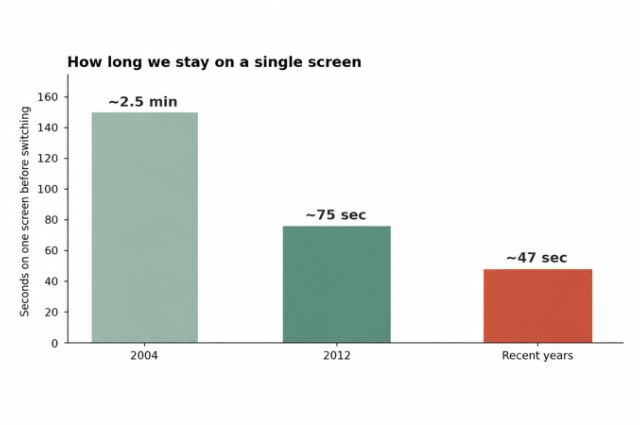
Figure 1. Average time on a single screen before switching. Data: Gloria Mark, Attention Span (Hanover Square Press, 2023). Chart created by the author.
Read that again, slowly, if you can. Forty-seven seconds is shorter than most voice notes we send. It is shorter than the time it takes a grandmother to finish the first half of a story she has told a hundred times. And it is an average, which means that for many of us, many times a day, the break comes sooner.
Mark’s research also points to the cost of each break. After an interruption, people often need more than twenty minutes to fully return to what they were doing. We are not just distracted. We are constantly re-entering our own lives.
The phone that never rings
You might say: fine, but I am not on my phone when someone is talking to me. It is just lying there, face down, politely ignoring everyone. Here the research becomes stranger.
In 2013, psychologists Andrew Przybylski and Netta Weinstein asked pairs of strangers to talk for ten minutes about a meaningful topic. In some conversations, a mobile phone sat nearby, unused. Those pairs later reported feeling less closeness and trust, and rated their partner as showing less empathy than pairs talking with no phone in sight. A phone did not have to buzz to be heard.
To be honest about the science, later studies have found this effect to be smaller and less consistent than first reported, and researchers are still debating how large it really is. But notice what is being debated. Scientists are arguing over whether a silent phone costs us a little or a lot. Almost nobody is arguing that it costs us nothing.
What the attention is for
So what exactly are we trading away? For an answer, we have to go back to 1938, when Harvard researchers began following 268 sophomores to find out what makes a life go well. Decades later, the project added 456 men from some of Boston’s poorest neighbourhoods, and later still their wives and children. It is now one of the longest studies of adult life ever carried out, and its current directors, Robert Waldinger and Marc Schulz, describe its message plainly in their 2023 book The Good Life.
The finding is almost embarrassingly simple. The people who were happiest and healthiest in old age were not the richest, the most famous or the most successful. They were the ones with warm, secure relationships. Closeness at fifty predicted health at eighty better than cholesterol levels did.
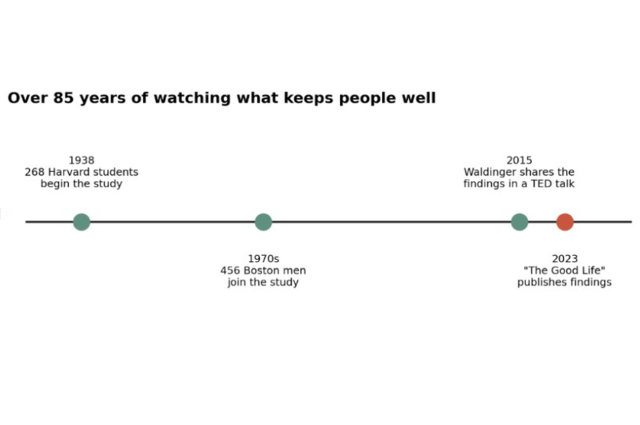
The study has real limits. Its earliest participants were all men, and it cannot speak for everyone. But it does not stand alone. A 2010 analysis led by Julianne Holt-Lunstad pooled 148 studies covering more than 300,000 people and found that those with stronger social relationships had about a 50 per cent greater chance of survival over the study periods. Across methods and decades, the pattern holds. Connection is not a luxury we indulge in after the real work is done. It is part of what keeps us alive.
A word we already had
What struck me most is that Indian languages seem to have understood this long before any laboratory did. In Hindi, we say “dhyaan se suno”, listen with attention. The word dhyaan carries a double meaning: it is the ordinary word for attention, and it is also the word for meditation. Somewhere in our own vocabulary, listening and meditating were never entirely separate things. To pay attention to another person was understood as a discipline, even a small spiritual practice.
Perhaps that is why the mother’s “Suno toh…” stings the way it does. She is not asking for entertainment. She is asking to be, for a moment, the most important thing in the room.
The forty-seven-second experiment
I do not think the answer is to throw our phones into a river. Phones carry our families across cities, our classrooms across continents, and, quite often, our best ideas. The answer is smaller and more doable than that.
Next time someone starts talking to you, try this. Put your phone out of sight, not just face down, but in a bag or another room. Then listen for forty-seven seconds without touching anything, finishing anyone’s sentence or composing your reply. Just forty-seven seconds, the same length as the average attention span of a modern screen. If the research is right, you will have matched the shortest stretch of focus we now routinely give anything, and you will have given it entirely to a person.
You may find, as most people probably will, that those seconds feel long. That is the point. They show us how much of attention is a muscle, and muscles can be trained.
The next time you hear “suno toh…”, remember that the whole of the Harvard study, the thousands of pages of data and the eighty-odd years of waiting, comes down to what that sentence is really asking. It is asking for the oldest gift one person can give another. And it costs only forty-seven seconds.
References:
- Mark, G. (2023). Attention Span: A Groundbreaking Way to Restore Balance, Happiness and Productivity. Hanover Square Press.
- Przybylski, A. K., & Weinstein, N. (2013). Can you connect with me now? How the presence of mobile communication technology influences face-to-face conversation quality. Journal of Social and Personal Relationships, 30(3), 237–246.
- Waldinger, R., & Schulz, M. (2023). The Good Life: Lessons from the World’s Longest Scientific Study of Happiness. Simon & Schuster.
- Holt-Lunstad, J., Smith, T. B., & Layton, J. B. (2010). Social relationships and mortality risk: A meta-analytic review. PLoS Medicine, 7(7), e1000316.
- Images: Figures 1 and 2 are original charts created by the author using the data cited above.