

Here is a puzzle that kept a few serious doctors awake in the early 1960s.
In a small Pennsylvania town, men were eating sausages fried in lard. They smoked hard, drank wine with lunch, and a good number of them were overweight. By every rule in the medical textbooks, their hearts should have been in trouble. Instead, almost nobody under sixty-five in that town seemed to be dying of heart disease.
The town was called Roseto. And what it taught researchers has very little to do with food.
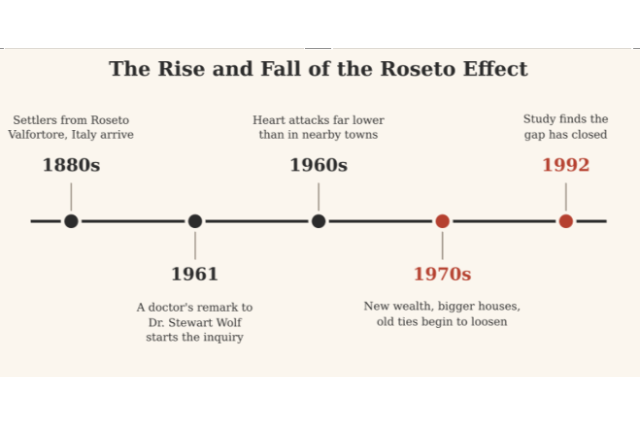
The rise and fall of the Roseto Effect. Image source: original graphic created for this article; timeline based on Bruhn & Wolf (1979) and Egolf et al. (1992).
A doctor's offhand remark
The story begins, as many good stories do, with a casual conversation. A local physician, Dr Benjamin Falcone, was chatting with a visiting medical professor, Stewart Wolf, at a local gathering. Falcone mentioned that in years of practice among the people of Roseto, he rarely saw heart disease in anyone younger than their mid-fifties.
Wolf did not nod politely and move on. He grew curious, and curiosity in a scientist is dangerous. Together with the sociologist John Bruhn and a team of colleagues, he began digging into medical records and death certificates, and later went door to door.
What they found was hard to believe. Compared with neighbouring towns just a few miles away, which had similar water, similar doctors and similar hospitals, Roseto's rate of heart attacks was strikingly lower. For men under sixty-five, the gap was dramatic. The researchers checked for the usual suspects: diet, exercise, smoking, genetics, weight. None of them explained it. If anything, Roseto's habits looked worse on paper.
So what was different?
The settlers of Roseto had come from a village in southern Italy called Roseto Valfortore, starting in the 1880s, and they had rebuilt their old life on a new hillside. Three generations often lived under one roof or on the same street. Grandparents were not hidden away in the corner of the house; they ran it. People knew whose child was ill, whose roof was leaking, whose son had quarrelled with his father.
The town had a church at its centre and a web of clubs and societies around it. Wealthy families did not show off, and poorer families were not made to feel small. If someone was in trouble, there was nearly always a neighbour at the door before the trouble had properly begun.
Bruhn and Wolf kept returning to the same idea. It was not the diet. It was not the climate. It was the way these people were held up by one another, every single day, almost without noticing.
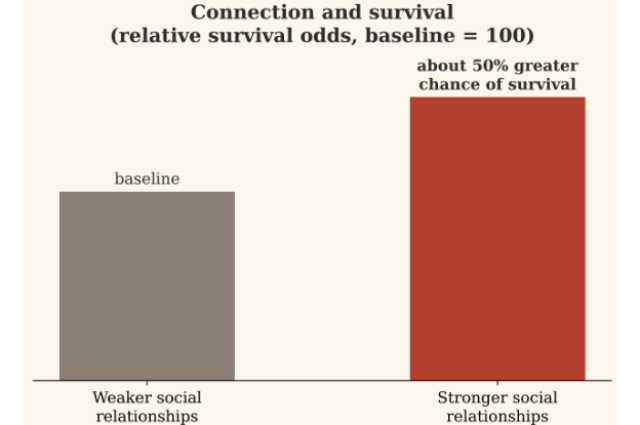
Stronger social ties and survival. Image source: original graphic created for this article; data from Holt-Lunstad, Smith, & Layton (2010), PLoS Medicine.
The part that hurts
If the story ended there, it would be a pleasant bit of trivia. But it has a second half, and the second half is the one I cannot stop thinking about.
By the 1970s, Roseto began to change. Young people went to college and left, and they came back with new ambitions. Bigger houses appeared, with fences around them. Cars got fancier. Families that had once shared everything began to compare. The old customs of showing no envy slowly faded.
And the hearts of Roseto changed with them. A later study published in 1992 in the American Journal of Public Health, by Egolf and colleagues, tracked the town over several decades. Heart attack deaths, especially among younger men, had risen until they matched those of the surrounding towns. The protection was gone. The diet had not changed. The community had.
Researchers later named this the Roseto Effect. Some critics still argue about how much of it can be pinned on social ties alone, and honest science should admit that. Roseto was one town, studied in an era with limited tools. But the pattern it showed has not stayed lonely.
It was not a one-town miracle.
In 2010, Julianne Holt-Lunstad and her colleagues at Brigham Young University published a large analysis in PLoS Medicine. They pooled the results of 148 studies covering more than 300,000 people. Their conclusion was blunt: people with stronger social relationships had about a fifty per cent greater chance of survival over the study periods than people with weaker ones. They noted that the effect was comparable to quitting smoking, and larger than that of obesity or physical inactivity.
Then there is the Harvard Study of Adult Development, which has followed the lives of men, and later their families, for more than eighty years. Its current directors, Robert Waldinger and Marc Schulz, say that the single clearest finding is simple. The people who were happiest and healthiest in later life were the ones who had warm, dependable relationships. Not the richest. Not the most famous. The most connected.
Why this matters to someone my age
I think about Roseto when I look at how my own generation lives. We have more ways to talk to each other than any group of humans ever had. We also say, in survey after survey, that we are lonely. We know the follower counts of strangers and not the names of the people on our own staircase.
In many Indian neighbourhoods, the Roseto kind of life is still just about alive. There is an aunty who sends over a bowl of something when she cooks too much. There is an uncle who knows your father's old scooter by its sound. There is the shopkeeper who asks why you looked tired yesterday. We tend to find these things a little annoying. Too much interference, too little privacy. I am guilty of this too.
But Roseto asks us to consider an uncomfortable idea: that this "interference" might be doing real work, quietly, for our bodies as well as our moods. That a town that asks too many questions might also be a town that catches you when you fall.
None of this means we should sneer at ambition or at private space. Nobody in Roseto was wrong to want a better life for their children. The lesson is gentler and harder than that. It is that progress which quietly dissolves the people around us may cost more than we have counted.
What I am taking from it
I will not pretend that reading about a Pennsylvania town has changed my life. But it has changed small things. I now knock on the neighbour's door more than I used to. I call my grandparents without waiting for a reason. I try to ask the second question, the one after "how are you", and then actually wait for the answer.
Doctors in the 1960s went looking for a secret in cholesterol and arteries, and found it instead in kitchens, churches and front porches. The most powerful thing they discovered was also the oldest thing we know: that people need people.
The hearts of Roseto did not refuse to break because they were stronger. They refused to break because they were never carrying the weight alone.
References:
- Bruhn, J. G., & Wolf, S. (1979). The Roseto Story: An Anatomy of Health. University of Oklahoma Press.
- Egolf, B., Lasker, J., Wolf, S., & Potvin, L. (1992). The Roseto effect: a 50-year comparison of mortality rates. American Journal of Public Health, 82(8), 1089–1092.
- Holt-Lunstad, J., Smith, T. B., & Layton, J. B. (2010). Social relationships and mortality risk: a meta-analytic review. PLoS Medicine, 7(7), e1000316.
- Waldinger, R., & Schulz, M. (2023). The Good Life: Lessons from the World's Longest Scientific Study of Happiness. Simon & Schuster.