
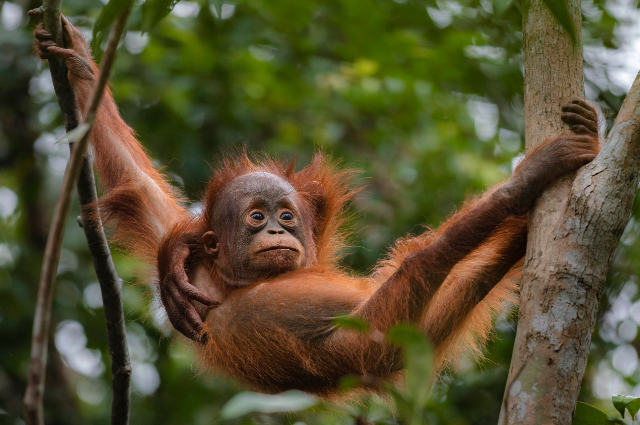
On September 8, forest officials in Odisha found something that should not have been there. Five young orangutans were in a casuarina forest in Balasore district, close to the border with West Bengal. They were not injured wildlife native to the region. They were not animals that had wandered into an unfamiliar part of India. Orangutans do not naturally live in India at all. They belong to the forests of Southeast Asia.
The five animals were taken to Nandankanan Zoological Park in Bhubaneswar, where they were placed under quarantine and medical supervision. They were estimated to be roughly one to one-and-a-half years old. Almost immediately, however, the rescue became secondary to a more difficult question: how did five infant orangutans travel thousands of kilometres and end up together in a forest in Odisha? There is still no complete answer. That is what makes this story different from an ordinary wildlife-rescue report. The five orangutans are alive, being cared for and gradually recovering. But the journey that brought them to India remains largely invisible. Investigators have been trying to reconstruct it through vehicles, documents, local enquiries and possible routes, while scientists are being asked to use the animals themselves as evidence.
The first photographs and videos from Nandankanan showed the five animals in quarantine, interacting with soft toys and being closely monitored by zoo staff. Their condition later became a concern when three were found to be anaemic, including one with severe anaemia. Veterinary teams carried out blood, urine, stool and X-ray examinations and provided supportive treatment. By September 28, zoo officials said all five had recovered from their immediate health problems and were gaining weight. For the people caring for them, the problem was therefore immediate and practical: keep five young animals alive. For investigators, it was something else. Find out where they came from.
The first clue was the animals themselves.
An orangutan in Odisha is already a clue. Five together are something much larger. The animals were initially believed, from their physical characteristics, to be Sumatran orangutans. Indonesia's Ministry of Forestry made the same preliminary assessment, while stressing that species and genetic origin would have to be established scientifically. Indonesia's government has since coordinated with Indian authorities and expressed its willingness to facilitate their repatriation if their Indonesian origin is confirmed. That distinction between suspicion and proof matters.
It would be easy to write that five Indonesian orangutans were smuggled into India and rescued in Odisha. The evidence available so far does not justify stating all of that as fact. Authorities are investigating suspected international wildlife trafficking, but no complete trafficking route has been publicly established. Even the scientific question is not finished. DNA testing was expected to help determine the species and genetic origin of the animals. But by September 29, the process had encountered a practical problem: authorities were seeking suitable reference blood samples from orangutans of known Indonesian origin so that the rescued animals could be compared properly. Discussions were under way with institutions including the Zoological Survey of India, Wildlife Institute of India and the Centre for Cellular and Molecular Biology. It is an unusual kind of investigation. Usually, investigators search for evidence outside the victim. Here, the victims may contain part of the evidence. Their DNA may help answer a question that CCTV footage, vehicle records and witness statements cannot: where did these animals actually come from?
Someone had to move them.
An infant orangutan cannot travel from Sumatra or Borneo to Odisha by itself. That simple fact changes the nature of the case. The Odisha Police Special Task Force and the Wildlife Crime Control Bureau began examining possible involvement of an animal-smuggling network. Investigators have looked at documents, questioned people and examined possible transport routes. A black SUV seen in the area became one of the leads under investigation. Police also explored whether information from other states could help, because young orangutans have previously been recovered in Assam, Mizoram and Maharashtra. But a lead is not a conclusion.
A vehicle near a forest does not prove who transported an animal. An earlier orangutan case does not automatically belong to the same network. A suspected trafficking route is not a proven trafficking route. The investigation has to establish the chain. Who acquired the animals? Where were they acquired? How were they transported? Who paid for them? Who was supposed to receive them? And why were five young orangutans eventually abandoned in a forest? Those questions are more important than the headline that first attracted attention. Because wildlife trafficking is ultimately not just about animals moving across borders. It is about demand.
The invisible market behind a visible animal
There is an uncomfortable economic question underneath the case: why would anyone take the enormous risk of moving endangered wildlife across countries? Because somewhere, there may be someone willing to pay. An orangutan can be worth far more to an illegal buyer than it is to the forest in which it evolved. The animal can become an exotic possession, a status symbol or part of a private collection. The forest does not put a price on it. A market does. This is where the Odisha case becomes larger than five animals.
Researchers and conservation experts have warned that demand for exotic wildlife in India can create incentives for international trafficking. Nature India has connected the Odisha discovery with wider concerns about the movement of primates and other exotic species into the country. The concern is not that every private owner of an exotic animal is a trafficker, but that demand for rare species can create a market in which the legal and illegal trade become difficult to distinguish from the outside. The consumer sees an unusual animal. The trafficking chain sees a commodity. The animal experiences something completely different: separation from its habitat, separation from its mother and an unfamiliar journey that it cannot understand. That difference is central to wildlife crime. The price paid by the buyer is visible. The ecological price is not.
Five babies change the meaning of the case.
The age of the orangutans makes the story harder to dismiss as a simple case of exotic-animal possession. Young orangutans are highly dependent on their mothers. Sumatran orangutans, in particular, have one of the longest periods of maternal dependence among mammals. Young animals can remain with their mothers for many years while learning how to feed, move through the forest and survive independently. The five animals found in Odisha were nowhere near that stage.
That does not prove what happened to their mothers. There is no evidence publicly establishing whether the animals were taken directly from the wild, came from a breeding facility, or passed through some other route before arriving in India. A member of Odisha's technical committee specifically noted that physical characteristics alone could not determine whether they originated from breeding centres or the wild. But their youth explains why the conservation implications are so serious. A baby orangutan is not simply a smaller adult. It is an animal whose survival normally depends on a relationship that cannot easily be replaced by human care. The people at Nandankanan can provide food, warmth, medicine and protection. They can monitor weight and behaviour. They can treat anaemia and fever. They can make the enclosure less frightening. They cannot recreate the forest or the mother that may have been lost.
The law has to cross the border too.
The case has also moved from Odisha's forests into international law. All three living orangutan species are listed under Appendix I of CITES, the Convention on International Trade in Endangered Species of Wild Fauna and Flora. That places them among species receiving the highest level of protection under the convention's international trade framework. That is why the future of the five animals cannot be decided simply by asking whether Indonesia wants them back.
Indonesia does want to help bring them home. Its Ministry of Forestry has been coordinating with Indian authorities, including India's CITES Management Authority, and has said it is working toward possible repatriation while the animals' origin is verified. But repatriation is not the same thing as sending an animal across a border. The authorities have to establish what species the animals are, where they came from, what legal process applies and whether they can safely be transported and rehabilitated. Scientific identification, veterinary care, international coordination and legal documentation all have to move together. The case therefore places two governments on opposite sides of a question that is actually shared by both: what is the lawful and biologically appropriate future for five animals that should never have been in this situation?
India has seen this before
The Odisha case would be easier to dismiss as an extraordinary accident if India had never encountered anything similar. But it has. In 2022, two young orangutans were rescued in Assam's Cachar district. Another orangutan was recovered in Mizoram in 2023, and another was found in Maharashtra in 2024. The circumstances of these cases were not identical, and there is no established public evidence that they all belong to one trafficking network. Still, the recurrence is difficult to ignore. It has prompted authorities investigating the Odisha case to seek information from other states. The purpose is not to manufacture a connection, but to see whether old cases contain information that could help explain a new one.
The Assam case is particularly instructive because the rescue did not produce an immediate ending. Questions surrounding the animals' legal future and possible repatriation continued long after the initial discovery. That is an important lesson. Finding an animal is not the same as solving the case. Rescuing an animal is not the same as returning it home. And arresting one person, if that eventually happens, may not reveal the entire market that created the demand in the first place.
The mystery is the story.
There is a temptation to finish this story too early. We could say five endangered orangutans were rescued from smugglers and are now waiting to return to Indonesia. It would make a satisfying ending. But the evidence does not yet give us that ending.
As of the end of September, the animals' health had improved. They were eating, gaining weight and becoming more active. Investigators were still examining how they reached Balasore. DNA testing was still being worked out. Indonesia was preparing for a possible repatriation. No public breakthrough had yet explained who brought five infant orangutans to Odisha and why they were abandoned there. That uncertainty should not weaken the story. It should make us pay closer attention. Because the unanswered questions reveal how wildlife trafficking works even when the traffickers themselves remain invisible. We can see the final five animals. We can see the forest where they were abandoned. We can see the zoo where they are recovering. We can see the scientists preparing to examine their DNA. We can see two governments discussing their future. What we cannot yet see is the journey between those points. Somewhere in that missing journey is the real story. It may eventually reveal a chain of capture, transport, money and buyers. It may reveal a different explanation. The evidence will decide. Until then, the five orangutans remain an unusual kind of witness. They cannot tell investigators where they were born. They cannot identify the people who moved them. They cannot explain why they were left in an Odisha forest. But their presence is evidence enough that something crossed a border that should not have crossed it. And perhaps that is the most important lesson of this case.
Wildlife trafficking is often imagined as something that happens deep inside distant forests, far away from ordinary life. The five orangutans show how quickly that hidden economy can surface in an entirely different country, in an ordinary forest, in front of people who had never expected to become part of an international conservation story. For now, the five animals are safe. They are eating. They are gaining weight. They are being studied. And they may eventually go home. But the people who brought them thousands of kilometres away remain unidentified. Until that changes, the rescue is only the beginning. The five orangutans have already crossed one enormous distance. The investigators now have to reconstruct the journey.
References:
- Sujit Bisoyi, The Indian Express, “As 5 orangutans find new home in Odisha, a probe into how they landed there,” September 2026.
- The Indian Express, “'Alert, active' but baby orangutans found in Odisha have a health red flag,” September 2026.
- The New Indian Express, “DNA profiling can ascertain orangutans’ species, origin at Odisha's Nandankanan zoo,” September 2026.
- The New Indian Express, “Odisha STF to seek help from Assam, Mizoram, Maharashtra cops in orangutan case,” September 2026.
- Nature India, “Orangutan babies in India spotlight massive primate trafficking network,” September 2026.
- Ministry of Forestry, Republic of Indonesia, “Pemerintah Indonesia Serius Tangani Penemuan Lima Bayi Orangutan di India, Upayakan Repatriasi ke Indonesia,” September 10, 2026.
- ThePrint, “What is legal future for orangutans found in Odisha? Two apes have been waiting for 4 years,” September 2026.
- The Telegraph, “Orangutans show recovery at Nandankanan following abandonment in Balasore,” September 28, 2026.
- Prameya News, “DNA test delayed as Nandankanan Orangutans’ origin remains unclear,” September 29, 2026.