
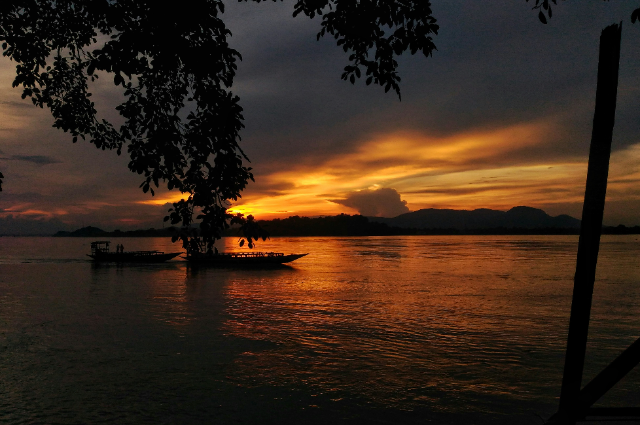
For years, the Brahmaputra kept moving my relatives' home. Then came an eviction. Five years later, I am still trying to understand what it means to lose a place that was never geographically permanent, yet always felt like home.
Every year, when I went to visit my grandmother and uncles, I had the same strange feeling: I could not remember exactly where their home was. It was not because I had forgotten the way. The place itself kept changing. My relatives lived in the riverine landscape of Sipajhar in Assam's Darrang district, close to the Brahmaputra. Floods and erosion were part of life there. The riverbank could change, land could disappear, and families could find themselves rebuilding or shifting.
I would visit once, sometimes twice, a year. When I returned after several months, I would look around and wonder whether I had come to the right place. The house seemed to be somewhere else. The landscape looked different. Sometimes even the village felt different. But there was one thing I never doubted. I was going home to my relatives. Years later, I returned and again could not find the homes I remembered. This time, the Brahmaputra had not taken them. They had been demolished.
Before the Bulldozers
My grandfather died before I was born, more than two decades ago. By then, he had spent much of his life in this part of Assam. My father had left the area when he was young and eventually settled in Bongaigaon district, where our family has lived for more than thirty years. But my grandmother and my father's three brothers remained. They were not wealthy landowners. Their economy was small and ordinary: cultivation, livestock, fishing, and small-scale trading in fruits and vegetables. But it worked.
The land and river gave them ways to survive. This is one reason why the question outsiders sometimes ask—Why didn't they simply move somewhere else?—is more complicated than it sounds. Where does a poor farmer move? Where does he take his cattle? Where does a fisherman go when the river is part of his livelihood? Where does a vegetable seller establish himself when his savings are limited and the people he knows live around him? For families with property elsewhere, leaving may mean relocation. For families without it, leaving can mean starting again from almost nothing.
My relatives' position was also legally vulnerable. The land on which they lived was not recorded as their privately owned land. They possessed identity- and citizenship-related family records and participated in government schemes, but those documents did not amount to legal title over the particular land they occupied.
For my relatives, however, the place had something no government document could easily measure: time. They had lived there. Worked there. Raised families there. Lost land to floods there. Rebuilt there. And after rebuilding, rebuilt again. The river had already taught them not to become too attached to walls. But it had not taught them how to stop calling a place home.
September 2021
In September 2021, an eviction drive began in the Dhalpur villages of the Gorukhuti area under Sipajhar Revenue Circle. The Assam government maintained that the families were occupying government land and sought to clear the area for the Gorukhuti agricultural project. The affected population was predominantly Bengali-speaking Muslim.
My relatives were among them. Notices and news of the coming eviction had reached the area. Some families left. Those with enough money, another piece of land, relatives elsewhere, or some other possibility could make arrangements. Many others could not. My relatives were among the people confronting a question for which an eviction notice provided no answer: If we leave, where exactly do we go?
On September 20 and 23, houses across the Dhalpur villages were demolished. Three of those households belonged to my uncles. My family later told me about the machinery arriving, homes being pulled down, and people attempting to move whatever they could. According to their recollections, some residents were provided tractors to carry their household belongings away. I was not there. That distinction matters to me. I cannot tell this part of the story as an eyewitness. What happened next became much bigger than my family's individual story.
The Day Two People Did Not Return Home
On September 23, 2021, the eviction operation turned violent. Residents had gathered in protest. Police said protesters attacked personnel with stones, sticks and other weapons and that firing occurred in self-defence. Accounts from residents and their representatives disputed aspects of how the confrontation developed. By the time it was over, two civilians had been killed in police firing.
One was only twelve years old. Several civilians and police personnel were injured. Images from Dhalpur travelled far beyond Assam. For people watching on phones and television screens, Dhalpur became a news story. For the families who lived there, there was no possibility of changing the channel. Their houses were still gone the next morning. I Came Back Later; I visited after the eviction. This is the part of the story I can tell without saying, " Someone told me. I saw it. I had visited that landscape year after year when my relatives still had their homes. Now I saw people without them. Families were living in makeshift shelters and tents. Some were staying on fields where rice and vegetables had previously been cultivated.
The Brahmaputra was still there. The fields were still there. The sky was the same. But the human landscape had changed. Where families had lived, there were absences. And yet there were still traces.
Their traces were still there. I remember looking at the places where my relatives and their neighbours had lived. And I felt like crying. I had never thought of myself as someone deeply attached to that land. I did not live there. My father had left decades earlier. I belonged to another district. But memory had quietly created its own ownership inside me. I remembered coming there year after year. I remembered being confused because the river had shifted things again. I remembered my relatives living their ordinary lives. Perhaps that is when I understood that attachment to a place does not always announce itself while the place is still there. Sometimes you discover it only when something is missing.
What My Relatives Remember
There are also details from those months that I cannot present as documented evidence. They belong instead to my family's oral memory of the eviction. My relatives told me that after the land was cleared, boundaries were established around parts of the evicted area and residents understood that they were not permitted to cross them. They described the boundary not merely as a line around land, but as a dividing line between the life they had known and a place they could no longer freely enter.
One story has remained in my memory. According to people in the area, an animal belonging to a displaced resident—a cow—crossed into the restricted area. When its owner went after it, he was allegedly assaulted by police personnel. I did not witness this incident. I do not possess a police complaint, medical record or other document with which to independently establish what happened. I therefore cannot present it as a verified event.
But I include it because oral histories contain another kind of evidence: they reveal what people remember, repeat and fear after a traumatic event. Whether every detail of such a story can be independently documented is a separate question from what the story tells us about how displaced residents experienced the boundaries around their former homes.
My relatives also remember local government schools—including lower-primary and other schools in the area—being used by security personnel during the period of heightened surveillance following the eviction. Again, this is part of the testimony passed to me by people who were there. I was not present during the operation itself, and I have not independently documented every detail of their account. That distinction is important. There are things I saw. There are things my relatives told me. And there are things the public record documents. A truthful story should not pretend that these three kinds of knowledge are identical.
The River Had Displaced Them Before
There was an irony I could not ignore. This was not the first time my relatives had lost the physical place where they lived. The Brahmaputra had been doing that for years. Floods came. Banks eroded. Land disappeared. They shifted. They rebuilt. Then another flood came. As a child, I found this almost confusing. Every visit required me to learn the geography again. But natural erosion and an administrative eviction are not the same experience. When a river takes the land, there is no office to appeal to. When the state orders an eviction, questions of law, notice, procedure and rehabilitation arise. And those questions did not disappear after September 2021.
The Assam government told the Gauhati High Court that the displaced residents were encroachers on government land. It also said rehabilitation would be considered subject to criteria including citizenship and landlessness. Petitioners, meanwhile, went to court seeking compensation and rehabilitation and questioning the process through which families had been removed. The litigation continued beyond the immediate aftermath.
The state also constituted a one-man inquiry commission under retired Gauhati High Court judge Justice B. D. Agarwal to examine the circumstances leading to the police firing. The commission took three years to complete its work. It received 55 memoranda and cross-examined 44 witnesses before submitting a 319-page report containing 16 recommendations to the Assam chief minister in October 2024. Public reporting about its findings said the commission considered the government entitled to conduct eviction from public land, while also reporting concerns about aspects of how the operation was conducted, including the notice period and use of police force. The legal and administrative record matters. But it still does not answer another question: What happened to the families after everyone else stopped watching?
After Everyone Else Went Home
An eviction makes dramatic photographs. Rehabilitation rarely does. The machines leave. Police personnel leave. Journalists leave. Politicians eventually move to another issue. The displaced remain. My three uncles did not end up in the same place. Two moved farther into the riverine area. They crossed a river channel and settled farther inside, on exposed land where there was no water at the time. Another uncle went to an area where displaced families were eventually given residential land. Government rehabilitation did reach many affected families. Public records and court proceedings show that relocation and rehabilitation continued to be dealt with for years after the original eviction.
But a plot is only one component of rebuilding a life. The difference is easy to miss on paper.
One family — one plot — rehabilitated.
A government file can close there. A family's life cannot. A house needs to be built. Income has to return. A farmer needs cultivable land. A trader needs customers. Livestock needs space. Children need access to school. People need roads, transport, electricity, healthcare and markets. A relocated family does not simply move its roof. It has to move an entire system of survival.
One Uncle Moved. Two Went Deeper.
I often think about what happened to my three uncles because their lives became three branches of the same story. Two stayed within the uncertain geography of the river. They moved farther inward and began again. The third accepted the possibility of resettlement and established himself on the residential land provided after the displacement.
His life was never easy. He supported a household of several people. When he was able to work, he did small-scale vegetable trading. Then his health deteriorated. Last year, he was seriously ill for a long period. More recently, his condition had improved enough for him to begin moving forward again. Five years had nearly passed since the eviction. Perhaps from a distance, that sounds like enough time for a family to recover. Then, only weeks ago, I received another piece of news from home. His house had caught fire.
He Lost His Home Again
I am writing this far away from him. I did not see the fire. I cannot describe flames rising from the roof or tell you what he did in those first minutes because I was not there. All I know is what my family told me afterwards. The house caught fire. The family lost what they had inside. And my uncle, who had already lost one home during the eviction and had struggled with illness, was once again facing the question of how to begin again.
When I heard what had happened, there was little I could do from where I was. I spoke to my family. I expressed my sorrow. And then life around me continued. That itself bothered me. A disaster can consume one person's entire world while remaining a message on another person's phone. I was studying far away. People around me continued attending classes, eating meals, making plans, and discussing their futures. Somewhere in Assam, my uncle was trying to understand what remained after another home disappeared.
I Don't Want to Call Him Resilient
There is a particular way we like to write about poor people after disasters. We call them resilient. We admire their courage. We say they rebuilt. We turn survival into an inspirational lesson. I hesitate to do that with my uncle. Of course he has survived. So have the other members of my family. But sometimes the word resilience allows those of us watching from a safe distance to make repeated suffering sound beautiful. There is nothing beautiful about having to rebuild because a flood destroyed your home.
There is nothing beautiful about having to rebuild because your house was demolished. And there is nothing beautiful about rebuilding again after a fire. A person may continue because there is simply no alternative. That is survival. It does not need to become a motivational quote.
Who Owns a Memory?
There is another complication in telling this story. My family did not hold recorded private title to the land from which they were evicted. I cannot erase that fact simply because I love them. The government regarded the land as public property under encroachment. That belongs in this story. But another fact belongs here too. For decades, families had organised their lives around that landscape. Legal ownership and human attachment answer different questions. A land record asks: Whose property is this? Memory asks: Whose life happened here? The answer to one does not automatically answer the other. My relatives could lack title to a parcel of land and still have memories attached to it. My grandmother could have lived there. My uncles could have worked there. Children could have grown up there. Fields could have been cultivated there. Livestock could have grazed there. And a nephew from Bongaigaon could have spent years returning to it until the place became part of his own childhood. Acknowledging those things does not settle a legal dispute. It tells us why displacement cannot be understood through land records alone.
Five Years Is a Long Time in the News
September 2021 feels distant now. Five years is enough time for thousands of other stories to occupy newspaper front pages. But I sometimes wonder what happens to the people inside yesterday's headlines. Court proceedings related to rehabilitation continued years after the original eviction. That tells us something important. An eviction may happen in a morning.
Its consequences can last for years. I can see that without opening a court file. I can see it in my own family. One uncle relocated. Two moved deeper into the riverine landscape. Livelihoods had to be reconstructed. Illness came. And then fire destroyed another home. This is why I no longer think of September 2021 as simply the day my relatives' houses were demolished. It became part of everything that followed.
The Place I Could Never Find Twice
There is a childhood version of me that still exists somewhere in my memory. He is travelling to Darrang to visit his grandmother and uncles. He looks out and wonders: Was their house here last year? Or was it farther that way? Why does everything look different? At the time, it was almost amusing. The Brahmaputra had rearranged the map again. Today that memory means something different to me.
My relatives taught me, without intending to, that a home can move. It can be rebuilt. It can stand on uncertain land. It can disappear and remain inside the people who lived there. But their story has also taught me something harder: There is a limit to how many times we should romanticise someone's ability to begin again. People need more than praise for surviving. They need the conditions that make ordinary, stable life possible. I don't know what the future will bring for my uncles. I don't know whether the Brahmaputra will change their landscape again. I don't know how quickly my uncle will recover from the recent fire. And I do not want to invent a hopeful ending simply because stories are more satisfying when everything eventually works out.
This story has not worked out yet. It is still happening. What I know is much smaller. I know that my grandfather once made a life near this river. I know that my grandmother and uncles continued that life. I know that every year I visited, the geography seemed to change. I know that after the eviction, I returned and saw families living in temporary shelters where ordinary homes and lives had existed before. I know that when I saw the traces left behind, I felt like crying. And I know that five years later, one of those families is again trying to recover from the loss of a home.
For years, I thought I could never remember where my relatives lived because the Brahmaputra kept changing the landscape. Now I understand that I was remembering the wrong thing. I was trying to remember a location. What stayed with me was never the location. It was the people who made it home.