
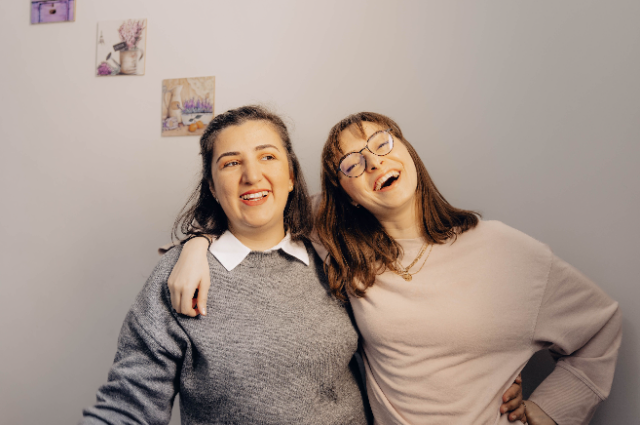
In 1996, two teenage girls met at a gathering for children adopted from India. They had never met before. Yet within a short time, the people around them began noticing something neither girl could explain: they looked remarkably alike.
Meena Geltink and Minal Tijssen were both Indian-born girls growing up in the Netherlands, but in different families and different towns. Neither knew she had a sister. Neither knew that the other existed. They were simply two adopted teenagers who happened to meet at an event where children with similar beginnings had been brought together. Their resemblance was so striking that their friends were fascinated. Meena and Minal became friends, exchanged addresses and began writing to each other. At some point, they started calling each other “sis.” It was a teenage joke, an affectionate nickname between two girls who felt an unusual connection. It was also, although neither of them knew it, literally true.
Nearly thirty years later, in the spring of 2026, Minal was sitting at home in France when a notification appeared on her phone. Her DNA test results were ready. At the top of the list was a name she recognised: Meena. The result identified Meena as her sister. At first, Minal did not immediately understand what she was seeing. She knew a Meena. She had known a Meena as a teenager. But the possibility that this was the same person seemed almost impossible. She searched for her on social media, found photographs and finally realised that the girl from her teenage years and the person appearing in her DNA results were the same woman. She contacted Meena.
Meena had taken a DNA test years earlier, in 2017, while trying to find information about her biological family. Nothing significant had happened for years. She eventually stopped checking the service and lost access to the account. Now Minal's message forced her to return to it. The genetic result was not merely a possible connection. It showed that the two women were full biological sisters. A relationship they had once imagined as a joke had been hiding in their DNA all along.
Their story had begun more than four decades earlier, in India. Both women were born in the early 1980s and were adopted as infants by separate families in the Netherlands. They grew up roughly 130 kilometres apart. Their adoptive families gave them homes, but neither girl knew that another child carrying the same biological history was growing up nearby. For Meena, the journey began in 1983. Her adoptive parents travelled to the Netherlands with her as a baby. Minal had arrived in the Netherlands the previous year after being adopted by another Dutch family. Their childhoods were separate, but there were similarities beyond their appearance. Both grew up interested in sports, including gymnastics, and both had questions about where they had come from.
Those questions were not necessarily about rejecting the families who had raised them. Both women have spoken about being loved by their adoptive parents while also experiencing a sense of incompleteness around their biological origins. Minal has described having almost no information about her birth family. She knew that she had been left as an infant outside an orphanage in Mumbai, but for years that was essentially the extent of what she knew about her beginnings.
Meena also wanted answers. Her adoptive family had taken her to India when she was young, allowing her to learn more about her origins. But the information available to her could not reveal the existence of a biological sister living in the Netherlands. Then came that meeting in 1996. The teenagers were attending a gathering for adopted children when they noticed each other. According to their accounts, their resemblance was obvious enough to attract the attention of their friends. They stood beside each other and compared their faces. The similarities were difficult to dismiss. But resemblance is not proof of family.
Two Indian-born girls adopted into Dutch families could look alike for many reasons. At the time, neither had any information suggesting that they shared parents. They therefore treated the resemblance as an extraordinary coincidence. Their friendship continued. They wrote letters to each other for years and called each other “sis.” Then adulthood arrived. Their lives changed. Minal eventually moved to France. Meena continued her life in the Netherlands. Without the social-media tools that now make maintaining distant relationships so easy, their correspondence gradually ended. By 2011, they had lost touch.
The irony of what happened next is difficult to improve upon because the facts already contain the twist. They had spent years apart, but neither woman was searching specifically for the other. They were separately trying to understand their own beginnings. Minal made attempts to find information about her origins in Mumbai, including visits to the orphanage connected to her adoption records. She did not find the answers she hoped for. Meena eventually turned to genetic genealogy and submitted a DNA sample to MyHeritage in 2017. For years, nothing happened. Then Minal took her own DNA test in 2026. The technology succeeded because the missing piece had finally entered the same database. Minal's DNA could now be compared with Meena's. The result connected two people who had already known one another long before either knew why.
That detail makes their story different from the familiar stories of DNA tests helping strangers discover lost relatives. Meena and Minal did not first meet because of DNA. They met without it. They became friends without it. They even called each other sisters without it. The DNA test did not create their relationship. It explained it. That explanation changed the meaning of an old memory. The faces they had compared as teenagers were not simply similar. The instinctive familiarity they had felt was not evidence of anything they could have proved at the time. The nickname “sis” was not an accurate description by coincidence. It was an unknowingly correct description of who they were to each other.
Their first reunion after the discovery took place in the Netherlands in August 2026. Reuters reported that it was marked by tears, laughter, hugs and a first selfie together. The women, now in their forties, began talking and messaging each other regularly after the discovery. Yet the most interesting part of their story may not be the reunion itself. It is what the reunion says about identity. Adoption can give a child a family without necessarily answering every question about biological origins. For Meena and Minal, those two parts of identity existed alongside each other. They had adoptive parents and families who had raised them, while also carrying unanswered questions about their beginnings. Finding a biological sibling did not erase the lives they had already lived. It added another part to them.
That distinction matters because adoption stories are often reduced to a search for biological parents. Meena and Minal's experience shows that the search can also be about siblings—people whose existence may be completely unknown to an adopted person. It also shows how incomplete records can leave people searching for answers that technology may eventually uncover in a completely different way. Minal's attempts to find information in Mumbai did not give her the answer. Meena's first DNA test in 2017 did not give her the answer either. The answer appeared only when both women's genetic information happened to become available for comparison.
Even then, the technology needed something human to complete the process. Minal had to recognise the name. She had to realise that the Meena in the DNA results was the same Meena she had known as a teenager. She had to find her online and contact her. Meena then had to return to an account she had effectively abandoned years earlier. The reunion was therefore neither purely technological nor purely accidental. It was built from a series of small events separated by decades. Two infants left India for separate lives. Two teenagers met in the Netherlands. Two friends lost touch. One of them took a DNA test. Years later, the other did the same. And suddenly, a friendship from adolescence acquired a completely different meaning.
There is something almost unsettling about how close they had been to the truth without knowing it. Their lives had crossed once before either woman had enough information to understand what that crossing meant. When they first met, they saw each other as two adopted girls who looked alike. When they met again in 2026, they knew what the resemblance had been. The women have spoken about returning to Mumbai, the place where both of their stories began. They cannot recover the childhood they might have shared or the years during which they did not know one another. They can only begin a relationship from the point at which the truth finally became available to them. Perhaps that is why the simplest sentence from their story carries so much weight. “We were friends before we were sisters,” Minal told Reuters. “We were sisters the whole time, but we didn't know.” For years, “sis” had been a joke between two teenagers who thought they had found an unusual friend. In 2026, a DNA test turned the joke into family history. And suddenly, the strangest thing about their story was no longer that two sisters had found each other. It was that they had already found each other once—and had no idea.
References:
- Anthony Deutsch and Marta Fiorin, Reuters, “Adopted Indian women find ‘missing piece’ when DNA test reveals they are sisters,” August 12, 2026.
- Vidheesha Kuntamalla, The Indian Express, “They giggled like sisters at 15, then lost each other and waited 29 years,” August 29, 2026.
- Roi Mandel and Daniella Levy, MyHeritage, “Both Adopted from Mumbai, They Called Each Other ‘Sis.’ 30 Years Later, They Found Out They’re Actually Sisters,” September 7, 2026.
- India Today, “Indian-origin women, separately adopted 40 years ago, discover they are siblings after DNA test,” August 13, 2026.