
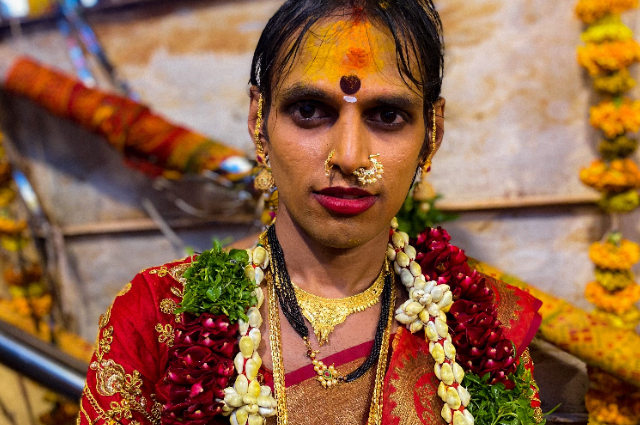
From leaving home as a teenager to becoming a recognised voice for transgender rights, Shreegauri Sawant's life reflects the struggle for identity, motherhood and equal citizenship in India.
In March 2019, Shreegauri Sawant received an appointment that few people would have imagined when she first arrived in Mumbai as a teenager. The transgender activist was selected by Maharashtra's Chief Electoral Officer as one of the state's election icons to encourage people to participate in the democratic process. She was no longer standing outside the institutions that shape public life. She had been invited to become part of an effort to bring more citizens into them.
For Sawant, this recognition was connected to a much longer journey. She had experienced rejection, struggled to find a place in society and worked for years to support people who faced similar difficulties. Her life had also challenged familiar ideas about family and motherhood. Today, many people know her through Taali, the web series in which Sushmita Sen portrayed her. But the story behind the series is not simply about an individual who became famous. It is about a woman who turned difficult experiences into a sustained effort to secure dignity and opportunities for others.
Her journey also raises a question that India continues to face: is recognising someone's identity enough, or must society also accept that person as an equal member of the community?
Leaving Home and Finding a New Beginning
Shreegauri Sawant was born as Ganesh Suresh Sawant in Pune, Maharashtra. Her mother died when she was young, and she was brought up by her grandmother. Her father worked as a police officer. As she grew older, Sawant began to understand that the identity she felt within herself did not match the expectations others had of her.
Growing up with this difference was not easy. The society around her had clear ideas about how a boy should behave, dress and live. Sawant did not feel comfortable within those expectations. The lack of understanding around her identity made her teenage years particularly difficult.
Eventually, during her mid-teens, she left home and travelled to Mumbai. Published accounts differ about her exact age at the time, but they agree that she was still very young. She arrived in a city where she had to begin almost everything again. Finding shelter, earning a living and meeting people who would accept her were immediate concerns.
Her early experiences in Mumbai introduced her to the difficulties faced by other transgender people. Many had been rejected by their families or had limited access to education, healthcare and employment. Some struggled to find even the basic security that others often take for granted.
Sawant gradually became involved in community outreach work and came into contact with organisations supporting LGBTQ+ people. These experiences helped her see that the difficulties she had faced were not isolated incidents. They were part of a wider social problem. What began as her own search for a place in society slowly developed into a commitment to helping others find one.
Creating Support Where It Was Needed
In 2000, Sawant established Sakhi Char Chowghi Trust in Mumbai. The organisation works with transgender people and individuals affected by HIV/AIDS. Its activities have included counselling, safe-sex awareness, health-related assistance and community support.
The work of such an organisation may appear ordinary at first: providing information, helping someone access services or offering a place to seek advice. But for people who regularly face discrimination, these forms of support can make a considerable difference.
A transgender person may hesitate to visit a hospital because of the treatment they expect to receive. Finding a job or renting a room can also become difficult when employers and landlords are unwilling to accept them. In such circumstances, an organisation that understands their problems can provide a much-needed point of contact.
Sakhi Char Chowghi was established to address some of these concerns. Rather than limiting its work to public awareness, it focused on the everyday difficulties experienced by members of the community.
Sawant's social work was not restricted to transgender people. A report published by The Indian Express in March 2019 also described her involvement with Nani Ka Ghar, a proposed support centre for children of sex workers. These children can face social stigma because of their family circumstances, often without having any control over the situation in which they were born.
She was also associated with Swayam Siddha, where members of the transgender community were encouraged to learn practical skills such as soap-making. The purpose was to help people develop ways of earning an income and becoming more financially independent.
These efforts reveal an important part of Sawant's work. She was not only asking society to change its attitude towards transgender people; she was also trying to create opportunities that could improve their lives. Respect is important, but it must be accompanied by access to education, healthcare, employment and a secure place to live.
The Meaning of Motherhood
Perhaps the most widely known personal chapter of Sawant's life is her relationship with a girl named Gayatri, whom she took into her care and raised as her daughter.
Gayatri's biological mother died after living with HIV, leaving the child in a vulnerable situation. Sawant decided to take responsibility for her. The decision was significant not only because she was providing a home for a child who needed care, but also because it challenged the assumptions people held about who could become a parent.
Motherhood is often understood through biological relationships and conventional family structures. Sawant's experience offered another perspective. For her, being a mother meant taking responsibility for a child's upbringing, providing protection and remaining committed to her future.
However, raising Gayatri was not free from difficulties. Sawant has spoken about the questions and judgement she faced when she went out with her daughter. People sometimes struggled to understand their relationship because she was a transgender woman. What was an ordinary experience for the two of them could become a subject of public attention.
In 2017, their story reached a much wider audience through Vicks India's Touch of Care advertisement. The campaign featured Sawant and Gayatri and presented their relationship through everyday expressions of love and care. It encouraged viewers to think about motherhood in terms of responsibility and affection rather than limiting it to biological connections.
The advertisement brought her story into many homes, but public appreciation did not remove the larger questions surrounding the rights of transgender parents. A person may be celebrated in an advertisement while still facing uncertainty about their legal and social position.
Sawant had already begun raising these concerns. In 2014, she approached the Supreme Court seeking recognition of adoption rights for transgender people. Her petition drew attention to a question that had received little public discussion: should a person's gender identity become an obstacle to raising a family?
It is important to distinguish this campaign from a court decision that automatically granted adoption rights to all transgender people. Nevertheless, her efforts helped bring the issue into public discussion. Her own experience with Gayatri gave the question a human dimension that legal arguments alone could not always communicate.
A Landmark in the Fight for Recognition
Another important development in India's transgender-rights movement took place on 15 April 2014. On that day, the Supreme Court delivered its judgment in National Legal Services Authority v. Union of India, commonly known as the NALSA judgment.
The judgment recognised transgender people as a third gender and affirmed that gender identity is connected to constitutional rights, personal dignity and individual freedom. It also directed governments to take steps towards welfare measures, education and other protections.
Sawant was among the activists associated with the wider movement for transgender recognition. Her work formed part of a larger effort by transgender individuals and organisations to challenge the denial of basic rights. However, the legal history should be stated accurately: the principal petition was filed by the National Legal Services Authority, along with a related petition. The judgment should not be described as a case filed by Sawant alone.
The decision was an important moment because it recognised that transgender people were entitled to constitutional protection. It challenged the idea that only two gender categories could be recognised by the state.
Yet the judgment did not immediately change everyday experiences. A legal declaration cannot, by itself, ensure that a transgender student will be treated respectfully in school or that a qualified applicant will receive fair consideration during recruitment. It cannot automatically remove prejudice from a neighbourhood or guarantee respectful treatment in a hospital.
This gap between legal recognition and social acceptance has remained one of the central concerns of Sawant's activism.
A Place in the Democratic Process
In March 2019, Sawant received another form of public recognition. Maharashtra's Chief Electoral Officer appointed her as one of the state's 12 election icons ahead of the general elections. Her role was to encourage voter registration and participation, particularly among communities that were often overlooked in awareness campaigns.
Several contemporary news reports described her appointment as a first for a transgender person in an Election Commission goodwill ambassador role. She was expected to use her public presence to encourage transgender people to register as voters and participate in elections.
There is a historical detail worth keeping in mind. A Business Standard report from March 2019 mentioned that another transgender activist, Laxmi Narayan Tripathi, had held a similar election-related role in 2014. Therefore, the most accurate way to describe Sawant's appointment is that she became one of Maharashtra's 12 state election icons in 2019, in an appointment widely reported at the time as a first for a transgender Election Commission goodwill ambassador.
The appointment was meaningful for another reason. Transgender people are citizens with the same democratic rights as everyone else, but many face difficulties in accessing those rights. Problems with identity documents, social discrimination and lack of awareness can make voter registration and participation challenging.
Sawant's position allowed her to address these concerns publicly. She encouraged members of her community to understand the voting process and take part in elections. Her role also showed that transgender people could contribute to public institutions rather than being viewed only through the difficulties they faced.
For someone who had experienced exclusion, being recognised in a public responsibility connected with citizenship carried a particular significance. It was an opportunity to speak not only about the rights of transgender people but also about their responsibilities and participation as citizens.
When Visibility Is Not the Same as Acceptance
Sawant's life later reached an even larger audience through Taali, the web series starring Sushmita Sen. The series brought attention to her personal journey and the struggle for transgender recognition in India. For many viewers, it was an introduction to a story they might not otherwise have encountered.
However, becoming visible in the media does not necessarily mean that a community is fully accepted. Sawant has spoken about the need for transgender people to be represented in a wider range of roles. They should not appear on screen only as people experiencing tragedy or hardship. They should also be shown as professionals, parents, friends and individuals with ordinary ambitions and responsibilities.
This is an important point. When a community is represented only through suffering, viewers may feel sympathy without understanding the full range of its members' lives. Transgender people, like everyone else, have different interests, occupations, relationships and aspirations. Their stories should reflect that diversity.
In her interview with The Times of India, Sawant also questioned the way some organisations and companies show support during Pride celebrations. She argued that inclusion should not become an activity limited to one month or a series of public messages. Support must continue in workplaces, schools and public institutions throughout the year.
Her comments about the jogtin traditions found in parts of Maharashtra, Karnataka and Telangana provide another example of the difference between tolerance and acceptance. People may be respected when they occupy a traditional role, but would that respect remain if they appeared in ordinary clothes such as jeans and shirts? The question challenges a form of acceptance that depends on whether a person fits society's expectations.
Sawant has also observed that families of queer individuals are becoming more accepting, while society at large has not changed at the same pace. A person may receive support at home and still face discrimination outside it. The experience of acceptance within a family does not automatically extend to a school, workplace, hospital or neighbourhood.
The Distance Between Law and Everyday Life
India has taken important steps towards recognising transgender rights. The NALSA judgment of 2014 established constitutional recognition, while the Transgender Persons (Protection of Rights) Act, 2019, created a legal framework to address discrimination in areas such as education, employment and healthcare.
Section 9 of the Act prohibits discrimination against transgender people in matters relating to employment, including recruitment and promotion. These protections are important, but their effectiveness depends on how they are implemented.
Sawant has spoken about the difficulties transgender people face when seeking formal employment, including opportunities in government institutions. Her concerns point to a problem that cannot be solved simply by bypassing legislation. People must also be able to access the opportunities that the law promises.
Consider the difficulties faced by someone who has left home because of rejection. Continuing education may become difficult. Without education or training, finding formal employment can be challenging. When employers are unwilling to recruit transgender applicants, financial independence becomes even harder to achieve. These problems can reinforce one another.
This is why initiatives involving counselling, skills training, employment opportunities and community support are important. They address the practical conditions that shape a person's life rather than treating discrimination as only an issue of public attitude.
The question is no longer simply whether transgender people are recognised in law. It is whether they can experience that recognition in the places where they study, work, receive healthcare and build relationships.
What Her Journey Asks of Society
Shreegauri Sawant's life brings together experiences that are often discussed separately. Her childhood and decision to leave home reveal the personal cost of rejection. Her work through Sakhi Char Chowghi shows the importance of community support. Her relationship with Gayatri challenges conventional assumptions about motherhood. Her involvement in the movement for legal recognition and her appointment as a Maharashtra election icon demonstrate her engagement with public institutions.
None of these achievements means that the struggle is over. In fact, the questions raised by her work remain relevant to people whose names are not widely known.
Can a transgender student complete an education without humiliation? Can a qualified candidate apply for a job and receive fair treatment? Can a transgender parent raise a child without having their family constantly questioned? Can transgender citizens register to vote and participate in public life without facing unnecessary barriers?
These are not questions about special privileges. They concern the ordinary rights and opportunities that every citizen should be able to access.
Sawant's journey is often presented as an inspiring story, and there is certainly much in it that can inspire others. But it is equally important to understand the social conditions that made her struggle necessary. Celebrating one person's achievements should not distract from the difficulties experienced by the wider community.
Her appointment as an election icon, the story of Gayatri and the public attention created by Taali all helped bring transgender experiences into wider discussion. The real test of progress, however, will be whether that discussion leads to fair treatment in everyday life.
A society should not require someone to become famous before recognising their dignity. Transgender people should not have to prove their worth through extraordinary achievements to receive ordinary respect. They should be able to study, work, raise families and participate in public life simply because they are equal members of society.
That is the larger meaning of Shreegauri Sawant's journey. It is not only the story of one woman who found her voice. It is also a reminder that a democratic society must make room for every citizen to live with dignity.
References:
- Anuradha Mascarenhas, “Transgender Activist Gauri Sawant Among ‘State Icons’ Who Will Raise Awareness Among Voters,” The Indian Express, March 20, 2019.
https://indianexpress.com - “Shree Gauri Sawant: Families of Queer Individuals Are More Accepting Now; Can't Say the Same About Society at Large,” The Times of India, 2026.
https://timesofindia.indiatimes.com - Sanjana Ray, “Taali: Know the Real Story Behind Shreegauri Sawant, the Trans-Activist Played by Sushmita Sen in Her New Series,” GQ India, August 14, 2023.
https://www.gqindia.com - Vinay Arote, “Gauri Sawant—How I Became a Mother,” Mumbai Mirror, April 3, 2017.
https://mumbaimirror.indiatimes.com - National Legal Services Authority v. Union of India, Supreme Court of India, April 15, 2014.
https://indiankanoon.org/doc/193543132/ - Government of India, The Transgender Persons (Protection of Rights) Act, 2019.
https://www.indiacode.nic.in/handle/123456789/13091 - “Transgender Activist Gauri Sawant Appointed as EC's Ambassador,” Business Standard, March 20, 2019.
https://www.business-standard.com/