
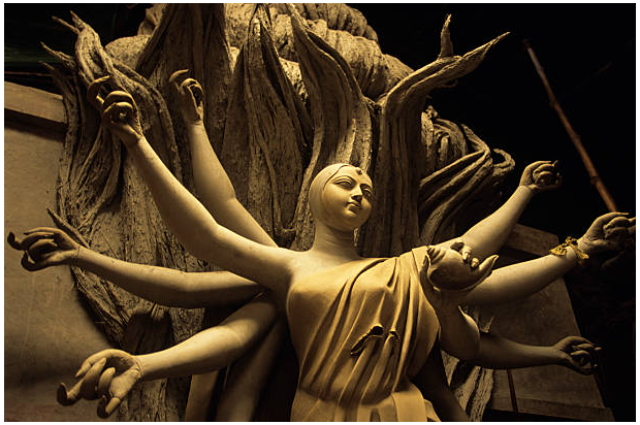
In Kumartuli, the air never quite settles. It hangs heavy with wet clay, river silt from the Hooghly, straw, and smoke from small tea stalls. I went there last October not to see the goddesses, but to see the men who make them and then unmake them every year.
Shyamal Pal is 78.
He has been making Durga idols for 61 years. His father did it, his grandfather did it. His workshop is no bigger than a garage, with a calendar from 2021 still hanging because no one bothered to take it down. When I asked him how he remembered the exact proportion of a goddess's eyes, he laughed. "I don’t remember,” he said in Bengali. "My hands remember. I told them once when I was twelve, and they never forgot.”
He showed me.
He does not use a measuring tape. He uses the length from his elbow to the tip of his middle finger, a unit called a haat. He mixes Ganga clay with rice husk by feel, not ratio. If you ask him for the recipe, he will fail. If you watch him for three hours, you will learn it. This is what psychologists call tacit knowledge — knowledge that lives in the body, not in the manual.
For two weeks, I watched him work.
He wakes at 4:30 am. He touches the clay before he touches his tea. And every year, he watches the idols he spent months building dissolve in the river in ten minutes on Vijayadashami. I asked him if it hurts. He said, “If you are afraid of losing, you will never learn to make.”
That line stayed with me because it contradicts everything we are taught about preservation today.
We are told to save, backup, archive in the cloud. Shyamal Pal is part of a tradition that practices deliberate impermanence.
This is not just a sentimental story.
It is a research problem.
In 2022, UNESCO published a warning in its report on Intangible Cultural Heritage: over 40% of traditional craftsmanship skills in South Asia are at high risk of disappearing within two generations, not because there is no demand, but because the transfer mechanism is broken.
Young people leave for white-collar jobs; masters have no formal way to teach what their bodies know.
The Harvard Study of Adult Development, the longest study on human happiness ever conducted at over 85 years, found one consistent predictor of a good life in old age: not wealth, not achievement, but the quality of warm, intergenerational relationships.
When we asked Shyamal if he had, as students, he said, “I had two. One drives an Uber now. He earns more.” It was not bitterness. It was a fact.
A 2021 study in the Journal of Cognition showed that procedural memory — the kind Shyamal uses — actually degrades more slowly than factual memory if it is socially rehearsed.
In other words, his hands will remember only as long as someone is there to watch them. Memory, in this sense, is not a hard drive. It is a conversation.
This is where the second story begins.
Last winter, a small collective of students from Jadavpur University started something called “The Listening Project.” No funding, no NGO.
Just ten students with notebooks and phones. Their rule: they cannot record video for the first three visits. They can only listen and write by hand.
I joined one of them, Anwesha, 21, a literature student.
She was sitting with a 72-year-old kansa utensil maker in North Kolkata, whose family had made bell-metal utensils for temples for five generations. No one wants bell-metal now; steel is cheaper. He was going to close his shop.
Anwesha didn’t ask him, “What is your craft?” She asked, “When was the first time you felt ashamed of your work?” He paused for a long time.
Then he told her about 1998, when his son’s school teacher asked his son what his father did, and his son said “shopkeeper” instead of “kansa shilpi.” He remembered the exact date because it was Saraswati Puja.
That is not data you will find in a government survey.
But it is the real reason a craft dies. Not economics alone, but shame.
Shame can't be fixed by giving money; it's fixed by being seen.
The Listening Project now has 63 handwritten stories.
They aren't on Instagram. They are stored in a tin trunk in the college library. When I asked why not put them online, Anwesha said, “We will. But if we digitise too quickly, we might start editing for likes. We want to learn how to listen before we learn how to share.”
This is the thought-provoking idea I want to share for your competition: We live in an era where we remember everything and forget everything at the same time.
Our phones store 100,000 photos we’ll never look at again. Meanwhile, we are losing knowledge that can’t be found online. An AI can create an image of Durga in two seconds. But it can't tell you how cold the clay feels at 5 a.m. in December, or how to tell it’s ready by the sound it makes when you touch it.
Philosopher Matthew Crawford calls this “the attentional commons” — the idea that attention is like clean water, a resource we're all using, but also polluting.
When Shyamal Pal works, his attention is completely focused. There are no notifications. There's just the pressure of a thumb. What if the most radical act of preservation today is not to record everything, but to give full attention to one person who knows something that's disappearing?
Research supports this.
A 2023 study by the Indian Institute of Science on apprenticeship learning found that students who learned pottery through direct observation and working together retained 34% more skill after six months than those who learned through video tutorials alone, even when the video quality was high. The body needs another body to learn.
We often talk about AI taking over from humans. But a more uncomfortable question is: what if we've already started replacing ourselves? By relying on devices to remember things, we've stopped exercising the skill of recalling someone else's story accurately. I realised I could recite ten popular Reels from memory, but I couldn't remember the story Shyamal told me without checking my notebook.
So the competition isn't just about the artisans.
It's about all of us.
Kolkata is a city that honours both Kali and Karl Marx, tradition and revolution.
It understands that nothing stays forever—idols crumble, governments fall, coffee houses close. Yet every year, we create them again. That isn’t foolishness. It's a belief: that creating is valuable even if destruction is certain.
When I left Kumartuli on the last day, Shyamal gave me a tiny, unfired clay bird.
“Take it,” he said. It will break in your bag. That’s okay.” And it did. A wing chipped off during the metro ride. I still have it on my desk. It reminds me that the point wasn’t to keep the bird perfect. The point was that someone took the time to make it for me, with hands that remember.
Perhaps the real crisis isn’t that old knowledge is disappearing.
It’s that we’ve stopped believing we are worth receiving it. We scroll because we think wisdom comes from somewhere else, somewhere bigger. Sometimes it comes from a small, damp workshop where a man with clay under his fingernails tells you, without words, that remembering is a form of love.