
The Morning in My Village
One summer morning, in my small cottage in Deoghar, I woke up early. The summer in Deoghar is not like the summer in the cities. It is hot, but the mornings are still soft and kind. I remember that day very clearly because the air was different.
I woke up before everyone else. I did my morning prayer, as my "_Gogo_" (which means mother in English) had taught me, joined my hands, closed my eyes, and thanked the Lord for this day, for this life. After prayer, I went out of the room just to see if the sun had risen or not — just kidding! Actually, I went out because I loved the morning.
Surprisingly, when I woke up, I saw no one else in the courtyard. Only me, myself, listening to pigeons cooing on the top of our roof, chickens clucking and walking here and there, searching for grains for their little ones, roosters crowing loudly as if they were the alarm clock of our whole village. It was their daily routine, as usual as every day, but that morning I was listening to them more carefully.
The sky was becoming clear. At first it was greyish, then slowly it turned light blue. A soft breeze of morning air was coming from the fields. It was touching my hair, my skin, giving a tingling sensation. Birds were flying over the sky in groups, coming from somewhere else and going somewhere far. Everything was pleasant and wonderful. In that moment, I felt that the world was only mine.
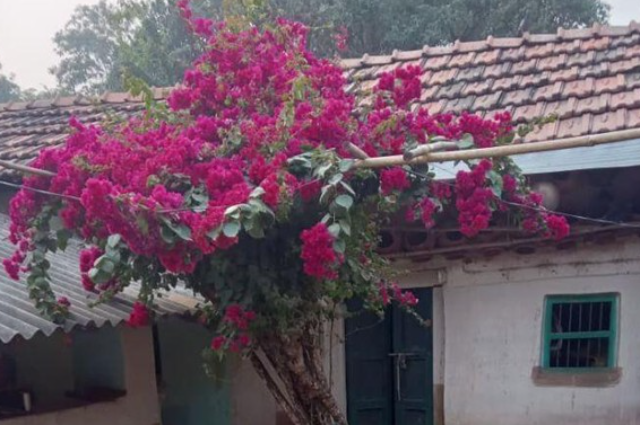
Our home is beautifully built with mud and straw, and not just with those things but with lots of love and care also, and we too have "_racha_" (which is called a courtyard in English), and in our _racha_ we have a marvellous flower plant surrounded by mud around it, so we would sit on those mud seats and enjoy looking at those beautiful flowers.
The Kagoc Baha
At that moment, my eyes went to the flower plant "_Kagoc Baha_" - which means Bougainvillaea flower in English, but for us Santhals, Baha means flower and Kagoc is paper, because its flower looks like coloured paper.
That plant was planted by my father many years ago when he was 4 years old. It had grown very big. Its branches spread everywhere, climbing on our roof, flowers spreading everywhere, and its stem had big, sharp thorns. But on top of those thorns, there were hundreds of beautiful flowers — pink, magenta, and white. They were blooming fully because it was summer.
It looked so mesmerising with its beautiful blooming flowers that I couldn't stop myself from wanting to pluck a flower. I thought, if I take one flower and put it in my hair, I will look so beautiful. If I take one and put it on my study table, my room will look beautiful.
I went closer and closer to the flower plant to pluck its flower. I was standing very carefully and balancing myself on that mud seat; I thought I could avoid the thorns. My small hands were stretching; my fingers were almost touching the flower.
Suddenly, from behind, my mother taunted me by saying "_Alu Biti_" — which means "don't do it, child" in Santhali.
Her voice was not shouting, but it was strict. It was a taunt that every Santhal child knows. Alu means don't; Biti means daughter/child. It is not a bad word; it is a word of stopping, a word of elders.
So as an obedient child, I went back, sitting on the ground, staring, staring and staring at those flowers and started thinking why I was not allowed to pluck those flowers. What will happen if I pluck one? The plant has so many flowers; if I take one and put it in my hair or on my study table, what is the problem? I was a child; I did not understand protection; I only understood beauty.
My mother went back to her work. She was cleaning rice; she was busy. But she was looking at me out of the corner of her eye. A mother's eyes always watch.
I sat there for a long time. I saw bees coming near the flowers, butterflies sitting on them. I saw how the thorns were protecting the flowers. But I did not understand it then. I thought thorns were bad; flowers were good.
The Second Day - The Pain
The next day, I woke up again, and this time I had decided in my mind that I would pluck that flower today. No one will stop me. I woke up even earlier than the previous day. I did my prayer very fast, and I just quickly ran straight to that flower plant, trying to pluck the flowers.
I put my whole hand inside the branches. I was not scared of thorns this time. I caught a beautiful pink flower and pulled it hard.
And then I felt a sharp, deep pain.
"_Gogo!_" - which means mother in Santhali - I screamed and cried as my finger was pricked by the thorns of the flower plant. The thorn was very sharp. It went deep inside my finger, and blood started coming out. Bright red blood on my small finger.
I was crying loudly. My scream was so loud that the pigeons flew away.
My mother came running, crying and holding me in her arms, holding my hand and trying to stop the bleeding from my finger. She left all her work. She took the edge of her saree and wrapped it around my finger.
I was nervous, I was confused, I was crying. I was thinking, it is just a small thorn; why is she so scared?
She took me inside, made me sit, brought water, washed my wound, and after a while, when she was applying antiseptic cream to my finger, I was just looking at her. Her hands were shaking. Her eyes were red. She was blowing on my finger softly, like she wanted to take my pain away.
I was just looking at her and thinking in my mind that I got hurt, but why was she crying? The pain was in my finger, but tears were in her eyes. That was the first time I saw that someone else could cry for your pain.
She said nothing that time. She did not say "I told you so." She did not say "_Alu Biti_" (which means don't do child in English) again. She just applied the cream and put a small bandage, kissed my forehead, and said Don't worry, child; you will be fine. That kiss was more healing than the cream.
The Night of Thinking
That night, when everyone was sleeping, I was still thinking about the incident. Our house was silent. I could hear the sound of crickets outside, the soft snoring of my father in the next room, the clock ticking. My finger was hurting a little, throbbing.
Then I started comparing my mother's taunt and the thorn. Both of them hurt, but in different ways.
The thorn pricked my finger and gave me pain for some time. It was physical pain. I could see it; I could see blood; I could feel it. It was direct.
Mother's taunt also gave me pain for some time, but it was a different pain. It was in my heart. When she said "Alu Biti", I felt bad. I felt that I was not trusted; I was not allowed. That also was pain, but it was invisible.
Afterwards, I realised why it happened. Why did she stop me? Not because she did not want me to be happy. Not because she wanted the flowers only for herself. She stopped me because she knew what I did not know. She knew that under every beautiful flower, there are thorns hiding.
The thorn pricked my finger and gave me pain for some time, and then it went away. But if I had not learned, I would have gotten hurt again and again.
Mother's taunt also gave me pain for some time but made me realise my mistake and taught me a lesson not to repeat it. Her words were protecting me like the thorns protect the flower.
Then I understood that both of them are beautiful. Both are needed.
What I Learned - moral lesson
Now when I am grown up, and I live a little away from Deoghar for my studies, I still remember that _Kagoc Baha_ plant. Every time I see a Bougainvillaea plant in my colony, in someone's balcony or garden, I remember my Gogo's words.
I understood that in life, everything beautiful has thorns around it. Success has thorns of hard work. Love has thorns of sacrifice. Dreams have thorns of waiting.
And every "Alu Biti" from our elders is not a taunt to stop us; it is a thorn to protect us. Our parents, our Ayo, our Gogo, they have seen the thorns before us. When they say "don't do", they are not cutting our wings; they are saving us from falling.
The Kagoc Baha taught me that beauty without protection cannot survive. If there were no thorns, anyone would pluck all the flowers and the plant would become empty. The thorns keep the beauty alive.
Similarly, my mother's strictness keeps me alive, keeps me safe, keeps me on the right path.
If you ask me today, what is more beautiful — the flower or the thorn? I will say both. If you ask me what is more beautiful — my mother's smile or her taunt "Alu Biti"? I will say both.
Because both come from love. The thorn protects its Baha, and my Gogo protects her Biti. Her strictness is not anger; it is love with thorns. It is love that sometimes hurts, but always heals.
And that is why, even today, when I go back to Deoghar, I never pluck the Kagoc Baha. I just sit on the ground, like that obedient child, and stare at it, and smile. And imagine the same situation again, and I would hear my mother saying "Alu Biti" — and now I understand that it is the most beautiful word in the whole world.